





As cities continue to expand and underground infrastructure becomes increasingly complex, accurately locating buried gas pipelines has become a critical requirement for utility operators, contractors, and municipal authorities.
Every year, thousands of underground utility strikes occur during excavation and construction activities. These incidents can lead to service disruptions, costly repairs, environmental damage, and, in severe cases, serious safety hazards. For gas utilities, the consequences of accidentally damaging a buried pipeline can be particularly significant.
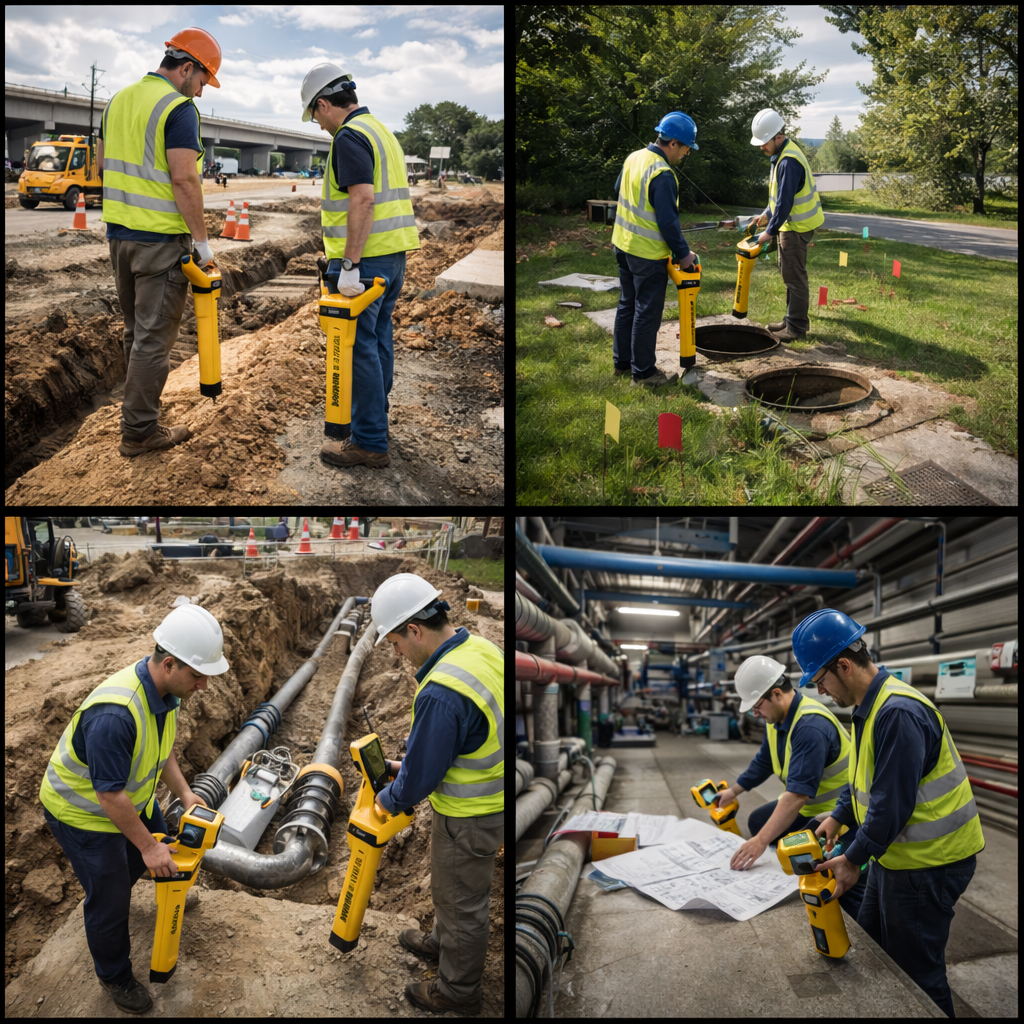
To reduce these risks, organizations around the world rely on modern underground utility locating equipment to identify, trace, and map buried gas pipelines before excavation begins.
In this article, we’ll explore the common challenges faced in gas pipeline detection, the technologies used in modern utility locating systems, and the key factors professionals should consider when selecting a pipe and cable locator.
Why Accurate Gas Pipeline Location Matters
Natural gas distribution networks form a vital part of modern infrastructure. These pipelines often run beneath roads, sidewalks, industrial facilities, residential developments, and transportation corridors.
However, many underground utility networks were installed decades ago, and records may be incomplete, outdated, or inaccurate. In rapidly developing urban environments, multiple utilities—including gas pipelines, electrical cables, telecommunications lines, fiber-optic networks, water mains, and sewer systems—are frequently installed within the same corridor.
Accurate pipeline locating helps organizations:
- Prevent accidental utility strikes
- Improve excavation safety
- Reduce project delays
- Minimize repair costs
- Support regulatory compliance
- Protect workers and nearby communities
As a result, utility locating has become an essential component of modern asset management and damage prevention programs.
Common Challenges in Gas Pipeline Detection
Although utility locating technology has advanced significantly, locating buried gas pipelines remains challenging in many environments.
1. Congested Underground Utility Corridors
In urban areas, underground space is becoming increasingly crowded.
Gas pipelines often share corridors with:
- Electrical power cables
- Telecommunications lines
- Fiber-optic networks
- Water pipelines
- Sewer systems
When multiple utilities are installed close together, locating signals can overlap or interfere with one another, making it difficult to identify the target pipeline accurately.
Without proper utility identification technology, operators may mistakenly trace the wrong line, increasing the risk of excavation errors.
2. Electromagnetic Interference
Modern cities generate substantial electromagnetic noise.
Potential sources of interference include:
- High-voltage transmission lines
- Electric rail systems
- Industrial machinery
- Power substations
- Communication infrastructure
Traditional locators may struggle to distinguish target signals from background interference, resulting in inaccurate readings or unstable signal tracking.
3. Aging Infrastructure and Incomplete Records
Many gas distribution networks have been expanded and modified over several decades.
As-built drawings may be outdated, incomplete, or unavailable altogether. In some cases, undocumented repairs or rerouted pipelines further complicate locating efforts.
Field crews are often required to verify utility locations before maintenance, replacement, or excavation projects can proceed safely.
4. Challenging Environmental Conditions
Utility locating operations frequently take place in demanding environments, including:
- Extreme temperatures
- Heavy rainfall
- Dusty construction sites
- Remote utility corridors
- Uneven terrain
Equipment reliability becomes especially important when field crews depend on accurate data to make critical operational decisions.
Technologies Used in Modern Gas Pipeline Locating
Today’s underground utility locators incorporate a variety of technologies designed to improve locating accuracy and efficiency.
Electromagnetic Locating Technology
Electromagnetic (EM) locating remains the most widely used method for tracing buried conductive utilities.
A transmitter applies a signal to the target pipeline, while a receiver detects the electromagnetic field generated by that signal. By following the field, operators can determine the route of the buried utility.
EM locating offers several advantages:
- Fast deployment
- Non-destructive operation
- Long locating range
- High locating accuracy
Active and Passive Locating Modes
Modern locators typically support both active and passive locating.
Active locating uses a transmitter to apply a known signal directly to the target utility.
Passive locating detects existing signals naturally present on utilities, such as power frequencies or communication signals.
The combination of both methods enables operators to locate a wider range of underground assets.
Current Direction Identification
Current Direction (CD) technology helps distinguish the target utility from adjacent conductors carrying similar signals.
This feature is particularly valuable in congested utility corridors where multiple pipelines and cables run parallel to one another.
By confirming the direction of signal flow, operators can reduce the likelihood of tracing the wrong utility.
Automatic Depth Measurement
Accurate depth information is critical for excavation planning and risk assessment.
Modern utility locators can automatically estimate the depth of a buried pipeline, helping crews understand the spatial relationship between multiple underground assets.
Digital Signal Processing
Advanced digital filtering algorithms help improve signal clarity by reducing the effects of electromagnetic interference.
These technologies allow operators to maintain reliable signal tracking even in challenging urban environments.
What to Look for When Choosing a Gas Pipeline Locator
Selecting the right underground utility locator can significantly improve locating efficiency and reduce operational risk.
High Signal Output Power
A powerful transmitter helps maintain signal integrity over long distances and in difficult soil conditions.
Higher output power can improve signal penetration and facilitate locating in congested urban environments.
Strong Interference Rejection
The ability to filter unwanted noise is essential for maintaining accuracy near electrical infrastructure and industrial facilities.
Advanced signal processing technology can help operators obtain more stable and reliable locating results.
Accurate Depth Measurement
Reliable depth estimation supports safer excavation planning and reduces the likelihood of utility damage.
Utility Identification Features
Technologies such as Current Direction identification help operators confidently distinguish target pipelines from nearby utilities.
Safety Protection Functions
Built-in safety features, including hazardous voltage detection, can help protect field personnel when working near energized infrastructure.
Rugged Field Design
Utility locating equipment should be capable of withstanding harsh environmental conditions while maintaining reliable performance over time.
How the TFN T6000 Addresses These Challenges
The TFN T6000 Underground Pipe & Cable Locator is designed to help utility professionals overcome the common challenges associated with gas pipeline detection and underground utility locating.
Powerful 12W Signal Transmission
The T6000 utilizes a high-power 12W transmitter capable of delivering strong locating signals across long distances and through challenging ground conditions.
This enhanced signal strength helps improve locating performance in urban environments where interference and utility congestion are common.
Intelligent Digital Filtering
Advanced digital signal processing technology helps suppress unwanted interference and improve signal stability.
As a result, operators can maintain reliable utility tracing performance even in electrically noisy environments.
Real-Time Depth Measurement
The T6000 provides automatic depth estimation, enabling field crews to quickly assess pipeline burial depth during locating operations.
This capability supports safer excavation planning and improves operational efficiency.
Current Direction Utility Identification
Current Direction technology helps operators distinguish the target pipeline from adjacent utilities carrying similar signals.
This feature is especially valuable when working in densely populated underground utility corridors.
Hazardous Voltage Warning
To improve field safety, the T6000 incorporates an external hazardous voltage alarm that alerts operators when potentially dangerous electrical conditions are detected.
Rugged Construction for Field Operations
Built with a durable aluminum-alloy housing, the T6000 is designed to withstand the demands of daily utility locating work.
Its sealed control system and backlit display provide dependable operation across a wide range of environmental conditions, from dusty construction sites to extreme weather environments.
Applications of Underground Pipe Locators in the Gas Industry
Modern utility locating equipment plays an important role throughout the lifecycle of gas infrastructure.
New Pipeline Installation
Locators help identify existing underground utilities before trenching and installation activities begin.
Pipeline Maintenance and Rehabilitation
Utility operators use locating equipment to verify pipeline routes prior to maintenance and replacement projects.
Emergency Leak Response
Rapid pipeline identification can help response teams locate affected assets quickly during emergency situations.
Utility Mapping and Asset Management
Accurate utility locating supports GIS mapping initiatives and infrastructure documentation programs.
Damage Prevention Programs
Utility locating is a critical component of “Call Before You Dig” and damage prevention programs implemented worldwide.
Conclusão
As underground infrastructure networks become more complex, the importance of accurate gas pipeline locating continues to grow.
Modern underground utility locators help organizations reduce excavation risks, improve worker safety, minimize service interruptions, and support efficient infrastructure management.
By combining high-power signal transmission, intelligent interference rejection, precise depth measurement, Current Direction identification, and rugged field-ready construction, the TFN T6000 provides utility professionals with a reliable solution for locating buried gas pipelines and other underground utilities in demanding real-world environments.
For utility companies, contractors, and infrastructure operators seeking to improve locating accuracy and operational efficiency, investing in advanced pipe and cable locating technology is an essential step toward safer and more effective underground asset management.