





As telecom networks continue expanding toward higher bandwidth, denser 5G coverage, and more complex private communication infrastructure, fiber splicing equipment is facing increasingly demanding field conditions. From long-haul backbone deployment in remote outdoor environments to emergency restoration work on urban base stations, contractors and network operators require fusion splicers that can deliver consistently low splice loss, fast operation, and reliable performance under pressure.
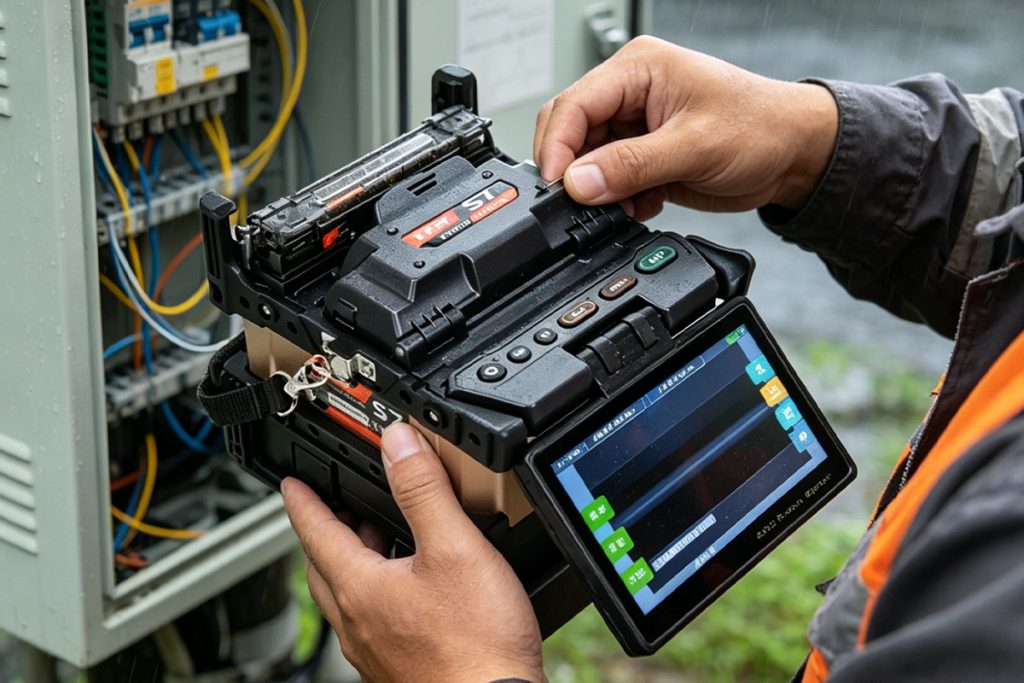
The TFN S7 Six-Motor Fusion Splicer has been deployed in a wide range of real-world communication projects, helping engineering teams improve splice consistency, accelerate installation schedules, and reduce maintenance downtime across multiple network environments.
Long-Haul Backbone Fiber Deployment with Strict Loss Requirements
During the construction of a long-distance optical transmission network for a regional telecom infrastructure project, engineering teams faced significant challenges related to splice quality consistency and outdoor working conditions.
The backbone route extended across more than 100 kilometers using G.652D single-mode fiber designed for high-capacity transmission services. Because cumulative splice loss directly affects overall transmission performance, every splice point required extremely stable low-loss performance throughout the entire route.
At the same time, crews were working across mixed deployment environments including overhead lines, roadside ducts, and remote outdoor sections where wind, dust, and unstable weather conditions could easily impact construction efficiency.
Using the TFN S7, field technicians were able to maintain highly stable low-loss splicing performance throughout the project. The six-motor core alignment system helped achieve precise fiber alignment, while the fast splice-and-heat workflow significantly improved daily productivity for large-count fiber deployment tasks.
The long battery endurance and ruggedized body design also reduced interruptions during outdoor work, allowing crews to continue operating efficiently without frequent charging or equipment adjustments in the field.
Project teams reported smoother construction progress, improved splice consistency, and faster overall delivery compared with previous-generation splicing equipment.
Faster 5G Base Station Restoration and Maintenance
In another wireless network maintenance project involving thousands of 5G base station sites, maintenance contractors required a fusion splicer capable of supporting rapid emergency response and daily fiber maintenance across highly varied field environments.
Technicians frequently moved between rooftop installations, indoor telecom rooms, street-level cabinets, and remote outdoor sites. Different fiber types and limited operating space often slowed down conventional splicing workflows, especially during urgent fault restoration tasks where downtime directly affected network coverage quality.
The TFN S7 helped simplify field operations through its universal fiber holder design, allowing engineers to splice multiple fiber types without changing clamps or accessories. Combined touchscreen and physical button controls also made operation more convenient in different weather and lighting conditions.
The real-time splice visualization interface improved on-site quality control, helping technicians verify splice status immediately and reduce rework during emergency repairs. Maintenance teams also benefited from automatic arc calibration, which minimized manual adjustments when operating under changing environmental conditions.
As a result, operators were able to shorten average maintenance time per site while improving repair efficiency during critical network recovery operations.
Reliable Fiber Splicing for Utility and Industrial Communication Networks
Beyond public telecom infrastructure, the TFN S7 has also been applied in private communication network projects for industries such as utilities, transportation, and industrial control systems, where network reliability and traceability are especially important.
In one communication room deployment project, engineers needed to handle multiple fiber types — including single-mode, multimode, and specialty fibers — while working within limited cabinet space and strict installation standards.
The S7’s customizable splice modes and broad fiber compatibility allowed technicians to optimize splicing parameters for different network requirements without additional equipment changes. Its compact structure also improved handling efficiency inside confined installation environments.
To support project documentation and long-term maintenance management, splice records and loss data could be exported directly for engineering reports and quality traceability.
For infrastructure operators managing mission-critical communication systems, stable splice quality and standardized installation processes remain essential for long-term network reliability — especially in sectors where communication interruptions can directly impact operational safety.
Built for Modern Fiber Network Engineering
Whether supporting backbone transmission projects, 5G infrastructure maintenance, or industrial communication systems, the S7 Fusion Splicer is designed to meet the practical demands of modern fiber optic engineering.
Its combination of precision core alignment, efficient field operation, rugged environmental adaptability, and broad fiber compatibility makes it well suited for contractors, telecom operators, and infrastructure teams working in high-demand deployment environments worldwide.