





As fiber optic networks continue to expand across telecommunications, power utilities, railways, military communications, and data center infrastructure, the demand for accurate and efficient fiber testing has never been higher.
When a fiber fault occurs, every minute of downtime can result in service disruption, operational delays, and increased maintenance costs. That’s why choosing the right Optical Time Domain Reflectometer (OTDR) is critical for network operators, contractors, and maintenance teams.
However, selecting an OTDR is not simply a matter of comparing prices or purchasing the model with the longest specification sheet. The best OTDR is the one that matches your network environment, testing requirements, and operational workflow.
This guide explores four key factors that should be evaluated before investing in a professional OTDR and explains how the TFN RM7 Series addresses these requirements in real-world applications.
Why OTDR Performance Matters
An OTDR is one of the most important diagnostic tools in fiber optic maintenance. By sending optical pulses into a fiber and analyzing the reflected signals, it can identify:
- Fiber breaks
- Excessive splice loss
- Connector issues
- Macrobending and microbending
- Reflective events
- Overall link attenuation
For short enterprise links, basic testing capabilities may be sufficient. However, operators managing backbone networks, railway communication systems, utility networks, or defense communication infrastructure often require much greater testing capability.
In these scenarios, the OTDR must deliver accurate measurements over long distances while maintaining the resolution needed to identify minor faults that could eventually become major failures.
Factor 1: Dynamic Range Determines How Far You Can See
One of the most important OTDR specifications is dynamic range.
Dynamic range defines how effectively the OTDR can analyze signal reflections over distance. The higher the dynamic range, the longer the fiber link that can be tested and the more events that can be detected.
Many technicians focus primarily on maximum testing distance, but the real value of dynamic range lies in its ability to reveal events near the end of long fiber routes.
For example, a network operator managing a 180 km transmission link may need to identify a small splice loss occurring near the far end of the fiber. An OTDR with insufficient dynamic range may fail to distinguish that event from background noise.
The TFN RM7 Series provides dynamic range options from 37 dB to 50 dB, enabling reliable testing of long-haul fiber networks exceeding 200 km while maintaining high event detection sensitivity.
When evaluating OTDRs, ask:
- What is the longest fiber route in my network?
- How many splices and connectors exist along the path?
- Do I need to identify low-loss events near the end of the link?
The answers will help determine the dynamic range required for your application.
Factor 2: Measurement Accuracy Is More Important Than Maximum Distance
An OTDR that can measure a long distance is not necessarily an OTDR that can accurately locate faults.
In many maintenance scenarios, the primary objective is not simply to detect a problem but to pinpoint its exact location.
Whether a technician is dispatched to repair a railway communication cable or troubleshoot a utility fiber route, inaccurate distance measurements can significantly increase repair time and operational costs.
A professional OTDR should provide:
- Accurate event location
- Reliable loss measurement
- Consistent repeatability
- Clear event characterization
High-resolution event analysis enables engineers to distinguish between splice loss, connector reflections, bending events, and fiber breaks.
The RM7 Series combines high dynamic range with precise event analysis, helping maintenance teams locate and diagnose faults more efficiently.
Factor 3: Ease of Use Directly Impacts Productivity
A common misconception is that advanced OTDRs are only suitable for highly experienced fiber engineers.
In reality, modern maintenance teams often consist of personnel with varying levels of technical expertise. An effective OTDR should support both experienced specialists and new technicians.
The TFN RM7 Series incorporates both Automatic Mode and Expert Mode.
Automatic Mode
Automatic Mode simplifies testing by automatically selecting measurement parameters and identifying common events along the fiber route.
Benefits include:
- Faster deployment
- Reduced training requirements
- Consistent test results
- Lower risk of operator error
This mode is particularly valuable for routine inspections and emergency fault localization.
Expert Mode
For experienced users, Expert Mode provides complete control over critical testing parameters, including:
- Pulse width
- Averaging time
- Measurement range
- Acquisition settings
This flexibility allows engineers to optimize testing performance for complex network environments.
Organizations that operate large maintenance teams often benefit from having both modes available, ensuring productivity across all skill levels.
Factor 4: Field Conditions Demand More Than Just Performance
OTDR specifications are important, but field usability can have an equally significant impact on operational efficiency.
Many fiber technicians spend hours working outdoors in:
- Direct sunlight
- Utility substations
- Railway corridors
- Construction sites
- Remote infrastructure locations
In these environments, screen visibility, battery life, portability, and equipment durability become essential considerations.
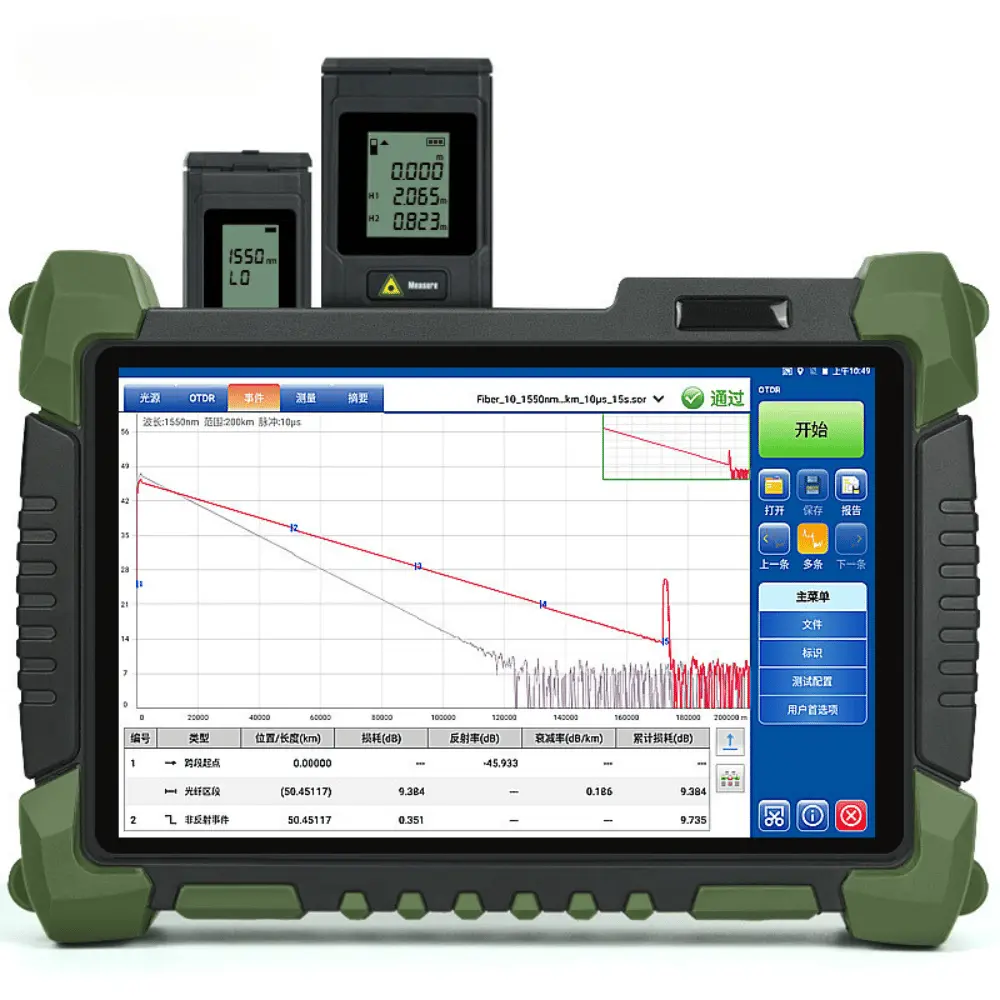
The TFN RM7 features a 10.1-inch high-definition touchscreen display that provides clear visibility of OTDR traces, event tables, and test reports.
The larger screen offers several practical advantages:
- Easier event interpretation
- Faster report review
- Reduced zooming and scrolling
- Improved usability under challenging lighting conditions
For field personnel who rely on OTDR measurements daily, these usability improvements can significantly increase productivity.
The Value of Integrated Testing Functions
Carrying multiple testing instruments can slow down field operations and increase equipment management complexity.
To address this challenge, the RM7 Series integrates multiple fiber testing tools into a single platform, including:
- OTDR testing
- Localizador visual de averías (VFL)
- Fiber end-face inspection
- Optical power measurement
- Laser distance measurement
Its removable optical power meter and laser rangefinder modules can also operate independently when required.
This integrated approach helps reduce equipment load while improving testing efficiency in the field.
Common Mistakes When Buying an OTDR
Many organizations make purchasing decisions based solely on price or specifications.
Some common mistakes include:
Choosing Based Only on Cost
A lower initial purchase price may result in higher maintenance costs and reduced testing capability over the equipment’s lifespan.
Ignoring Future Network Expansion
Fiber networks often continue to grow after deployment. Selecting an OTDR with limited dynamic range may create testing limitations in the future.
Overlooking User Experience
Complicated interfaces and small displays can reduce technician productivity and increase training requirements.
Buying Multiple Single-Function Instruments
Using separate OTDRs, power meters, VFLs, and inspection tools can increase equipment costs and reduce operational efficiency.
Conclusión
Choosing a professional OTDR requires balancing performance, accuracy, usability, and field practicality.
Before making a purchasing decision, organizations should evaluate:
- Dynamic range requirements
- Precisión de la medición
- Ease of operation
- Display quality
- Integrated functionality
- Field deployment needs
The TFN RM7 Series is designed to meet these demands by combining long-distance testing capability, precise fault analysis, dual operating modes, and integrated testing tools in a rugged portable platform.
For telecommunications operators, utility companies, railway maintenance teams, contractors, and other fiber professionals, selecting the right OTDR can significantly improve troubleshooting efficiency, reduce downtime, and support long-term network reliability.