





Wireless surveillance technology has evolved dramatically over the last decade. Modern covert listening devices are no longer limited to continuously transmitting analog RF signals. Many now use LTE, 5G, Wi-Fi, or Bluetooth modules, allowing them to remain silent for long periods before sending encrypted data in milliseconds.
For security professionals, this creates a major challenge:
The bug may not be transmitting when you’re looking for it.
Traditional RF bug detectors often miss these devices entirely.
In this article, we’ll explain why burst transmitters are difficult to detect, what technical capabilities truly matter, and how professional spectrum analysis combined with directional locating can significantly improve detection success.
Why Traditional RF Bug Detectors Often Miss Burst Transmitters
Older RF detectors were designed for an era when surveillance devices transmitted continuously.
Typical examples include:
- Analog FM transmitters
- Continuous video transmitters
- Constant wireless microphones
Detection was straightforward:
The device continuously emitted RF energy, allowing the detector to alarm whenever it entered range.
Today’s surveillance devices work differently.
Many commercial and custom-built spy bugs now use:
- LTE Cat-M modules
- NB-IoT
- 4G LTE
- 5G NR
- Wi-Fi upload
- Bluetooth relay
- Hybrid storage + scheduled transmission
Instead of transmitting continuously, they:
- Record audio locally
- Remain completely silent
- Upload only when triggered
- Send compressed data every few minutes—or even every few hours
A transmission may last only tens of milliseconds, making it easy for conventional detectors to miss.
What Is a Burst Transmitter?
A burst transmitter is any RF device that transmits only briefly rather than continuously.
Common examples include:
- Voice-activated audio bugs
- Motion-triggered cameras
- Cellular surveillance devices
- GPS trackers
- IoT monitoring devices
- Smart sensors
Some transmit:
- every few seconds
- every few minutes
- only after collecting enough data
- only when commanded remotely
The shorter the transmission window, the harder the signal is to observe.
This is why many inexpensive RF bug detectors produce a “clean” result even when surveillance devices are present.
Why Sweep Speed Matters
The single most important specification is often real-time sweep speed.
Imagine a transmitter that emits RF energy for only 20 milliseconds.
If a detector scans the entire frequency range in:
- 5 seconds
- 10 seconds
- 20 seconds
there is a high probability the transmission will occur while the receiver is scanning somewhere else.
The signal is simply missed.
Professional spectrum analyzers solve this by dramatically increasing acquisition speed and reducing blind intervals.
A high real-time sweep rate allows the receiver to repeatedly observe the same frequencies fast enough to capture short-lived RF events.
This capability becomes increasingly important when searching for:
- burst transmitters
- LTE bugs
- 5G spy devices
- Wi-Fi cameras
- frequency-hopping transmitters
Peak Hold Helps Reveal Hidden Signals
Even high-speed scanning is only part of the solution.
Professional RF analysis systems also use Peak Hold (or Max Hold).
Peak Hold records the highest received signal level observed at every frequency over time.
As repeated scans accumulate, intermittent bursts become visible even if each transmission lasts only a fraction of a second.
Instead of disappearing between sweeps, short transmissions gradually build a recognizable spectral signature.
This makes Peak Hold particularly valuable when investigating:
- periodic transmissions
- scheduled uploads
- low-duty-cycle RF devices
- intermittent interference
Signal Demodulation Adds Critical Context
A strong RF signal alone does not necessarily indicate a surveillance device.
Modern urban environments contain thousands of legitimate wireless signals, including:
- Wi-Fi routers
- Bluetooth devices
- cellular base stations
- IoT sensors
- wireless microphones
Professional equipment therefore combines spectrum analysis with signal demodulation.
Depending on the signal type, the operator may identify:
- analog FM audio
- AM modulation
- digital activity
- LTE uplink behavior
- Wi-Fi channel occupancy
- Bluetooth advertisements
Rather than simply displaying signal strength, demodulation helps determine whether the transmission is likely to be suspicious or simply part of the surrounding RF environment.
Locating the Source with a Log-Periodic Directional Antenna
Capturing a transmission is only the first step.
The next challenge is finding where it originates.
This is where a log-periodic directional antenna becomes essential.
6
Unlike omnidirectional antennas, a log-periodic antenna focuses reception in one direction.
As the operator slowly rotates the antenna, received signal strength changes noticeably.
The direction producing the strongest signal generally points toward the transmitter.
This process, known as Direction Finding (DF), allows investigators to narrow the search area quickly.
By taking measurements from multiple positions, operators can progressively isolate the source to a particular room, wall, ceiling, vehicle, or concealed object.
Log-periodic antennas are especially effective because they offer:
- Wide frequency coverage
- Directional gain
- Good front-to-back ratio
- Consistent performance across multiple RF bands
These characteristics make them suitable for locating devices operating across Wi-Fi, LTE, and other common surveillance frequencies.
Detecting 5G and LTE Spy Bugs
Many users assume a cellular bug constantly communicates with nearby cell towers.
In reality, most modern devices are designed for low power consumption and minimal RF visibility.
A typical cellular surveillance device may:
- Record audio internally.
- Remain idle for extended periods.
- Briefly attach to the network.
- Upload encrypted data.
- Disconnect immediately.
The transmission window may last only a few hundred milliseconds.
Detecting these devices therefore requires equipment capable of:
- fast real-time spectrum monitoring
- wide frequency coverage
- capturing transient signals
- peak hold analysis
- directional locating
No single feature is sufficient on its own.
Reliable detection comes from combining these capabilities into one workflow.
Real-World Example: Finding an Intermittent Cellular Audio Bug
During a routine technical security inspection of a corporate executive meeting room, investigators encountered repeated reports of confidential information appearing outside the organization.
An initial inspection using a conventional RF detector found no suspicious continuous transmissions.
The inspection team then switched to a professional real-time spectrum analyzer and monitored the local cellular uplink bands using Peak Hold mode.
After several minutes, a very brief transmission appeared repeatedly at consistent intervals.
Using a directional log-periodic antenna, investigators compared signal strength from different positions inside the room.
The strongest readings consistently pointed toward a decorative power strip installed beneath a conference table.
Further physical inspection revealed an unauthorized cellular-enabled recording device concealed inside the housing.
Because the transmitter remained silent for most of the inspection and transmitted only short bursts of encrypted data, it had gone undetected by conventional scanning methods.
This example is based on a representative TSCM investigation workflow and is intended to illustrate the detection process. Actual inspection methods and findings vary depending on the RF environment, device behavior, and operational procedures.
TFN Solution for Detecting Burst Transmitters
Professionals conducting Technical Surveillance Counter-Measures (TSCM) require more than simple RF signal alarms.
TFN’s professional RF detectors are designed for environments where intermittent and digitally connected surveillance devices are increasingly common.
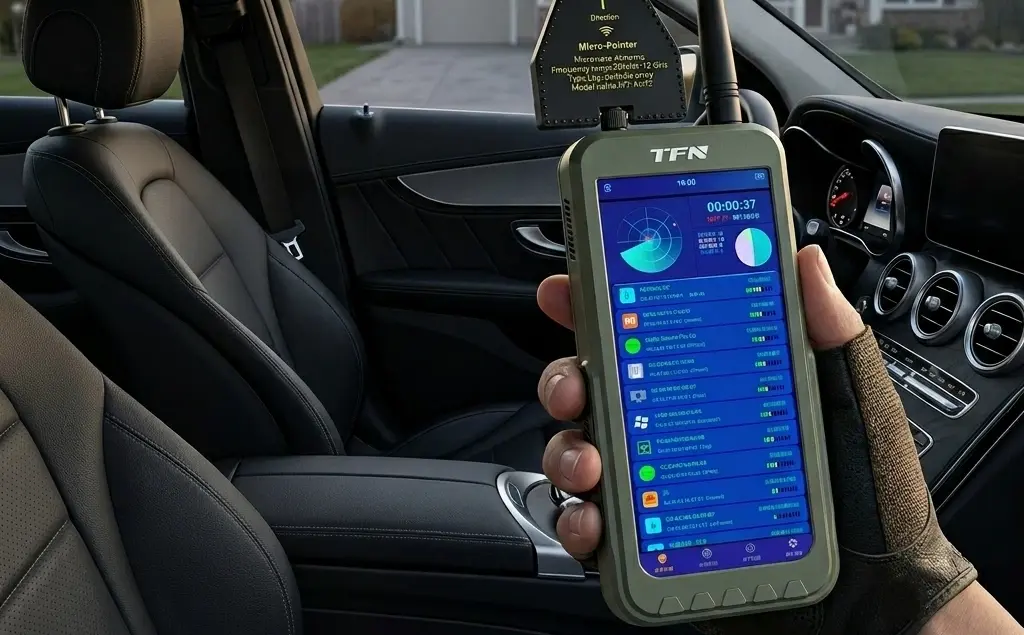
Combined with TFN’s directional antenna, the system enables operators to:
- Monitor a broad RF spectrum in real time
- Capture short-duration burst transmissions
- Analyze transient signal behavior using spectrum and Peak Hold functions
- Differentiate suspicious wireless activity from normal RF traffic through signal analysis
- Perform directional locating to narrow down the source of a transmission
- Improve efficiency when searching for LTE, 5G, Wi-Fi, and other wireless surveillance devices in complex electromagnetic environments
Rather than relying solely on signal strength, the workflow combines real-time spectrum observation, intelligent RF analysis, and directional measurement, helping investigators locate hidden transmitters more efficiently during professional inspections.
Best Practices for Detecting Burst Transmitters
Detection success depends on both equipment capabilities and inspection methodology.
Recommended practices include:
- Monitor suspect frequency bands for an extended period instead of performing only a quick scan.
- Use Peak Hold to capture intermittent emissions.
- Repeat scans during different operating conditions, such as idle and active network periods.
- Perform directional measurements after identifying suspicious activity.
- Minimize interference from nearby legitimate wireless devices whenever practical.
- Correlate RF findings with physical inspections of furniture, electronics, and concealed spaces.
الخاتمة
As surveillance technology continues to evolve, detecting modern wireless spy devices requires more than simply sensing RF energy.
Burst transmitters, LTE bugs, and 5G-enabled surveillance devices are specifically designed to minimize their RF footprint by transmitting only briefly.
Professional detection therefore depends on combining:
- High real-time sweep speed
- Peak Hold analysis
- Intelligent signal interpretation
- Wideband directional antennas
- Systematic direction finding techniques
For organizations responsible for protecting sensitive meetings, government facilities, executive offices, or critical infrastructure, these capabilities have become an essential part of modern TSCM operations.