





An Ethernet tester is a specialized test device that generates, transmits, receives, and analyzes Ethernet traffic to validate network performance and reliability. It is widely used in:
- Enterprise and data center networks
- Carrier Ethernet and metro networks
- Industrial and mission-critical communication systems
- Network equipment manufacturing and R&D labs
Unlike simple cable testers, professional Ethernet testers provide standardized performance benchmarks, precision timing analysis, and multi-service validation.
Basic Working Principles of Ethernet Testers
The fundamental principle of an Ethernet tester is based on controlled traffic simulation and precise measurement.
Physical Layer (L1) Signal Processing
At Layer 1, the tester must correctly handle electrical and optical Ethernet signals, including:
- Line encoding (e.g., 8B/10B, 64B/66B)
- Clock recovery and synchronization
- Jitter tolerance and signal integrity
- Electrical impedance matching and optical power measurement
Supporting multiple Ethernet rates requires careful hardware design to ensure low jitter, low BER, and stable clock adaptation.
Data Link to Transport Layers (L2–L4)
At higher layers, Ethernet testers generate standard-compliant frames and packets, allowing performance evaluation under realistic traffic conditions.
Key measurement principles include:
Throughput Formula
Throughput = (Successful Frames × Frame Size) / Test Duration
Latency Measurement
Latency = t₂ − t₁
Where t₁ is the transmit timestamp and t₂ is the receive or loopback timestamp.
Bit Error Rate (BER)
BER = Errored Bits / Total Transmitted Bits
High-precision timestamping is critical for accurate microsecond-level latency and jitter measurements.
Core Functions of a Professional Ethernet Tester
1. Multi-Rate and Multi-Interface Support
Modern networks operate across multiple speeds and media types. A professional Ethernet tester should support:
- 10M / 100M / 1G / 10G Ethernet
- Electrical interfaces (RJ-45)
- Optical interfaces (SFP / SFP+)
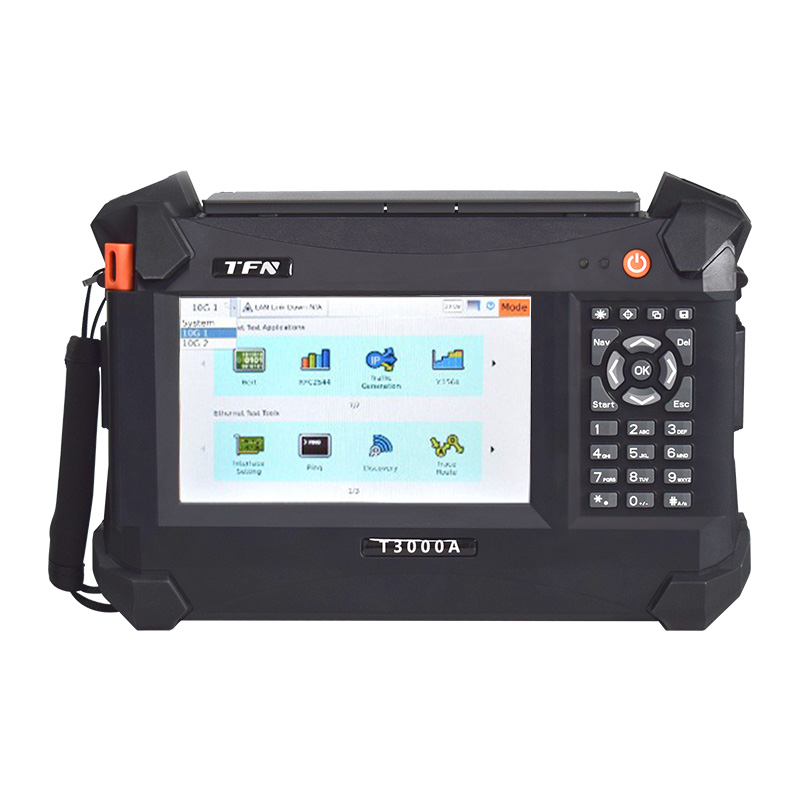
The T3000A Ethernet Tester supports full-rate testing from 10 Mbps to 10 Gbps, integrating multiple interfaces into a single portable device.
Engineering Insight: Achieving multi-rate compatibility requires advanced clock design, PHY abstraction, and signal integrity optimization—especially when combining copper and fiber interfaces.
2. Standardized Ethernet Test Suites
RFC 2544 Network Performance Testing
RFC 2544 is the most widely used benchmark for evaluating Ethernet device performance. It includes:
- Throughput – Maximum forwarding rate without frame loss
- Latency – Packet forwarding delay
- Frame Loss Rate – Loss percentage under defined traffic loads
- Back-to-Back Frames – Burst-handling capability
RFC 2544 is commonly used for equipment acceptance testing and baseline performance validation.
Y.1564 (Ethernet Service Activation Testing)
Y.1564 is designed for carrier Ethernet services and SLA verification. It enables:
- Simultaneous testing of multiple services
- CIR, PIR, and EIR configuration per service flow
- Measurement of latency, jitter, frame loss, and Service Disruption Time (SDT)
This standard is essential for telecom operators and managed service providers.
3. Traffic Generation and Deep Packet Analysis
Advanced Ethernet testers support multi-stream traffic generation to simulate real-world networks.
The TFN T3000A can generate up to 16 independent traffic streams, each configurable with:
- VLAN and Q-in-Q tags
- MPLS labels
- DSCP and priority settings
- IPv4 / IPv6 addressing
Analytical capabilities include:
- Jitter analysis for voice and video services
- Frame sequence detection to identify reordering issues
- Protocol decoding for VLAN, MPLS, IPv6, and more
4. Online Monitoring and Non-Intrusive Testing
For live networks, Ethernet testers must support non-intrusive testing modes, such as:
- Through mode monitoring
- Hardware and software loopback
These modes allow engineers to observe packet loss, latency, and jitter trends without interrupting services, which is critical in:
- Financial networks
- Power grid communications
- Government and defense infrastructure
5. Automated Testing and Professional Report Generation
Automation significantly improves testing efficiency and consistency.
A professional Ethernet tester should support:
- One-click execution of RFC 2544 and Y.1564
- Customizable test profiles
- Automatic generation of PDF or HTML test reports
The TFN T3000A includes 8 GB internal storage and supports data export via USB and FTP, enabling long-term result archiving and compliance documentation.
Practical Applications of the TFN T3000A Ethernet Tester
Scenario 1: 10G Data Center Interconnect Testing
Using dual 10G SFP+ ports, engineers can:
- Verify line-rate throughput
- Measure end-to-end latency (e.g., < 100 μs)
- Validate SLA compliance during acceptance testing
Scenario 2: Carrier Ethernet Private Line Activation
With Y.1564 testing, multiple Ethernet Virtual Connections (EVCs) can be validated simultaneously, ensuring:
- Correct CIR and PIR enforcement
- Effective QoS prioritization
- Stable multi-service performance
Scenario 3: Network Fault Diagnosis and Monitoring
By enabling online monitoring, the tester can continuously detect:
- Periodic packet loss
- Latency spikes
- Jitter anomalies
This allows engineers to proactively identify congestion or device faults.
How to Choose the Right Ethernet Tester
When selecting an Ethernet tester, consider the following factors:
- Protocol Support – IPv6, MPLS, SRv6 readiness
- Measurement Accuracy – Timestamp resolution and clock stability
- Ease of Use – Touchscreen and graphical UI for field efficiency
- Upgradeability – Firmware support for future standards
- Portability – Battery life, weight, and rugged design
The TFN T3000A offers a 7-inch touchscreen, over 4 hours of battery life, and a field-ready form factor.
Conclusion: Ethernet Testers as the Foundation of Network Quality
An Ethernet tester is far more than a connectivity checker—it is a critical instrument for ensuring network performance, reliability, and service quality.
By understanding its technical principles, standardized test methods, and real-world applications, engineers can approach network deployment and maintenance with greater precision and confidence.
With its full-rate coverage, comprehensive test suites, high-precision measurements, and user-friendly design, the TFN T3000A 10 Gigabit Ethernet Tester delivers a complete solution for laboratory testing, field deployment, and live network monitoring, making it a powerful tool for building high-performance and high-reliability Ethernet networks.