





As enterprise networks, data centers, and mobile backhaul continue to migrate toward higher bandwidth, 10 Gigabit Ethernet has become a baseline rather than a premium option. While higher speeds bring greater capacity, they also introduce new challenges in validation, service activation, and troubleshooting. In real-world deployments, verifying that a 10G link is “up” is no longer enough—engineers need to confirm that the network can sustain performance under real traffic conditions.
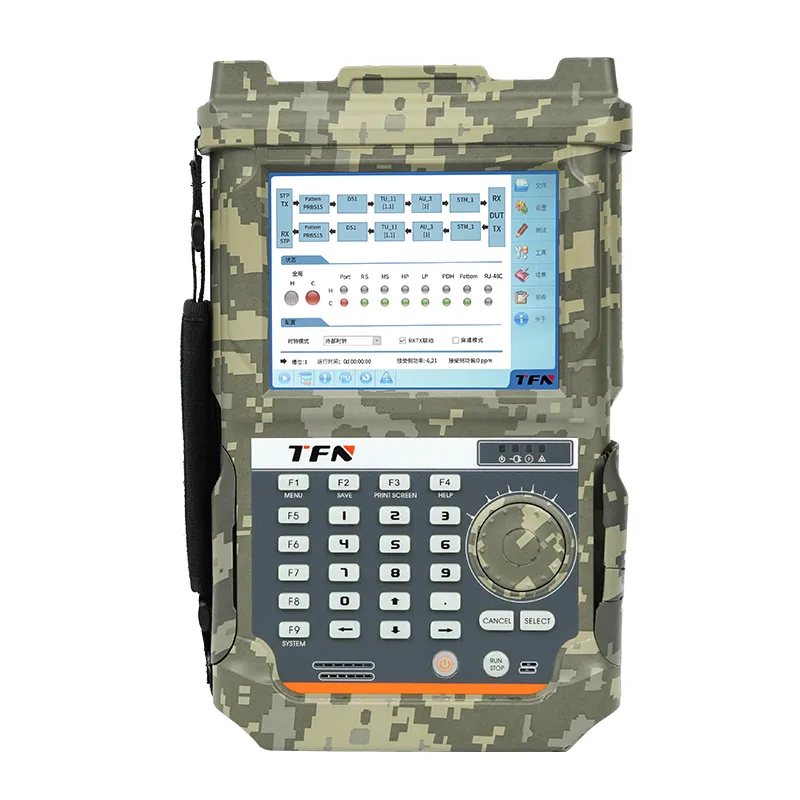
This is where professional Ethernet testing becomes critical. The TFN T5500A, a 10 Gigabit Ethernet tester and a core module of the FT100 intelligent network testing platform, is designed to address these challenges by supporting both traditional device benchmarking and service-oriented packet network testing.
Why 10 Gigabit Ethernet Testing Is More Complex Than It Looks
At lower speeds, basic link tests and simple throughput checks were often sufficient. However, at 10G rates, even small configuration issues, buffering limitations, or timing problems can lead to intermittent packet loss, increased latency, or service instability. These issues may not be visible during short tests but can quickly impact real services once the network goes live.
For network engineers responsible for deployment and maintenance, network performance testing must therefore cover more than raw bandwidth. It needs to reflect how traffic behaves across multiple services, how devices respond under load, and how consistently the network meets service-level requirements.
The T5500A is designed with this reality in mind. It combines line-rate traffic generation with detailed traffic analysis, supporting testing scenarios that mirror actual network behavior rather than ideal laboratory conditions.
From RFC2544 to Y.1564: How Ethernet Testing Has Evolved
For many years, RFC2544 testing has been the industry standard for evaluating Ethernet device performance. It provides a structured way to measure throughput, latency, packet loss, and burst handling, making it especially useful during equipment acceptance and initial benchmarking of switches and routers.
In practice, RFC2544 testing helps answer a fundamental question: Can this device forward traffic at the required rate without losing packets? The T5500A fully supports RFC2544 testing and automates the complete test sequence, allowing engineers to quickly generate repeatable results and professional test reports for validation and documentation purposes.
However, as Carrier Ethernet and multi-service networks became more common, RFC2544 began to show its limitations. Real networks rarely carry a single traffic stream at a time. Instead, they transport multiple services concurrently, each with its own bandwidth profile and performance requirements.
To address this gap, the industry introduced Y.1564 testing, also known as Ethernet service activation testing. Unlike RFC2544, Y.1564 focuses on validating actual services rather than just device capacity. It verifies whether committed and excess bandwidth levels are correctly enforced and whether performance metrics such as delay, jitter, and frame loss remain within SLA limits when all services are running simultaneously.
The T5500A includes a complete Y.1564 test suite, enabling engineers to move seamlessly from device testing to service activation. This makes it possible to identify configuration errors early, confirm SLA compliance, and reduce the risk of service degradation after handover.
Applying the T5500A in Real Packet Network Testing
Beyond testing methodologies, practical deployment requires flexible hardware capabilities. The T5500A provides a 10G Base-X interface alongside multiple Gigabit Ethernet ports, supporting both electrical and optical connections. This allows engineers to test a wide range of access, aggregation, and core network scenarios using a single platform.
One of its key strengths is the ability to simulate large numbers of concurrent data streams while maintaining per-stream statistics. By analyzing throughput, latency, packet loss, and jitter on a per-service basis, engineers can observe how different traffic classes interact—an essential capability for modern packet network testing.
This approach is particularly useful during network upgrades or expansions, where new services are introduced alongside existing ones. Instead of testing each service in isolation, the T5500A enables validation under realistic, mixed-traffic conditions.
OAM, Synchronization, and Network Fault Diagnosis
Performance testing alone is often not enough when troubleshooting complex networks. Operational visibility plays an equally important role. The T5500A supports a range of OAM testing protocols, including IEEE 802.3ah, 802.1ag, Y.1731, and G.8113.1, enabling link discovery, continuity checks, loopback testing, and performance monitoring.
For time-sensitive networks, particularly in mobile backhaul and 5G environments, synchronization accuracy is critical. The T5500A supports SyncE and IEEE 1588v2 PTP testing on Gigabit interfaces, allowing engineers to validate timing performance and diagnose synchronization-related issues.
Combined with multi-layer traffic generation and filtering based on MAC, IP, VLAN, and MPLS parameters, these capabilities make the T5500A a practical tool for network fault diagnosis and ongoing maintenance, not just initial deployment.
A Practical Tool for Modern Ethernet Service Validation
The TFN T5500A is not simply a 10 Gigabit Ethernet tester—it is a comprehensive solution for validating modern Ethernet and packet-based networks. By supporting both RFC2544 testing and Y.1564 testing, along with OAM, synchronization, and multi-layer traffic analysis, it bridges the gap between device benchmarking and real-world service validation.
For engineers working in enterprise networks, data centers, and carrier environments, this integrated approach reduces testing complexity and improves confidence in network performance. As Ethernet speeds continue to increase and service requirements become more demanding, having a testing platform that reflects real operational conditions is essential for maintaining reliable and high-quality network services.