





As a technician who has been engaged in fiber optic communication engineering for a long time, I have handled dozens of splicing equipment of different brands and models. In practical engineering applications, whether it is the construction of provincial trunk lines or base station emergency repair and maintenance, the stability and efficiency of the splicing process often determine the progress of the entire project. Today, I will combine the actual parameters and operational logic of the TFN S7 Fiber Fusion Splicer to provide a step-by-step guide from fiber preparation to the completion of splicing, from the perspective of a technical engineer.
1. Preparation Before Splicing: Details Determine Success
Before each splicing operation, the quality of fiber preparation directly determines the level of splicing loss. Our team always follows the “Three Cleans” principle in practice: clean environment, clean tools, and clean fiber.
1.1 Stripping and Cleaning the Fiber Coating
Use the stripping pliers provided with the TFN S7 to remove the fiber coating, typically controlling the length to around 30-40mm. Here is a very practical detail: the S7 is equipped with a three-in-one functional clamp, so whether it is skinned wire, pigtail fiber, or bare fiber, there is no need to frequently change the clamp. This saves a significant amount of time on site when switching between multiple tasks.
After stripping, be sure to use a lint-free wiper soaked with 99% alcohol and wipe the fiber surface in one direction to avoid secondary contamination. Often, abnormally high splicing loss in the initial stage is caused by residual dirt on the fiber surface, leading to bubbles or dust combustion during subsequent discharge.
1.2 Precision Control in Fiber Cleaving
Cleaving is the step that most tests the operator’s technique. The design of the TFN series fiber cleaver ensures the flatness of the cleaved end face. The cleave length is generally controlled within 8-16mm. After cleaving, the fiber end must absolutely not contact any other object, even a seemingly clean fixture tabletop.
2. Core Steps of TFN S7 Splicing Operation
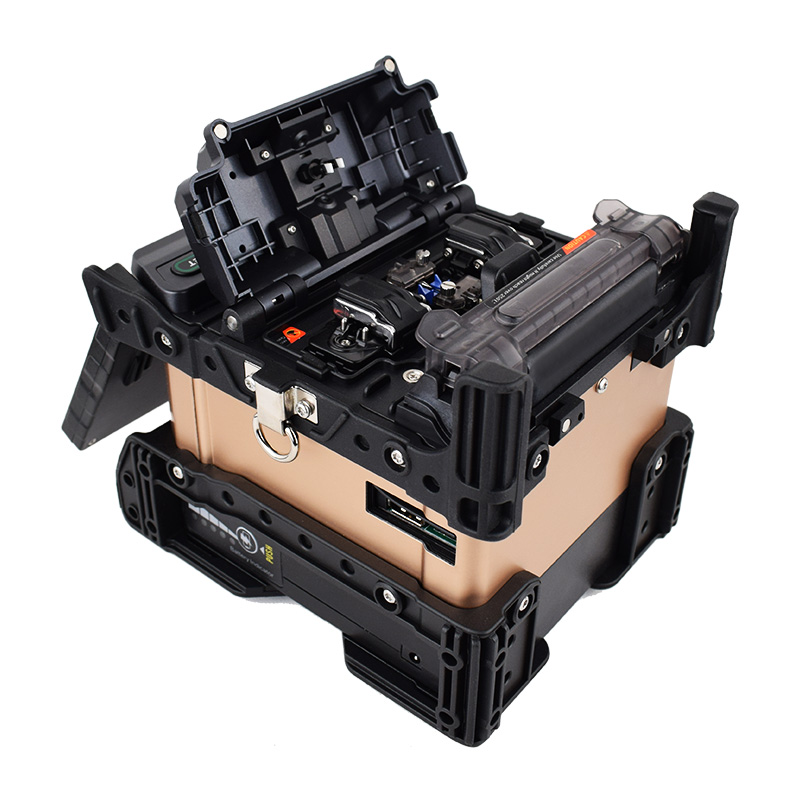
After preparation, it is time for the splicer to play its role. The reason the TFN S7 Six-Motor Fiber Fusion Splicer is widely used in long-distance trunk line projects lies in its six motors for core alignment precision and adaptability to harsh environments.
2.1 Power On and Mode Selection
Press the power button to start the fiber fusion splicer S7. The device’s 5-inch high-definition screen will clearly display the current status. On the initial interface, you can select the appropriate splicing mode based on the fiber type. For standard single-mode fiber, simply use the preset SM mode. The S7 has 41 built-in splicing modes, sufficient to handle the vast majority of engineering scenarios.
2.2 Fiber Placement and Automatic Splicing
Place the prepared fiber into the V-groove. Note that the fiber end face should be positioned between the electrode tip center line and the edge of the V-groove. Close the wind protector, and the S7 will automatically start the splicing process. From discharge cleaning and end face inspection to the final loss estimation, the entire process is very smooth.
Thanks to the S7’s six-motor core alignment technology, the core alignment precision is extremely high. Achieving loss as low as 0.01dB in actual operation is entirely feasible. This high-precision advantage is particularly evident when splicing NZDS fibers, effectively avoiding high return loss caused by core misalignment.
2.3 Real-time Observation During Splicing
During the splicing process, you can double-tap the screen to enlarge the X or Y view, observing the core alignment status and the discharge fusion moment in real-time. After splicing is complete, the screen displays the estimated loss value. While this estimated value cannot be used as the sole basis for project acceptance, it is highly valuable for quickly judging splicing quality on site.
3. Heat Shrink Protection and Efficiency Enhancement
Splicing only completes the physical connection; the true mechanical strength is ensured by the heat shrink sleeve.
A major highlight of the TFN S7 is its efficient heating system. The officially specified 20-second fast heating performs excellently in actual testing. This is attributed to its uniformly heating V-groove design, which provides more balanced heat distribution, resulting in neater shrinkage of the sleeve and extending the heater’s lifespan.
During operation, move the heat shrink sleeve to the center of the splice point and place it into the heater. The S7 supports an auto-heat function; once it senses that the fiber has been placed, it automatically starts the heating program. This significantly boosts efficiency for batch operations.
4. Battery Life and Maintenance: Ensuring Long-Duration Operation
Power supply is a major concern during field operations or base station emergency repairs. The S7 is equipped with a large-capacity lithium battery boasting 5200mAh capacity. Officially, it supports around 240 splicing and heating cycles. In our actual testing, this estimate is quite conservative; a full charge can basically support an entire day of high-intensity work without issue. Moreover, the battery is pluggable, allowing for seamless on-site replacement with spare batteries.
Regarding daily maintenance, two points require special attention:
1. Electrode Care: The S7’s electrode life is rated at around 3000 discharges. When the system prompts for replacement, it is crucial to perform electrode stabilization and arc calibration after installing new electrodes. This ensures the new electrodes’ discharge intensity and center position match, preventing increased splicing loss.
2. Optical Path Cleaning: Regularly perform the dust check function. If dust is found on the objective lens, clean it immediately with specialized cleaning tools. Failure to do so can affect fiber end face recognition, leading to misjudgment.
5. Conclusion
Overall, the TFN S7 Fiber Fusion Splicer is a highly mature piece of engineering equipment. It effectively combines high-precision alignment and high-efficiency fusion. For front-line operators, understanding the equipment’s various parameter settings and the principle behind arc calibration is far more important than blindly pursuing speed. Only by paying attention to every detail can you ensure that the splice points truly meet the transmission standards for long-line trunks, guaranteeing stable signal transmission between machine rooms.
If you are interested in TFN S7 Fiber Optic Fusion Splicer, welcome to contact TFN Support Team:
Email: info@tfngj.com
WhatsApp: +86-18765219251
Or you can leave messages Here