





In modern scientific research, communications, and material analysis, both spectrum analyzers and optical spectrum analyzers are essential precision measurement instruments. Although their names sound similar and both deal with “spectra,” they operate in entirely different domains of the electromagnetic spectrum. Understanding the distinction between the two is critical to selecting the right instrument for your application.
An optical spectrum analyzer measures and analyzes optical signals—that is, electromagnetic radiation in the infrared, visible, and ultraviolet ranges. It shows how the power of a light signal varies with wavelength (or frequency). Key parameters include central wavelength, wavelength range (bandwidth), spectral resolution (the ability to separate closely spaced wavelengths), and dynamic range. Measurements are typically expressed in nanometers (nm) or terahertz (THz).
OSAs are indispensable tools for fiber optic communication, laser characterization, and optical device testing.
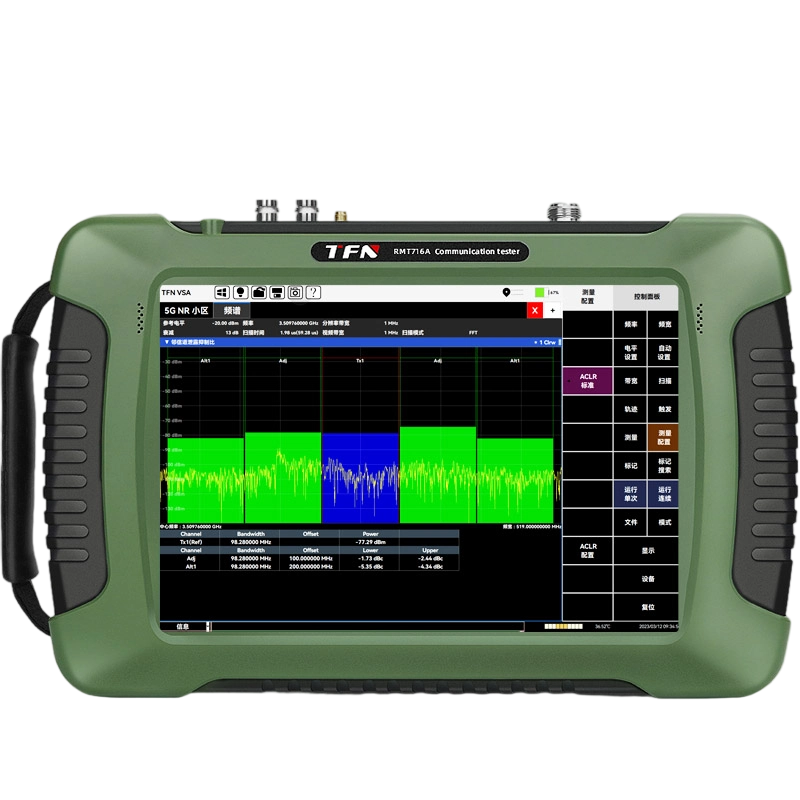
Whereas a spectrum analyzer focuses on electrical signals in the radio frequency (RF) and microwave domains. It measures how signal power is distributed across frequency. Typical operating ranges start from a few kilohertz (kHz) or megahertz (MHz) and can reach hundreds of gigahertz (GHz) or even the terahertz (THz) region with specialized modules. Key parameters include frequency range, resolution bandwidth (RBW), video bandwidth (VBW), displayed average noise level (DANL), and phase noise. This makes spectrum analyzers fundamental instruments for RF monitoring and analysis, and wireless system testing.
Besides the object they measure, their working principles also differ.
Most OSAs work based on either a diffraction grating or an interferometer:
- Grating-based OSA: Uses a diffraction grating to separate light by wavelength. The grating or detector moves so that different wavelengths are sequentially directed to a photodetector (e.g., photodiode) for power measurement.
- Interferometer-based OSA (FT-OSA): Uses a Michelson interferometer to produce an interference pattern, which is then Fourier transformed to obtain the spectral distribution. This approach offers higher resolution and sensitivity.
In both cases, the optical signal is eventually converted into an electrical signal for measurement and display.
Modern spectrum analyzers primarily use the superheterodyne architecture:
- Mixing – The input signal is mixed with an internal local oscillator (LO) signal.
- Intermediate Frequency (IF) Filtering – The resulting IF signal passes through a resolution bandwidth (RBW) filter, determining how closely spaced frequencies can be resolved.
- Detection and Display – The filtered IF signal is processed by detectors (peak, sample, or RMS) and displayed as power vs. frequency—the familiar frequency spectrum.
Additionally, real-time spectrum analyzers based on Fast Fourier Transform (FFT) technology are designed for analyzing transient or non-stationary signals, commonly used in radio monitoring and EMC testing.
Next, let’s discuss the differences in their application scenarios. Optical spectrum analyzers are typically used in the following scenarios:
- Laser characterization (linewidth, center wavelength, side-mode suppression ratio – SMSR)
- LED spectrum analysis
- Fiber optic communication testing (WDM/DWDM channel power, optical signal-to-noise ratio – OSNR)
- Optical filter and amplifier evaluation
- Raman and fluorescence spectroscopy (with suitable configuration)
- Material composition and structural analysis
While spectrum analyzers are used in:
- Wireless communication testing (mobile, base station, WiFi, Bluetooth transmitters)
- RF analysis of amplifiers, mixers, filters, and oscillators
- Electromagnetic compatibility (EMC) pre-compliance testing (radiated and conducted emissions)
- Radar and satellite communication signal analysis
- Signal monitoring and interference detection
- Use in portable spectrum analyzers for on-site radio monitoring and field testing
Choosing the Right Instrument
Whether to use a spectrum analyzer or an optical spectrum analyzer depends entirely on the nature of your signal:
Measuring light?
If you work with optical fiber outputs, laser beams, or LED light sources, and need to analyze wavelength composition (color, spectral purity, optical channel power), choose an optical spectrum analyzer.
Measuring electrical signals?
If you are analyzing RF, microwave, or millimeter-wave signals transmitted via cables or antennas—studying frequency components, power, distortion, or interference sources—then you need a spectrum analyzer.
Conclusion
Although the names spectrum analyzer and optical spectrum analyzer differ by only one word, they serve distinct physical quantities and frequency ranges:
Optical spectrum analyzers focus on the wavelength and spectral properties of light—vital for optical communications, laser technology, and optical material research.
Spectrum analyzers specialize in RF and microwave frequency-domain analysis, forming the foundation of wireless communication, radar, and EMC testing.
By understanding these core differences, users can make informed choices and achieve accurate, efficient measurement results—whether performing precise RF analysis or advanced optical spectrum characterization.