





In the rapidly evolving world of fiber optic communication networks, as a technical professional constantly working on trunk line projects and base station emergency repairs, I know firsthand that the quality of each splice directly impacts the transmission lifespan of the entire link. In our circles, choosing a reliable fiber fusion splicer is often more critical than simply chasing construction speed. Recently, I had the opportunity to thoroughly test the TFN S7 six-motor fiber fusion splicer, and its breakthrough in precision core alignment technology has genuinely brought significant improvements to our team’s workflow.
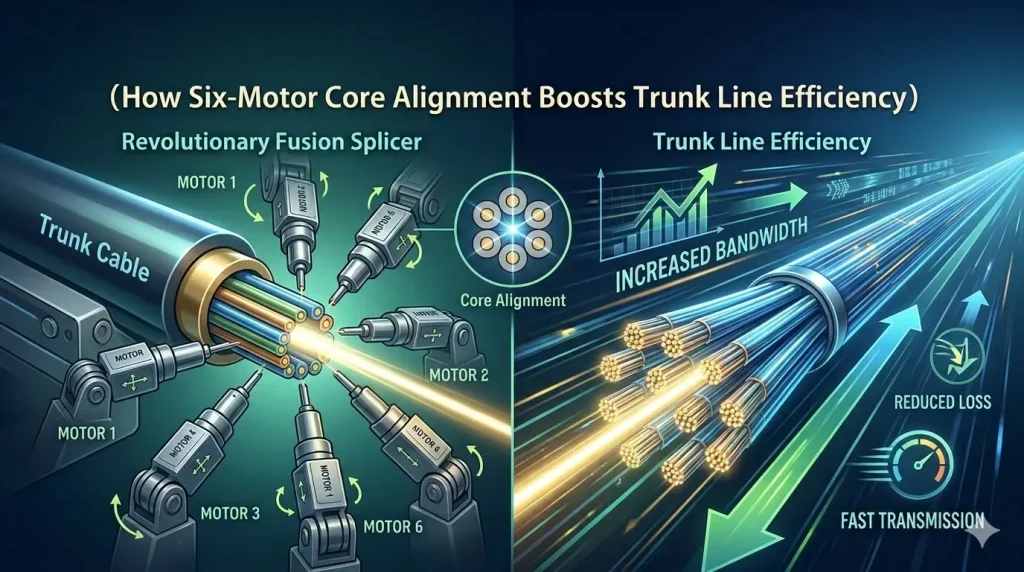
Six-Motor Precision Core Alignment: A Technological Leap from “Alignment” to “Precision Imaging”
Why Six-Motor Technology is the “Anchoring Force” for Trunk Line Splicing
When laying inter-provincial trunk lines exceeding 100 kilometers, even an extra 0.01 dB of splice loss, accumulated over dozens of splice points, can have a disastrous impact on the end signal. Traditional four-motor splicers align based on the fiber’s outer diameter. While this is sufficient for G.652.D fibers with minimal core eccentricity, it often falls short when handling bend-insensitive fibers like G.657 or performing dissimilar fiber splicing.
The core advantage of the six-motor precision core alignment technology in the TFN S7 lies in its two additional motors, which independently drive the lenses for high-precision core alignment along the X/Y axes. This means the machine no longer just looks at the fiber’s cladding; it truly “sees” the core. Utilizing dual cameras with 500x magnification, the system calculates positional deviations in real-time and performs dynamic corrections. According to a study in the IEEE Photonics Journal, core-direct alignment technology can reduce average splice loss by approximately 30%-50% compared to traditional cladding alignment when splicing dissimilar fibers [1]. This is the technical foundation for the S7’s ability to consistently control splice loss as low as 0.01 dB (typical for single-mode fiber).
The Algorithmic Support Behind 6-Second Rapid Splicing
Many colleagues ask, doesn’t achieving both precision and speed create a physical contradiction? The TFN S7’s answer is “intelligent algorithms.” In FAST mode, the machine completes the entire process from core alignment to arc discharge in just 6 seconds. This is made possible by its built-in dynamic matching of motor response speed and arc parameters. When the machine detects a perfectly cleaved fiber end-face angle, it automatically invokes a preset rapid splicing mode, maximizing speed while guaranteeing low loss. This is a huge advantage for time-critical scenarios like base station emergency repairs.
Reducing Link Loss: Ensuring Overall Fiber Link Quality from the Physical Layer
For network maintenance teams, our goal extends beyond the success of a single splice; it’s about the overall quality of the fiber link. Optical Return Loss (ORL) is a key indicator of reflection noise within the link. Excessive reflections can interfere with the normal operation of lasers and even cause signal errors. Through its six-motor precision adjustment, the TFN S7 ensures optimal end-face gap and axial alignment before splicing, achieving a return loss greater than 60 dB.
This is particularly crucial in Wavelength Division Multiplexing systems. Citing a viewpoint from a paper in the Journal of Lightwave Technology, in Dense Wavelength Division Multiplexing (DWDM) systems, low return loss at individual splice points can generate crosstalk through multiple reflections, severely impacting the signal-to-noise ratio in long-haul transmission [2]. The S7’s high-precision alignment mechanism eliminates this potential issue at the physical layer, ensuring that every kilometer of trunk line we lay is high-quality and highly reliable.
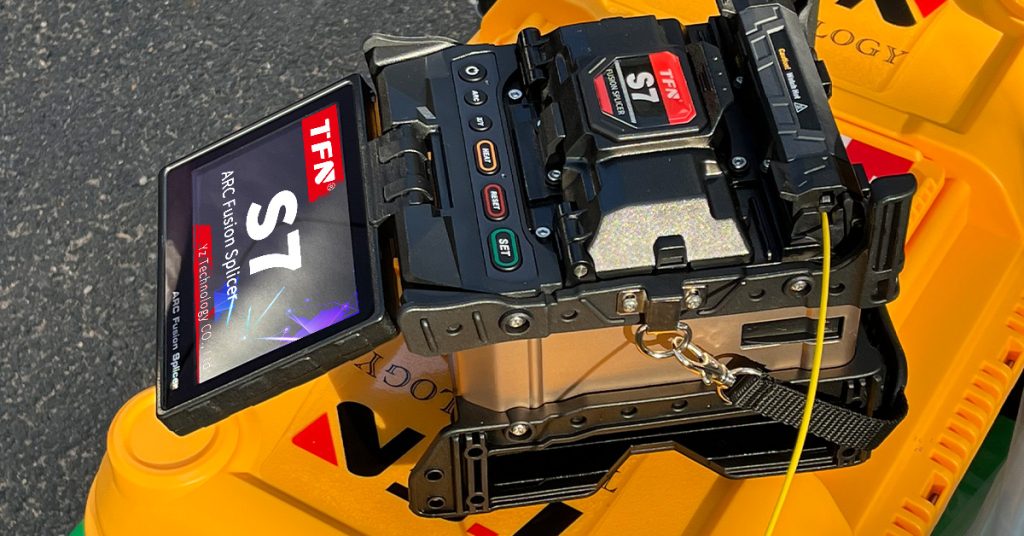
Field-Proven Performance: More Than Just Speed, a Reliable Work Partner
Three-in-One Clamp and Field Adaptability
In our line of work, the biggest fear is equipment that’s “picky” about materials. When splicing drop cables for FTTH access in the field, frequently changing fixtures wastes time and risks losing small accessories. The TFN S7’s standard three-in-one universal clamp effectively solves this pain point. It accommodates bare fibers from 0.25 mm to 3.0 mm, pigtails, and drop cables – truly “one clamp for all.” Coupled with the machine’s inherent rugged design (waterproof, dustproof, shock-resistant), the S7 has never let us down, even during recent typhoon-related base station emergency repairs.
High-Capacity Battery and Data Tracking
The 5200 mAh swappable battery is another highlight for me. Based on our typical daily workload of around 200 splices (including heating), a single S7 battery provides enough power for a full day of field operations, completely eliminating the reliance on generators for charging. Additionally, its built-in storage can record the last 2000 splice results. This is extremely practical for engineering projects requiring final as-built documentation. By exporting this data, we can clearly demonstrate the loss value for each splice point to the client, making the acceptance process transparent and efficient.
Conclusion: Technological Dividends Ultimately Translate into Engineering Efficiency
In summary, the success of the TFN S7 fiber fusion splicer lies in its ability to effectively translate the technological dividends of “six-motor” alignment into tangible engineering efficiency. From the ultra-low loss enabled by precision core alignment, to the high-speed construction enabled by 6-second splicing, to the stable operation ensured by its rugged design, it accurately addresses many of the pain points associated with long-haul trunk lines, base station maintenance, and FTTx deployment. For teams pursuing ultimate link quality and construction reliability, the TFN S7 is undoubtedly a trustworthy and intelligent choice.
If you would like to enjoy high-speed fusion splicing and ultra-low loss fiber optic fusion splicers, please contact TFN Support Team:
E-mail: info@tfngj.com
WhatsApp: +86-18765219251
Ou você pode deixar mensagens aqui
Referências:
[1] Y. Li et al., “Analysis of Core-to-Core Alignment Accuracy in Active Core Alignment Fusion Splicing for Dissimilar Optical Fibers,” in IEEE Photonics Journal, vol. 10, no. 4, pp. 1-10, Aug. 2018.
[2] K. Tanaka and M. Tateda, “Return loss characteristics of optical fiber splices and their effect on DWDM systems,” in Journal of Lightwave Technology, vol. 21, no. 2, pp. 379-385, Feb. 2003.
PERGUNTAS FREQUENTES
Six-motor core alignment is an advanced alignment technology that uses six independent motors to precisely position optical fibers along X and Y axes.
Unlike traditional cladding alignment, it directly detects and aligns the fiber core, resulting in significantly lower splice loss and higher accuracy.
Six-motor core alignment improves splice quality by:
Precisely aligning fiber cores instead of outer cladding
Reducing splice loss, especially in dissimilar fibers (e.g., G.652 vs G.657)
Minimizing optical return loss (ORL)
Ensuring more stable long-distance transmission
This leads to more reliable fiber links, especially in trunk line networks.
A high-performance six-motor fusion splicer like the TFN S7 can achieve:
Typical splice loss: as low as 0.01 dB (single-mode fiber)
Better consistency across multiple splice points
This is especially important for long-haul fiber networks where cumulative loss matters.
In long-distance trunk lines (e.g., 100 km+), even small splice losses accumulate.
Higher loss can result in:
Signal attenuation
Reduced transmission distance
Increased need for amplification
Low splice loss ensures longer lifespan and higher network performance.
Optical Return Loss (ORL) measures the amount of reflected light in a fiber link.
High ORL (e.g., >60 dB) is important because it:
Reduces signal reflections
Prevents interference with lasers
Improves performance in DWDM systems
Poor ORL can cause signal instability and noise.