





Antenna feeder systems are critical signal transmission components in mobile communication base stations, broadcast transmission sites, and private wireless networks. Installed outdoors and exposed to harsh environmental conditions for years, these systems continuously experience temperature fluctuations, moisture intrusion, salt spray corrosion, wind-induced vibration, and mechanical stress.
Over time, these environmental factors cause gradual performance degradation inside the RF transmission path. Typical symptoms include increased VSWR (Voltage Standing Wave Ratio), higher transmission loss, deteriorated return loss, and reduced signal coverage performance.
For network operators and maintenance teams, understanding how environmental conditions affect antenna feeder systems—and establishing a regular inspection program using professional antenna cable analyzers—is essential for improving network reliability and reducing long-term maintenance costs.
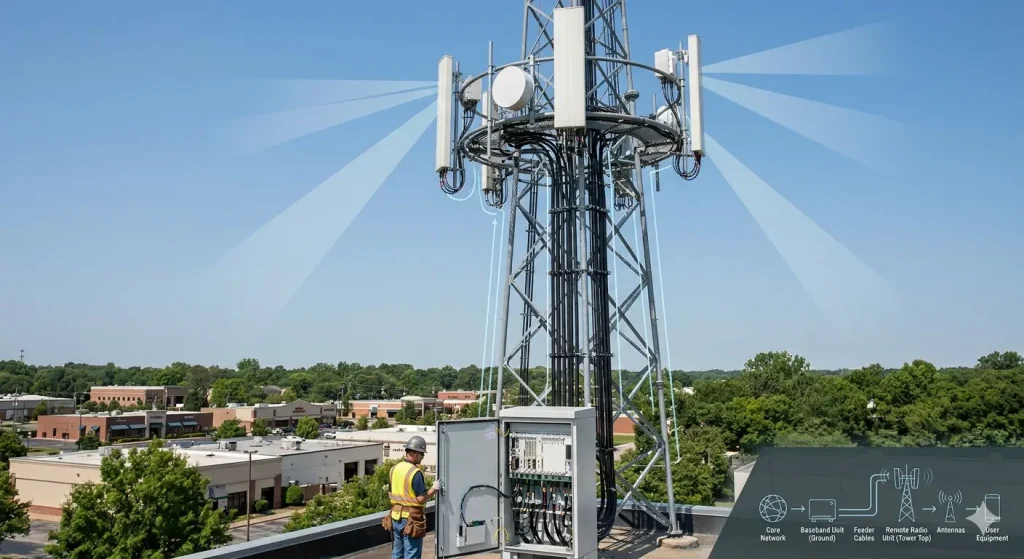
1. Temperature Cycling Causes Long-Term Degradation of Feeder Cable Performance
Outdoor antenna feeder systems experience continuous temperature changes caused by daily temperature cycles and seasonal variations. The inner and outer conductors, dielectric materials, and sealing components inside coaxial feeder cables expand and contract repeatedly as temperatures rise and fall.
Over years of operation, repeated thermal stress can lead to:
- Increased contact resistance at cable connectors;
- Aging and cracking of waterproof sealing materials;
- Changes in dielectric properties of insulation materials;
- Gradual deterioration of VSWR and return loss performance.
In regions with extreme cold, high temperatures, high humidity, or significant day-night temperature differences, these effects become more noticeable. Even when a system appears normal during visual inspections, internal performance degradation may already be affecting RF signal transmission.
Because these hidden problems cannot be identified through simple physical checks, engineers need professional VSWR testing equipment to perform full-frequency measurements. By monitoring VSWR trends, return loss, and cable performance over time, maintenance teams can detect early-stage degradation and take preventive action before service interruptions occur.
2. Moisture, Salt Spray, and Corrosion Gradually Damage RF Transmission Paths
Antenna feeder systems installed in coastal areas, humid environments, or industrial zones are particularly vulnerable to corrosion caused by moisture, salt spray, and chemical pollutants.
Over time, corrosive substances may penetrate connector sealing interfaces, causing:
- Oxidation of metal conductors;
- Damage to connector plating;
- Increased contact impedance;
- Reduced electrical performance.
When the outer jacket of a feeder cable becomes aged or damaged, moisture can enter the dielectric layer, resulting in increased cable attenuation, signal leakage, and abnormal VSWR values.
This type of damage is often difficult to detect during the early stages. Initial degradation may only appear as small increases in loss at specific frequency ranges while network services remain operational. However, if left untreated, corrosion can spread internally and eventually lead to complete cable failure.
Using an antenna cable analyzer with cable loss measurement and distance-to-fault (DTF) testing capabilities allows technicians to locate abnormal sections, identify damaged connectors, and detect moisture-related problems before they develop into major failures.
3. Wind Vibration, Ice Loading, and Mechanical Stress Cause Structural Damage
Antenna feeder systems installed on communication towers, mountains, and coastal sites are continuously exposed to mechanical stress caused by:
- Strong winds;
- Ice accumulation;
- Cable weight and tension;
- Tower movement and vibration.
Over long periods, mechanical stress can affect vulnerable areas such as cable bends, connector joints, and antenna feed points.
Potential consequences include:
- Micro-movement of inner conductors;
- Deformation of dielectric materials;
- Cracking of cable jackets;
- Loose or damaged connectors.
These issues increase signal reflection inside the transmission line, resulting in higher VSWR and unstable RF performance.
For sites located in areas with frequent storms or icing conditions, mechanically induced failures can occur suddenly and may be difficult to troubleshoot through conventional inspection methods.
An antenna cable analyzer with DTF measurement capability enables technicians to locate faults by measuring the distance from the test point to abnormal sections of the feeder system. This reduces troubleshooting time, minimizes tower climbing operations, and improves field safety.
4. Regular RF Testing Is Essential for Preventing Environmental Aging Failures
Environmental degradation of antenna feeder systems is a gradual and irreversible process. However, many early-stage problems can be corrected through relatively simple maintenance actions, such as:
- Retightening connectors;
- Reapplying waterproof protection;
- Replacing damaged components.
Once problems develop into severe water intrusion, cable failure, or signal interruption, repair costs increase significantly.
Therefore, establishing a regular RF maintenance program with an antenna cable analyzer is one of the most effective strategies for extending system lifespan.
Routine measurements of:
- VSWR;
- Return loss;
- Cable loss;
- Distance-to-fault location;
allow engineers to evaluate feeder system health, identify performance trends, and prevent unexpected network downtime.
TFN 150H: Professional Antenna Cable Analyzer for Field RF Testing
O TFN 150H antenna cable analyzer is designed for professional RF installation, maintenance, and troubleshooting applications.
Covering a frequency range from 2 MHz to 6100 MHz, the instrument supports essential measurements including:
- VSWR testing;
- Return loss measurement;
- Cable loss testing;
- Distance-to-fault (DTF) analysis.
Its portable handheld design makes it suitable for outdoor maintenance environments. With a built-in lithium battery providing up to 6 hours of operation and an operating temperature range of -10°C to 55°C, the TFN 150H can support field testing in challenging weather conditions.
The integrated fault location function helps engineers identify hidden issues such as:
- Water-damaged connectors;
- Cable damage points;
- Antenna mismatch problems;
- Abnormal reflection locations.
With both OSL and ECAL calibration methods, the analyzer maintains measurement accuracy under different field conditions, making it a practical solution for telecom operators, broadcast engineers, private network maintenance teams, and RF installation professionals.
Conclusion: Protect Network Reliability Through Preventive Antenna Feeder Testing
Weather and environmental conditions continuously affect antenna feeder systems through thermal stress, moisture intrusion, corrosion, and mechanical forces. These effects are often gradual and invisible, making them difficult to detect through conventional inspections.
Regular testing with a professional antenna cable analyzer provides valuable insight into the actual condition of RF transmission systems. By monitoring VSWR, return loss, cable loss, and fault locations, maintenance teams can identify potential problems early, reduce unexpected downtime, and lower total lifecycle operating costs.
For modern communication networks, preventive RF testing is not only a maintenance activity—it is an essential part of ensuring long-term signal reliability and network performance.