





In today’s business environment, confidential information extends far beyond digital files. Strategic planning, mergers and acquisitions, product roadmaps, contract negotiations, and executive discussions often take place behind closed doors. While organizations continue to strengthen cybersecurity, physical surveillance remains an overlooked security risk.
A hidden camera, covert microphone, or unauthorized recording device can expose valuable information without ever triggering a firewall or intrusion detection system. As surveillance technologies become smaller, cheaper, and more sophisticated, organizations need practical measures to safeguard sensitive spaces.
This is where Technical Surveillance Counter-Measures (TSCM) play a critical role. Rather than simply searching for hidden cameras, modern TSCM combines radio frequency (RF) analysis, physical inspection, and specialized detection equipment to identify a wide range of electronic surveillance threats.
This guide explains how professional TSCM inspections work, why traditional RF detectors are often insufficient, and what capabilities organizations should consider when selecting professional detection equipment.
What Is TSCM?
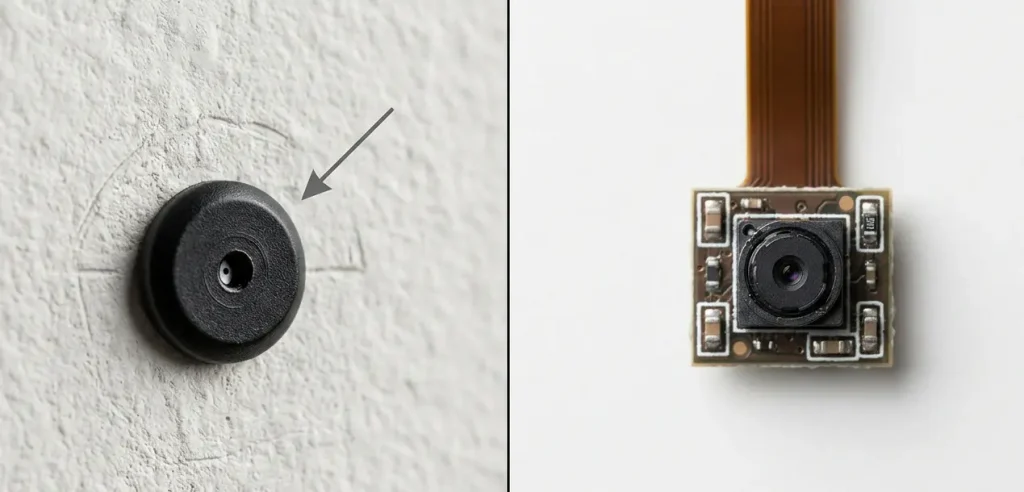
Technical Surveillance Counter-Measures (TSCM) refers to the systematic process of detecting, identifying, and locating unauthorized surveillance devices installed within a protected environment.
A professional TSCM inspection may involve detecting:
- RF transmitters used for covert audio or video monitoring
- Hidden Wi-Fi or Bluetooth-enabled cameras
- Cellular surveillance devices operating over 4G or 5G networks
- GPS tracking devices
- Passive recording devices that store information locally
- Suspicious electronic components hidden inside everyday objects
Unlike consumer “spy detectors,” professional TSCM does not rely on a single technology. Effective inspections combine RF spectrum analysis, directional signal localization, physical examination, and operator experience to distinguish legitimate wireless activity from potential surveillance threats.
Why Traditional RF Detectors Are No Longer Enough
Many inexpensive RF detectors were originally designed to identify continuous analog transmissions. While they may still detect some legacy surveillance devices, today’s electronic threats have evolved significantly.
Modern surveillance devices often communicate using legitimate wireless technologies, making them much more difficult to identify.
For example, some hidden cameras transmit through existing Wi-Fi networks instead of broadcasting dedicated RF signals. Others record data locally for hours before sending compressed information in extremely short bursts. These intermittent transmissions can easily be missed by slow-scanning detectors.
Bluetooth Low Energy (BLE) devices introduce another challenge. Because they transmit briefly and consume very little power, they may remain virtually invisible to basic RF scanners.
Not every surveillance device transmits wirelessly. Voice-activated recorders may store recordings internally without emitting measurable RF signals, requiring visual inspection or thermal imaging to locate them.
For these reasons, professional TSCM inspections increasingly combine multiple detection methods rather than relying solely on RF detection.
How a Professional TSCM Inspection Works
Although every inspection is different, professional TSCM teams generally follow a structured workflow.
Step 1: Establish the RF Baseline
Before searching for suspicious signals, investigators first identify the normal wireless environment.
Office Wi-Fi access points, Bluetooth peripherals, mobile phones, and nearby cellular base stations all generate legitimate RF activity. Understanding this baseline allows operators to recognize unexpected signals that warrant further investigation while reducing false alarms.
Establishing a baseline is one of the most important—and often overlooked—steps in professional TSCM.
Step 2: Perform Wideband Spectrum Analysis
Once the normal RF environment is understood, the inspection focuses on identifying abnormal transmissions across a broad frequency range.
Professional spectrum analysis tools continuously monitor wireless activity and help operators detect intermittent, low-power, or burst transmissions that conventional detectors may miss.
Features such as real-time spectrum display, peak hold, and signal history improve the likelihood of capturing brief transmissions from sophisticated surveillance devices.
Step 3: Locate the Signal Source
Detecting a suspicious transmission is only the beginning. The next challenge is determining exactly where it originates.
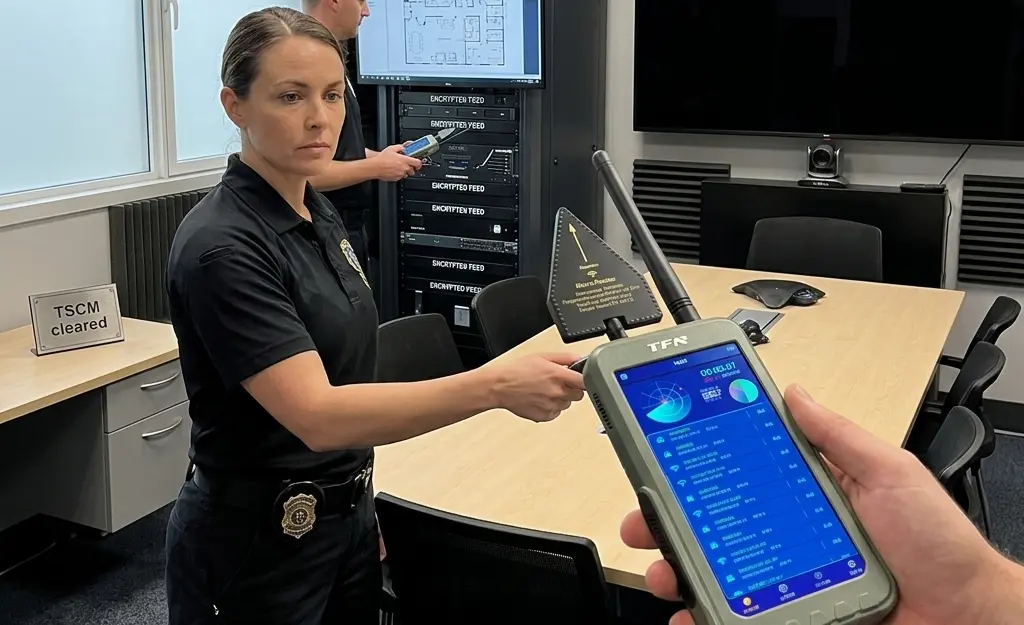
Directional antennas and signal strength indicators enable operators to narrow the search area by comparing signal levels from different locations. This process helps distinguish whether a signal originates inside the protected room or from an external source.
Accurate localization significantly reduces inspection time and minimizes unnecessary disruption.
Step 4: Conduct a Physical Inspection
Electronic surveillance devices are frequently concealed inside ordinary office equipment, including smoke detectors, USB chargers, power strips, wall outlets, clocks, lighting fixtures, and decorative objects.
A careful physical inspection remains an essential part of every professional TSCM operation. Depending on the environment, thermal imaging may also help identify powered electronic devices that are hidden from view.
No single technology can detect every surveillance threat. Combining electronic detection with physical inspection provides a more comprehensive assessment.
Common Mistakes During Corporate Bug Sweeps
Organizations sometimes perform security inspections using inexpensive consumer devices and assume their meeting rooms are secure. Unfortunately, this approach often creates a false sense of confidence.
Some of the most common mistakes include:
- Scanning only once instead of monitoring over time
- Ignoring intermittent or burst transmissions
- Assuming every RF signal is malicious
- Relying exclusively on omnidirectional RF detectors
- Skipping physical inspection of office equipment and furnishings
- Failing to document the normal RF environment for future comparisons
Following a structured inspection procedure is generally more effective than relying on a single detection device.
Choosing Professional TSCM Equipment
Professional TSCM equipment should support a complete inspection workflow rather than simply indicating that RF energy is present.
When evaluating detection equipment, organizations should consider capabilities such as:
- Wide frequency coverage for common wireless communication bands
- Real-time spectrum analysis for detecting intermittent signals
- Directional signal localization to identify the source of transmissions
- Signal demodulation to help verify the nature of detected signals
- Portable operation for inspecting conference rooms, executive offices, vehicles, and other sensitive environments
For organizations requiring advanced RF inspection capabilities, the TFN PHC12 RF Signal Detector, combines wide-band spectrum monitoring, directional localization, Wi-Fi and Bluetooth analysis, and audio demodulation in a portable platform designed for professional security applications. Rather than serving as simple RF detectors, these instruments support a more systematic TSCM inspection process across corporate, government, and critical infrastructure environments.
This is where the TFN PHC-Series Signal Detectors set the industry standard for B2B security deployments.
| Recurso | Consumer-Grade Detectors | TFN PHC12 / PHC18 Professional Detectors |
| Faixa de frequência | Typically limited (e.g., up to 3GHz or 6GHz) | Ultra-Wideband Sweep (covering sub-GHz to 12GHz/18GHz, including 5G & high-band Wi-Fi) |
| Sweep Speed & Accuracy | Slow sweep rate, high rate of false positives | Real-time spectral analysis capable of capturing intermittent burst transmissions |
| Direction Finding | Omnidirectional (tells you a bug is in the room, but not where) | Includes high-gain Log-Periodic Directional Antennas to pinpoint signal sources |
| Signal Demodulation | None (cannot hear or verify the signal) | Audio demodulation capabilities allowing operators to verify the exact nature of the transmission |
Conclusão
Protecting confidential information requires more than strong cybersecurity. As surveillance technology continues to evolve, organizations must also address the risks posed by unauthorized electronic monitoring inside their physical workspaces.
A professional TSCM program combines trained personnel, structured inspection procedures, and capable detection equipment to identify potential surveillance threats before sensitive information is compromised.
Whether securing executive boardrooms, research facilities, government offices, or other high-value environments, regular TSCM inspections can become an important part of a comprehensive security strategy.
If your organization is evaluating professional RF detection solutions, understanding the inspection process—and selecting equipment designed for real-world TSCM applications—is the first step toward improving physical information security.