





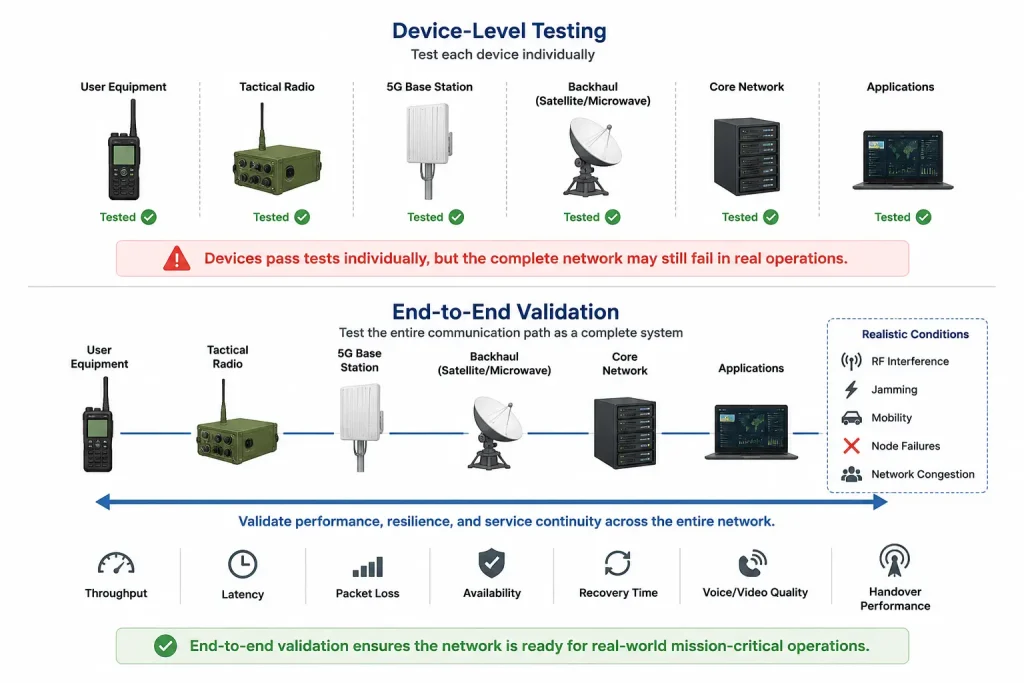
Modern tactical wireless networks are no longer built around a single radio, base station, or communication protocol. They combine multiple technologies—including tactical radios, private 5G, satellite communications, fiber backhaul, edge computing, and IP networking—to deliver resilient communications across dynamic operational environments.
As network architectures become increasingly heterogeneous, verifying the performance of individual devices is no longer sufficient. A radio may pass factory acceptance testing, and a base station may meet its technical specifications, yet the complete network can still fail when deployed.
This is why defense organizations and communication system integrators are placing greater emphasis on end-to-end validation rather than isolated device testing. Recent industry discussions on defense communications modernization consistently identify realistic system-level testing as a prerequisite for mission readiness, especially in environments affected by interference, jamming, mobility, and network failures.
What Is End-to-End Validation?
End-to-end (E2E) validation evaluates the entire communication chain instead of individual network components.
Rather than testing only a radio, modem, antenna, or base station independently, end-to-end validation examines how all components interact throughout the communication path, including:
- User equipment (UE)
- Tactical radios
- Private or public 5G infrastructure
- Satellite or microwave backhaul
- IP transport networks
- Edge computing platforms
- Command and control applications
The objective is to verify that mission-critical services continue functioning when real-world conditions change.
Typical performance indicators include:
- End-to-end latency
- Perda de pacotes
- Taxa de transferência
- Voice and video quality
- Handover performance
- Network recovery time
- Disponibilidade do serviço
Unlike laboratory compliance testing, end-to-end validation focuses on operational performance under realistic conditions.
Why Device-Level Testing Alone Is No Longer Enough
Testing individual devices remains essential during manufacturing and acceptance. However, many communication failures occur between systems rather than inside a single device.
Examples include:
- Interoperability issues between equipment from different vendors
- Routing failures after network topology changes
- QoS configuration inconsistencies
- Timing synchronization problems
- Authentication failures
- Incorrect failover behavior
- Spectrum interference affecting multiple network layers
These problems often remain invisible until the complete system is integrated.
For tactical communications, where multiple technologies operate simultaneously, testing each component independently cannot fully predict overall network performance.
Tactical Wireless Networks Are Multi-Domain Systems
Modern defense communication networks increasingly combine multiple transport technologies.
A single mission may involve:
- Private 5G for local broadband coverage
- Tactical radios for long-range communications
- Satellite links for beyond-line-of-sight connectivity
- Fiber networks inside command facilities
- Edge computing for local data processing
Traffic can dynamically switch between these communication paths depending on network availability and operational priorities.
Because of this complexity, validation must cover the entire communication architecture, not just individual hardware platforms.
Industry discussions on defense communications increasingly describe future military networks as multi-modal architectures designed around users, applications, and data rather than a single communication technology.
Testing Under Realistic Operational Conditions
A tactical network that performs well in a controlled laboratory may behave very differently in operational environments.
Comprehensive validation often includes testing under conditions such as:
RF Interference
Wireless networks may operate in congested spectrum where multiple systems compete for bandwidth.
Testing should evaluate how communications behave when interference levels increase.
Jamming Scenarios
Intentional interference can reduce throughput, interrupt connectivity, or force networks to change operating modes.
Validation helps engineers understand recovery behavior and network resilience.
Node Failures
Communication nodes may become unavailable due to equipment failure or physical damage.
End-to-end testing verifies whether traffic can be rerouted without disrupting mission-critical applications.
Mobility
Users, vehicles, or unmanned systems constantly move across coverage areas.
Testing handover performance ensures that voice, video, and data sessions remain stable during movement.
Network Congestion
Large numbers of connected devices may generate heavy traffic.
Validation verifies whether network quality remains acceptable under peak utilization.
Why Interoperability Testing Matters
Defense communication systems rarely originate from a single supplier.
A typical deployment may integrate:
- Radio systems
- Network switches
- Private LTE or 5G infrastructure
- Satellite terminals
- Security gateways
- Command software
Each vendor may comply with industry standards while implementing features differently.
End-to-end validation verifies that these heterogeneous systems operate together as intended.
This is particularly important for coalition operations, where interoperability across organizations and equipment vendors directly affects operational effectiveness.
From Performance Testing to Mission Assurance
Traditional network testing often focuses on technical metrics such as:
- Maximum throughput
- Peak data rate
- Receiver sensitivity
- RF output power
While these remain important, mission-oriented validation asks broader questions:
- Can critical applications continue operating after a network disruption?
- Does the network recover automatically?
- Are communication priorities maintained?
- Can users maintain connectivity during mobility?
- Are multiple communication paths available if one fails?
These questions better reflect how communication systems are actually used in operational environments.
Supporting Continuous Validation
Modern communication networks evolve continuously through software updates, security patches, configuration changes, and new devices.
As a result, validation is increasingly becoming an ongoing engineering process rather than a one-time acceptance test.
Many organizations now combine:
- Laboratory testing
- Network emulation
- RF channel simulation
- Field trials
- Continuous performance monitoring
to maintain confidence throughout the network lifecycle.
Industry experts increasingly recommend validating systems under realistic RF conditions—including interference, propagation effects, mobility, and large-scale deployments—before field deployment.
Test & Measurement Solutions for End-to-End Validation
Effective end-to-end validation requires multiple categories of test equipment working together.
Depending on the network architecture, engineers may use:
- Radio communication test sets to evaluate wireless links and protocol performance.
- Analisadores de espectro to identify interference, monitor spectrum occupancy, and troubleshoot RF environments.
- Antenna and cable analyzers to verify RF transmission paths.
- Traffic generators and network analyzers to simulate real application loads.
- GNSS or timing measurement tools where network synchronization is critical.
Selecting appropriate test equipment depends on the communication technologies being deployed and the operational objectives of the validation process.
Conclusão
As tactical wireless networks continue integrating private 5G, satellite communications, edge computing, and heterogeneous communication systems, testing individual devices alone can no longer provide sufficient confidence before deployment.
End-to-end validation enables engineers to evaluate how complete communication systems behave under realistic operational conditions, helping identify interoperability issues, performance bottlenecks, and resilience challenges before they affect mission-critical operations.
For organizations developing or deploying modern wireless communication systems, comprehensive system-level validation has become an essential part of ensuring reliable, resilient, and interoperable network performance.