





In the deployment and operation and maintenance phases of carrier-class Ethernet and IP RAN networks, a high-performance network tester is a core tool to ensure network link quality and verify service-level agreements (SLAs). With the large-scale construction of 5G mobile backhaul and metropolitan area Ethernet, concurrent transmission of multi-service streams has become the norm for networks, placing higher demands on the multi-stream testing capability, protocol compatibility and on-site adaptability of network testers. Relying on the FT100 intelligent network test platform, the TFN T5500A 10G Ethernet Tester features 512-stream multi-service testing as its core advantage and is compatible with a variety of international standard test protocols. It has become a professional solution for communication engineers to conduct 10G Ethernet and packet network tests. Its modular design and full-scenario adaptability also make this network tester an optimal choice for both on-site testing and laboratory verification.
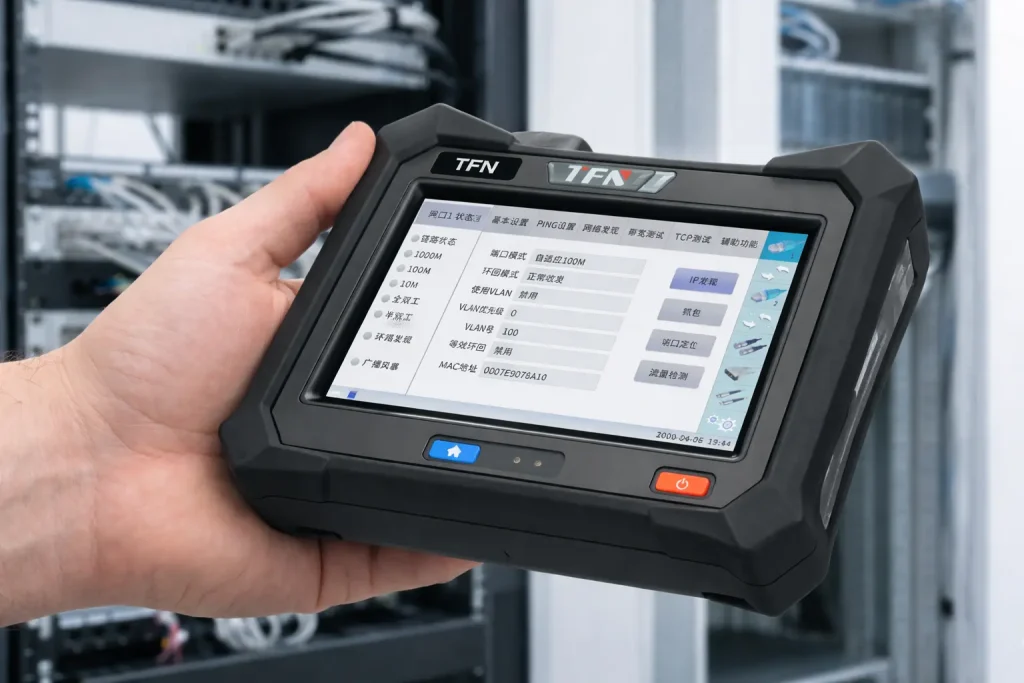
512-Stream Multi-Service Testing: Full-Scenario Service Simulation for 10G Networks
As a professional network tester for 10G networks, the TFN T5500A has achieved technological breakthroughs in the field of multi-stream testing: the Gigabit interface supports the generation and analysis of 8 data streams, while the 10G interface can realize simultaneous simulation of up to 512 data streams. This parameter fully matches the network characteristics of concurrent multi-services in modern metropolitan area Ethernet. For each data stream, this network tester can independently and accurately measure throughput, latency, frame loss and packet jitter. Engineers can set differentiated priorities for different data streams to simulate the transmission scenarios of voice, video, data and other services, and intuitively verify the QoS scheduling capability and forwarding performance of the network through multi-stream statistical data.
In terms of traffic generation, this network tester supports variable frame lengths from 64 to 16,000 bytes, including fixed, incremental, decremental and random frame length modes. It also allows custom mixed traffic of unicast and broadcast frames. Combined with configurable MAC/IP address pools, it can highly restore the service traffic characteristics of actual networks. The multi-stream test results of the device support independent single-stream statistics and overall summary analysis, providing accurate data support for communication engineers to locate network congestion and link bottlenecks.
Full Standard Compatibility: Professional Testing Capabilities from RFC2544 to Y.1564
A professional network tester must be highly compatible with international test standards. The TFN T5500A fully covers the mainstream test standards for Ethernet and packet networks, realizing the full-process coverage from device testing to service verification. In strict accordance with the RFC2544 standard, the device completes bidirectional measurement of throughput, back-to-back frames, latency and frame loss, which is a core function for network device network access testing and link basic performance verification. It is also equipped with a complete ITU-T Y.1564 test suite, creating a professional test solution for carrier Ethernet service activation and fault diagnosis. Compared with the traditional RFC2544 test, Y.1564 can achieve accurate identification of packet jitter and full SLA parameters with greatly improved test efficiency, making it more suitable for the needs of rapid on-site testing.
In terms of OAM link and service testing, this network tester supports mainstream OAM protocols such as IEEE 802.3ah, IEEE 802.1ag, ITU-T Y.1731 and ITU-T G.8113.1, and can complete full-function tests including link partner detection, remote loopback, connectivity check and link trace. Through Y.1731 and G.8113.1 messages, it can also realize the verification of latency and frame loss performance of PTN/IP RAN networks, providing a convenient technical means for packet network maintenance. In addition, the device supports packet jitter testing in accordance with the RFC3393 standard, which can perform jitter analysis on VoIP packets such as G.711 and G.729 to accurately evaluate the transmission quality of IP voice services.
Modular Design + On-Site Adaptation: Creating a Portable and Efficient Testing Experience
As a network tester for on-site testing, the TFN T5500A fully considers the actual needs of communication engineers in hardware design and function adaptation. Relying on the FT100 intelligent test platform, it achieves modular expansion and can be equipped with the T5500A(1) dual-fiber dual-electrical Gigabit module and the T5500A(2) single-port 10G module, flexibly adapting to different test scenarios of Gigabit and 10G networks. The test interfaces include 2 RJ45 Gigabit electrical ports, 2 SFP Gigabit optical ports and 1 XFP 10G optical port, supporting 10/100/1000M full-duplex/half-duplex auto-negotiation and 10G full-duplex mode to meet the testing needs of different links.
The device is equipped with a 6.5-inch outdoor enhanced LCD touch color display, adapting to a wide temperature working environment from -10℃ to 50℃. The lithium battery can achieve a maximum battery life of 12 hours, fully meeting the endurance requirements of outdoor on-site testing. It also supports fast export of test results through the USB 2.0 interface and remote access and control through the 10/100M Base-T interface. Combined with a graphical user interface and a rich key design, it makes on-site testing operations more efficient. In terms of test depth, this network tester can complete Layer 1 to Layer 4 error, loopback and remote intelligent loopback tests, and support pass-through testing with network impairment injection to accurately verify the network performance under abnormal conditions.
Synchronization Testing + Advanced Tools: Covering the Full-Dimensional Testing Needs of Networks
The TFN T5500A is not only a network tester focusing on Ethernet performance, but also equipped with a wealth of advanced testing functions, forming a differentiated advantage especially in the field of synchronous network testing: its Gigabit interface supports IEEE 1588v2 PTP and Sync-E master-slave simulation testing, supports unicast and multicast PTP information transmission, and can simulate and analyze synchronous Ethernet ESMC information in accordance with the ITU-T G.8264 standard, providing professional support for the deployment and verification of 5G synchronous networks.
In addition, the device is equipped with a complete set of advanced IP test tools, supporting advanced PING testing for specified IP address pools, Trace Route for route tracking, VCT for cable fault testing, and also realizing application layer testing functions such as FTP upload/download simulation and HTTP web browsing testing. It supports online service scanning based on MAC/IP/VLAN ID/MPLS Label to quickly identify service types and link utilization in the network, allowing communication engineers to quickly complete network configuration checks and fault location.
As a high-performance network tester, the TFN T5500A takes 512-stream multi-service testing as its core, and combined with full standard compatibility, modular design and full-scenario adaptability, it has become a professional tool for the testing of metropolitan area Ethernet, IP RAN and mobile backhaul networks. Its full-dimensional testing capability from the physical layer to the application layer and full-scenario adaptability from laboratory verification to on-site operation and maintenance enable communication engineers to efficiently complete network performance verification, SLA testing and fault diagnosis, providing reliable technical support for the high-quality deployment and operation and maintenance of carrier-class networks.
Se você estiver interessado em TFN T5500A Network Tester, Entre em contato com a equipe de suporte da TFN:
E-mail: info@tfngj.com
WhatsApp: +86-18765219251
Ou você pode leave messages here
Perguntas frequentes
O TFN T5500A is a professional-grade 10G network tester designed for carrier-class Ethernet and IP RAN networks. Its primary advantage lies in its 512-stream multi-service testing capability, allowing engineers to simulate complex 10G network traffic. It features a modular design (FT100 platform), full compatibility with international standards like RFC2544 and Y.1564, and a ruggedized build with 12-hour battery life, making it ideal for both laboratory verification and outdoor on-site maintenance.
The device offers industry-leading multi-stream simulation density. While the Gigabit interface supports up to 8 data streams, the 10G interface can simulate up to 512 concurrent data streams. This allows communication engineers to independently measure throughput, latency, packet jitter, and frame loss for diverse services—such as voice, video, and data—within a single test environment to verify QoS (Quality of Service) scheduling.
Yes. The TFN T5500A provides full-process coverage for mainstream Ethernet test standards. It supports RFC2544 for basic link performance verification (throughput, back-to-back, latency, and loss) and the ITU-T Y.1564 test suite. Y.1564 is particularly effective for modern carrier Ethernet, as it allows for faster, more accurate SLA (Service Level Agreement) validation and packet jitter identification compared to traditional methods.
Absolutely. Beyond standard Ethernet testing, the T5500A is equipped for 5G synchronous network deployment. It supports IEEE 1588v2 PTP e Sync-E (Synchronous Ethernet) master-slave simulation. It can also analyze ESMC information according to ITU-T G.8264, ensuring that timing and synchronization in mobile backhaul and IP RAN networks meet 5G’s strict technical requirements.
The T5500A is highly compatible with mainstream OAM (Operations, Administration, and Maintenance) protocols, including:
IEEE 802.3ah (Ethernet in the First Mile)
IEEE 802.1ag e ITU-T Y.1731 (Connectivity and Performance Monitoring)
ITU-T G.8113.1 (Operations for PTN/IP RAN) These allow for advanced functions like remote loopback, link trace, and connectivity checks, which are essential for maintaining packet-switched networks.