







When working with a spectrum analyzer, bandwidth settings directly affect how signals are displayed, interpreted, and ultimately measured. Among all bandwidth-related parameters—such as input bandwidth, IF bandwidth, real-time bandwidth (RTBW), and sweep bandwidth—Resolution Bandwidth (RBW) 및 Video Bandwidth (VBW) are the two most frequently adjusted, and also the two most commonly misunderstood.
In daily RF testing work, many engineers know that changing RBW or VBW “does something” to the spectrum trace, but they are often unclear about what exactly changes, why it changes, and which parameter should be adjusted first. This article explains the difference between VBW and RBW in a practical, measurement-oriented way, focusing on how these settings affect real spectrum analyzer results rather than just theoretical definitions.
What Is Video Bandwidth (VBW) in a Spectrum Analyzer?
Video Bandwidth (VBW) refers to the bandwidth of the video filter applied after signal detection. Once the spectrum analyzer converts the IF signal into a detected (envelope) signal, the VBW filter smooths that signal before it is displayed on the screen.
In practical terms, VBW controls how stable or “quiet” the trace looks, not how well different frequencies are separated. A smaller VBW reduces visible noise fluctuations and makes the trace smoother, which is especially helpful when observing low-level or stable signals. However, excessive smoothing can hide short-term variations or fast-changing signal behavior.
During real-world measurements, engineers often notice that reducing VBW makes the spectrum easier to read, particularly near the noise floor. On the other hand, when observing burst signals or rapidly varying interference, using a larger VBW allows the display to better reflect actual signal dynamics—even though the trace appears noisier.
It is important to emphasize that VBW does not improve frequency resolution. It only affects how the detected signal is displayed.
What Is Resolution Bandwidth (RBW) in a Spectrum Analyzer?
Resolution Bandwidth (RBW) defines the bandwidth of the intermediate frequency (IF) filter in a spectrum analyzer. It directly determines how close two signals can be in frequency before they begin to merge into a single peak on the display.
From a measurement perspective, RBW is one of the most critical parameters. A narrower RBW allows the analyzer to distinguish closely spaced signals and reduces the displayed noise floor. This is why RBW is essential when analyzing narrowband signals, adjacent channels, or fine spectral details in modulated signals.
The trade-off becomes obvious during actual testing: reducing RBW improves resolution, but it also slows down the sweep speed. Conversely, using a wider RBW allows faster scanning across a wide frequency span, but closely spaced signals may overlap and become indistinguishable.
In short, RBW determines what you can resolve in the frequency domain, and it should always be chosen based on the required measurement accuracy before considering display aesthetics.
VBW vs RBW: Understanding the Real Difference
Although VBW and RBW are often adjusted together, they serve very different purposes inside a spectrum analyzer.
RBW determines the analyzer’s frequency-selective behavior. It affects resolution, sweep time, and the ability to separate adjacent signals.
VBW, in contrast, operates after detection and mainly affects how smooth or noisy the displayed trace appears.
A useful way to think about this difference is:
- RBW defines what information exists in the measurement
- VBW defines how that information is visually presented
| 매개변수 | Resolution Bandwidth (RBW) | Video Bandwidth (VBW) |
|---|---|---|
| Definition | IF filter bandwidth | Video (post-detection) filter bandwidth |
| Primary function | Determines frequency resolution | Smooths displayed signal |
| Affects resolution | ✅ Yes | ❌ No |
| Affects noise display | Indirectly | ✅ Yes |
| Impact on sweep speed | Strong | Minimal |
| Typical adjustment goal | Separate adjacent signals | Reduce trace fluctuations |
Because of this relationship, changing VBW will never recover frequency details lost due to an excessively wide RBW.
How to Choose RBW and VBW for Accurate Measurements
In real measurement scenarios, RBW should always be selected first. The required frequency resolution determines how narrow the RBW must be. Once RBW is properly set, VBW can then be adjusted to improve display readability without affecting resolution.
A commonly used practical guideline is:
VBW should be equal to or smaller than one-third of the RBW
This ratio provides sufficient smoothing while preserving the spectral detail defined by the RBW filter.
For example:
- When measuring narrowband or low-level signals, engineers typically use a small RBW to achieve high resolution and then reduce VBW to stabilize the trace.
- When performing wideband scans or quick signal searches, a larger RBW speeds up measurements, and a correspondingly larger VBW allows real-time signal behavior to remain visible.
A common mistake is reducing VBW while leaving RBW too wide, expecting better resolution. In practice, this only produces a smoother but still inaccurate spectrum.
RBW and VBW Control in TFN RMT Series Spectrum Analyzers
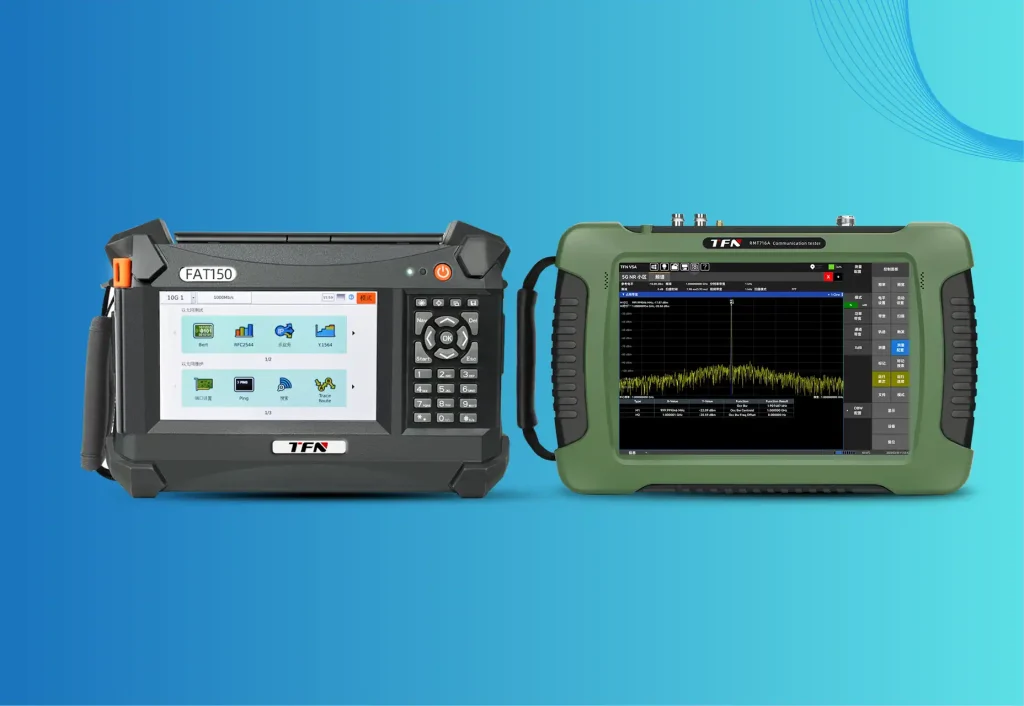
TFN RMT series spectrum analyzers provide both automatic and manual control of RBW and VBW, allowing users to adapt bandwidth settings to different measurement requirements.
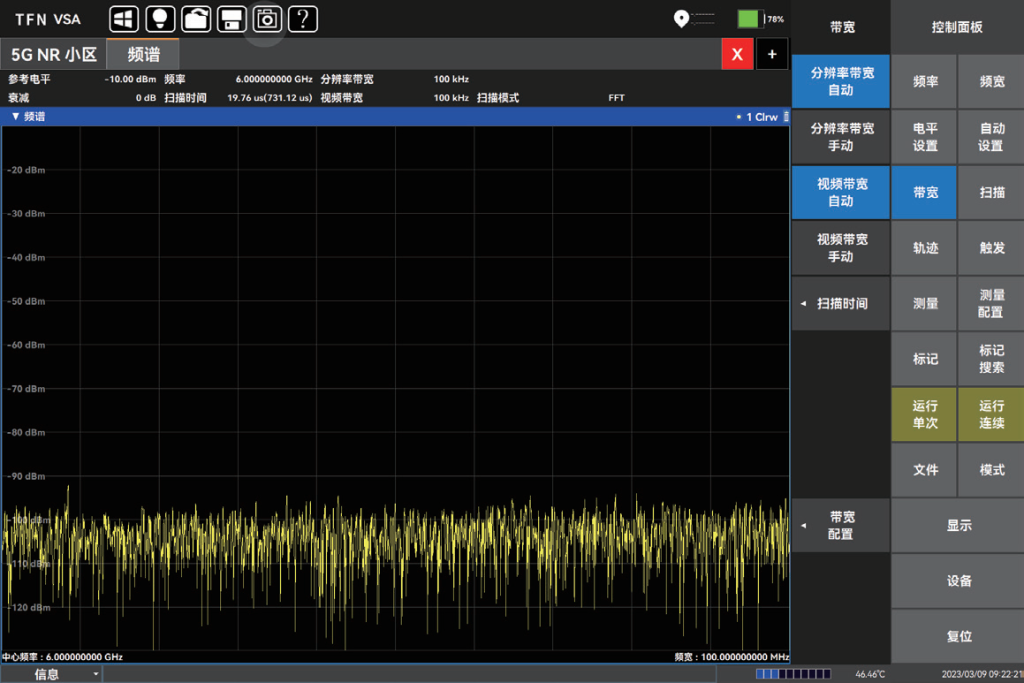
The resolution bandwidth can be adjusted from 1 Hz to 3 MHz. In manual mode, values can be entered directly using numeric keys or adjusted with a rotary wheel. In automatic mode, RBW changes dynamically with the frequency span according to the configured SPAN/RBW ratio, ensuring a reasonable balance between resolution and sweep speed.
The video bandwidth also supports a range from 1 Hz to 3 MHz. When set to automatic mode, VBW tracks RBW based on a predefined RBW/VBW ratio, which helps users quickly achieve a stable and readable display without manual fine-tuning.
This flexible bandwidth control is particularly useful when switching between precision measurements and fast spectrum surveys.
Why the Difference Between VBW and RBW Matters
Misunderstanding VBW and RBW often leads to incorrect conclusions during spectrum analysis. Engineers may overlook interference signals, misjudge noise levels, or misinterpret modulation characteristics simply because bandwidth settings are not optimized.
By clearly distinguishing the roles of RBW and VBW, users can:
- Improve measurement reliability
- Reduce test time
- Avoid false or misleading spectrum results
In professional RF testing, correct bandwidth configuration is not just a display preference—it directly affects measurement validity.
Conclusion: VBW vs RBW in Practice
- Resolution Bandwidth (RBW) determines frequency resolution and signal separation
- Video Bandwidth (VBW) controls trace smoothness and displayed noise behavior
- RBW impacts sweep speed and measurement accuracy
- VBW improves readability but does not enhance resolution
For accurate spectrum analyzer measurements, always configure RBW based on resolution needs first, then adjust VBW to achieve a clean and interpretable display.
If you would like to learn more about spectrum analyzers with flexible RBW and VBW control or need assistance selecting the right instrument for your application, please contact the TFN team:
Email: info@tfngj.com
WhatsApp: +86-18765219251
TFN provides professional spectrum analyzer solutions for RF testing, interference analysis, and communication system verification.