






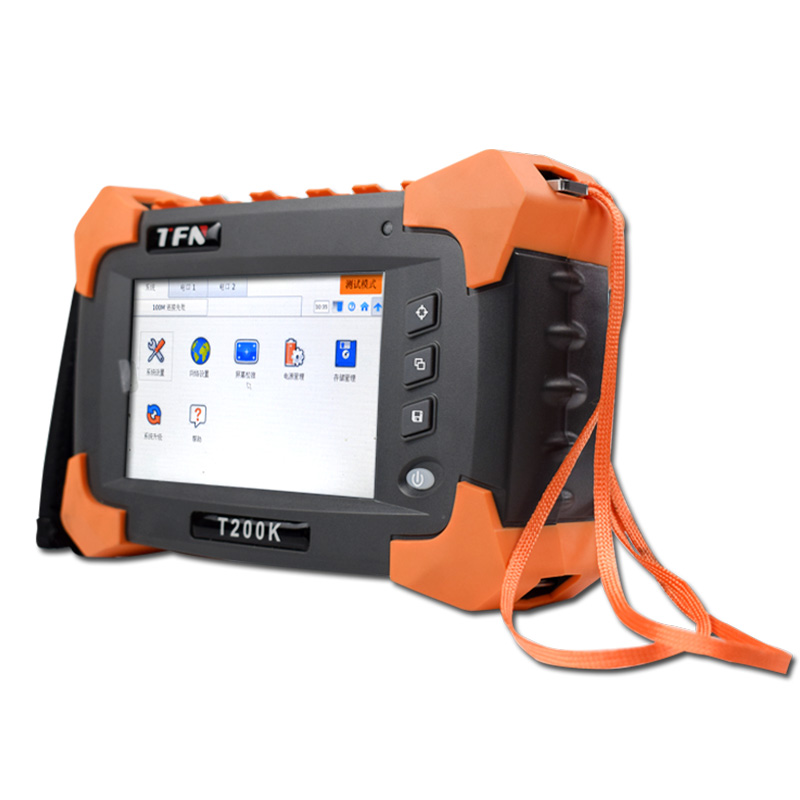
Ethernet testers are indispensable tools for the research, development, production, and maintenance of high-quality network infrastructure. For engineers, a deep understanding of their operating principles is not only a prerequisite for operating the equipment but also key to fault diagnosis and performance optimization. This article will systematically dissect the core working principles of Ethernet testers from an R&D engineer’s perspective, covering the complete testing chain from the physical layer to the application layer.
I. Physical Layer Testing: The Foundation of Signal Integrity
Physical layer testing is the “first line of defense” for network health, primarily verifying whether the electrical characteristics of cables and transceivers comply with standards.
Time Domain Reflectometry (TDR) Principle
TDR is the core technology for locating cable faults (such as opens, shorts, impedance mismatches). The tester transmits a fast-rising edge pulse into the cable and continuously monitors the reflected signal. The distance to the fault point is calculated precisely by measuring the time difference Δt between the transmitted and reflected pulses:
Distance D = (v Δt) / 2
Here, v is the propagation velocity of the signal in the cable, typically around 0.65 times the speed of light in a vacuum (depending on the cable dielectric). The reflection coefficient Γ at an impedance discontinuity is calculated using the following formula (1):
Γ = (Z_L – Z_0) / (Z_L + Z_0)
Where Z_0 is the cable’s characteristic impedance (e.g., 100Ω for Cat5e/6), and Z_L is the actual impedance at the fault point. A positive Γ indicates higher impedance (possibly an open), while a negative Γ indicates lower impedance (possibly a short).
Eye Diagram Analysis and Jitter Measurement
For high-speed Ethernet (e.g., Gigabit, 10-Gigabit), signal quality is assessed via the “eye diagram.” The tester captures data from numerous signal transitions and displays them superimposed. The openness of the “eye height” and “eye width” visually reflects the signal-to-noise ratio and timing jitter. Jitter is typically decomposed into Random Jitter (RJ) and Deterministic Jitter (DJ). Total Jitter (TJ) can be estimated using the following model (based on the dual-Dirac model):
TJ(BER) = DJ + n(BER) RJ
Here, n(BER) is a multiplier factor related to the target Bit Error Rate. For example, at a BER of 1E-12, n is approximately 14. Excessive jitter leads to sampling errors at the receiver and is a primary cause of high-speed link failure. Research indicates that accurately separating jitter components is crucial for diagnosing Synchronous Switching Noise (SSN) and crosstalk (1-Reference 1-2003).
II. Data Link Layer Testing: Frame and Flow Control
Building upon error-free electrical signals, data link layer testing focuses on frame construction, switching, and flow control.
RFC 2544 Test Suite
This is the authoritative benchmark for evaluating network device performance, defined by the IETF. Ethernet testers execute it using hardware-accelerated engines to generate and measure line-rate traffic precisely (2-Reference 2-1999).
- Throughput: The maximum data rate a device can forward under zero packet loss conditions. The tester performs a binary search iteration to quickly determine this critical point.
- Latency: The tester timestamps outgoing test frames with high-precision (often based on the IEEE 1588 PTP protocol) and calculates the difference upon receiving the looped-back frame. Store-and-forward latency can be theoretically estimated as: Frame Size / Link Rate + Processing Delay.
- Frame Loss Rate: The difference between the number of frames sent and received under a specific load (e.g., 80% line rate).
- Back-to-Back: Tests the device’s buffering capacity by sending bursts of maximum allowed length frames (1518 bytes or larger) and checking for packet loss.
Error Injection and Stress Testing
A capable tester not only detects but also proactively creates “problems.” Engineers can program the insertion of CRC error frames, runt frames, jabber frames, or modify the Inter-Frame Gap (IFG) to verify the Device Under Test’s (DUT) fault tolerance and stability. This simulates harsh real-world network conditions and is a critical step in ensuring device robustness.
III. Network Layer and Above Testing: Emulating Complex Network Environments
Modern Ethernet testers have evolved into powerful network emulators capable of constructing complex topologies and traffic models.
Protocol Emulation and Conformance Testing
Testers can emulate various routing and multicast protocols like OSPF, BGP, and IGMP, establishing real neighbor relationships with the DUT to verify if its protocol implementation conforms to standards (e.g., IEEE 802.1D/Q, RFC 4271 for BGP-4). By sending malformed protocol messages, they can assess the device’s behavior when faced with unexpected input.
Application Traffic Modeling and Quality of Service (QoS) Validation
Utilizing hardware-based time schedulers, testers can generate mixed traffic models at line rate—for example, simultaneously simulating video streams (fixed packet size, constant bitrate), voice (small packets, high priority), and data traffic (variable packet size, bursty). By measuring the latency, jitter, and packet loss of different priority traffic, engineers can validate the effectiveness of the DUT’s queue scheduling algorithms (like Weighted Fair Queuing – WFQ) and Differentiated Services (DiffServ) policies. While the overall network capacity is bound by Shannon’s theorem, its conceptual framework is instructive for traffic planning:
C = B log₂(1 + S/N)
Although this is a channel capacity formula, its underlying principle guides network bandwidth planning: effective throughput is constrained by bandwidth (B) and “noise” (here interpretable as protocol overhead, collisions, retransmissions).
IV. Performance Stress Testing and Long-Term Reliability Assessment
A network device’s performance limits and long-term stability must be validated under extreme conditions.
Line-Rate Traffic Generation and Statistics
The tester’s specialized Network Processing Unit (NPU) or FPGA ensures it can generate traffic at 100% line rate for 64-byte minimum-sized frames—the ultimate test for any switch’s fabric and lookup engine. For a 10-Gigabit interface, the rate for 64-byte frames reaches 14.88 Mpps (Million Packets Per Second). The tester must maintain real-time, precise counts, byte totals, and latency distributions for each flow (defined by a 5-tuple), handling massive amounts of data.
Long-Term Stability Testing (Burn-in Testing)
In the later stages of R&D, devices must operate continuously for days or even weeks under high-temperature conditions with a load of 70%-90%. The tester continuously monitors for any bit errors, frame loss, or protocol session timeouts during this period. Any sporadic errors are logged and trigger alarms, helping engineers capture elusive defects that only appear under specific timing conditions. Research shows that network device failure rates are higher in early and end-of-life stages, following a bathtub curve. Long-term stress testing is therefore crucial for passing the early failure period and ensuring delivery quality (3-Reference 3-2007).
Conclusione
For the R&D engineer, an Ethernet tester is far more than a simple “pass/fail” inspection tool. It is a precise measurement system and a programmable network environment emulator. From the eye diagram opening at the physical layer, to the throughput inflection point at the data link layer, and on to interactions with complex protocol state machines, the tester’s operation is rooted in communication theory and network protocol specifications. A profound understanding of the principles behind TDR, RFC 2544, jitter analysis, and traffic modeling empowers engineers to design, verify, and troubleshoot network faults more efficiently, thereby building more reliable and high-performance Ethernet products and systems. In an increasingly complex networking world, this depth of principled knowledge is a core competency for delivering exceptional engineering value.