





In contemporary telecommunications and power infrastructure construction, the efficiency of duct and cable installation directly determines project timelines and costs. Traditional manual pulling methods are not only labor-intensive but also prone to causing tensile damage to cables, leading to signal attenuation or even core breakage. With the rapid expansion of Fiber to the Home (FTTH), 5G backhaul networks, and urban power distribution grids, construction teams urgently need a solution that both protects cables and significantly increases installation speed. The emergence of the hydraulic cable blowing machine has completely transformed this landscape, and TFN’s T700CY multi-functional hydraulic cable blower stands as a benchmark product in this field. This article will provide an in-depth analysis from a professional contractor’s perspective on why the T700CY has become core equipment for high-efficiency construction.
T700CY Core Parameters and Technical Highlights
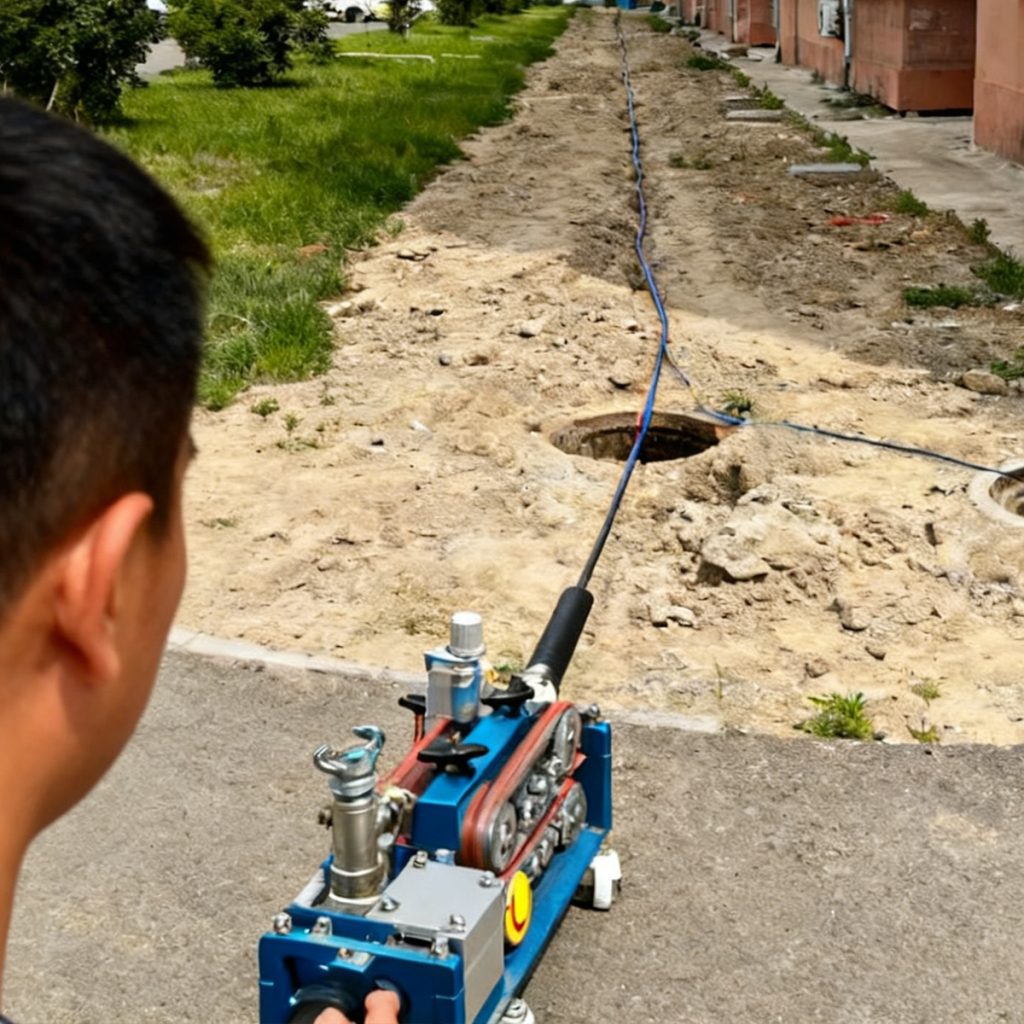
The T700CY is a fully hydraulic cable blowing equipment powered by a 13HP Briggs & Stratton gasoline engine, paired with dual imported hydraulic motors, delivering a maximum thrust of 1000N and blowing speeds up to 120 meters/minute. The main unit weighs only 32kg, and together with the independent QY30L mobile hydraulic power station (110kg), the entire system can be quickly relocated, adapting to various complex terrains.
Powerful Hydraulic Drive System
Unlike electric cable blowers, the T700CY utilizes an independent hydraulic power unit, completely eliminating dependence on site grid power. The hydraulic system provides smooth, infinitely variable thrust, maintaining precise speed control of 0–120 m/min even when blowing heavy armored optical cables or 22mm diameter power cables (such as YJV22 2×10mm²). According to research by Griffioen, thrust must be evenly distributed during the blowing process to avoid localized stress concentration [1]. The T700CY’s dual hydraulic motor design ensures synchronized track gripping force and thrust, maintaining consistent thrust even over installation distances up to 2000 meters.
Precision Cable Protection Mechanism
The most critical concern during cable installation is sheath abrasion or microbending of fibers. The T700CY employs a dual protection system: “soft track gripping + air-assisted floating”. The adjustable pressure rubber tracks automatically adapt gripping force based on cable diameter, while a sealed air chamber directs compressed air (requiring an external 10–15 m³/min air compressor) into the duct, causing the cable to float within the tube, reducing friction coefficient by over 80%. This design aligns with the “air bearing” principle proposed by Plumettaz et al., effectively eliminating lateral pressure during pulling [2]. In practical applications, GYTA optical cables installed using this equipment consistently maintain attenuation increases below 0.02 dB/km, significantly superior to traditional pulling methods.
Multi-Function Compatibility and Microduct Blowing Capability
The T700CY accommodates various cable types with outer diameters of 8–22mm, including GYTA and GYTS fiber optic cables, YJV power cables, and composite cables. More notably, it can simultaneously blow 1–3 10/8mm microducts (8–12mm customizable). This functionality provides operators with an expansion solution of “installing multiple microducts in one pass, blowing fibers on demand”. In dense urban areas, using pre-installed microducts within larger ducts enables rapid deployment of 5G fronthaul cables later without road excavation, significantly reducing reconstruction costs.
Ergonomic Design and Portability
The main unit weighs only 32kg, allowing single-person transport. Hydraulic lines utilize quick-connect couplings, enabling system connection within 3 minutes. The control panel features clearly marked speed control valves and high-pressure air flow switches, making operation intuitive even for new users. Additionally, the included aviation case and comprehensive set of seals, spare belts, and accessories simplify on-site maintenance.
Efficiency Improvements from a Contractor’s Perspective
Long-Haul Backbone Cable Installation
In provincial backbone network projects, individual cable lengths often exceed 4km. Traditional pulling methods require pulling points every 500m, which is time-consuming and risks fiber damage. The T700CY’s 1000N thrust combined with high-pressure airflow can blow cables over 2km continuously in silicone-core ducts without intermediate breaks. Taking a 100km line of a certain operator as an example, using T700CY shortened the construction period from 45 days to 18 days and reduced manpower input by 60%.
Complex Urban Ducts and Microduct Deployment
Urban ducts feature numerous manholes and small bend radii, causing standard cable blowers to jam frequently. The T700CY’s infinitely variable speed adjustment allows operators to adjust speed in real-time based on resistance, successfully navigating 90° bends when combined with cable lubricant. Simultaneously, its microduct blowing capability solves the “last 100 meters” access challenge: pre-installing 10/8mm microducts within buildings allows microcables to be blown in only when users require service, avoiding upfront investment waste.
Power Cables and Armored Cables
Power cables (such as YJV22) are heavy with hard sheaths, making traditional pulling prone to insulation damage. The T700CY’s hydraulic tracks provide sufficient friction without damaging the sheath; combined with air-assisted drag reduction, a 2×16mm² armored cable can be easily delivered to substations 1.5km away. Electricians on-site reported that cable installation previously requiring 8 people can now be completed by just 3.
Scientific Basis: Mechanical Advantages of Blowing Technology
The core efficiency of cable blowing technology lies in combining mechanical thrust with airflow friction forces. Griffioen’s “Installation of optical cables in ducts by blowing” derived relationships between blowing distance, thrust, duct inner diameter, cable diameter, and friction coefficient, demonstrating that when airflow velocity is sufficient, axial tension on the cable becomes negligible [1]. Subsequent research further confirmed that with air assistance, contact pressure between cable and duct wall approaches zero, eliminating additional tension from the “capstan effect” [3]. This means installed cables exhibit lower Polarization Mode Dispersion (PMD), significantly enhancing long-term reliability.
Regarding microduct technology, European Telecommunications Standards Institute (ETSI) reports indicate that microduct + microcable solutions can increase duct utilization by 3–5 times, with single blowing distances not limited by traditional duct bend radii [4]. The T700CY translates laboratory data into field productivity through precision seals and airflow control based on these theoretical foundations.
Practical Application Cases and User Feedback
In a Thai 5G fronthaul project, the contractor used the T700CY to simultaneously blow three 12/10mm microducts into 40/33mm silicone-core ducts, achieving a single blowing distance of 1.8km. Subsequently, 144-core microcables were blown into the microducts without any failures. The site supervisor commented: “Previously, using imported equipment required multiple passes; the T700CY completes it in one go, doubling efficiency.”
A European power grid company purchased the T700CY for 20kV cable upgrades, specifically highlighting its bidirectional capability: “In narrow tunnels, the main unit can be positioned in reverse to blow from the other end, avoiding cable coiling—an extremely practical design.”
Conclusion: Future Trends in Cable Installation and T700CY’s Value
As network bandwidth demands surge and power grids undergo intelligent upgrades, efficient, non-destructive installation technologies will become industry necessities. With its powerful hydraulic drive, precision cable protection, multi-purpose compatibility, and excellent portability, the T700CY not only addresses current construction challenges but also reserves capacity for future network expansion. For contractors prioritizing timelines and quality, this cable blower undoubtedly represents an investment that enhances core competitiveness.
If you are interested in TFN T700CY hydraulic cable blowing machine, welcome to contact TFN support team:
Email: info@tfngj.com
WhatsApp: +86-18765219251
Or you can leave messages Here
References:
[1] Griffioen, W. (1993). Installation of optical cables in ducts by blowing. Proceedings of the 42nd International Wire and Cable Symposium, 112–118.
[2] Plumettaz, G., & Griffioen, W. (2005). A new approach to blowing optical fibers in installed ducts. Journal of Lightwave Technology, 23(2), 567–573.
[3] Griffioen, W., & Greven, W. (1998). The air assisted fiber installation in ducts. International Wire & Cable Symposium Proceedings, 47, 412–419.
[4] ETSI TR 102 817 (2011). Access terminals for micro-duct and micro-cable installations; Overview and requirements. European Telecommunications Standards Institute.