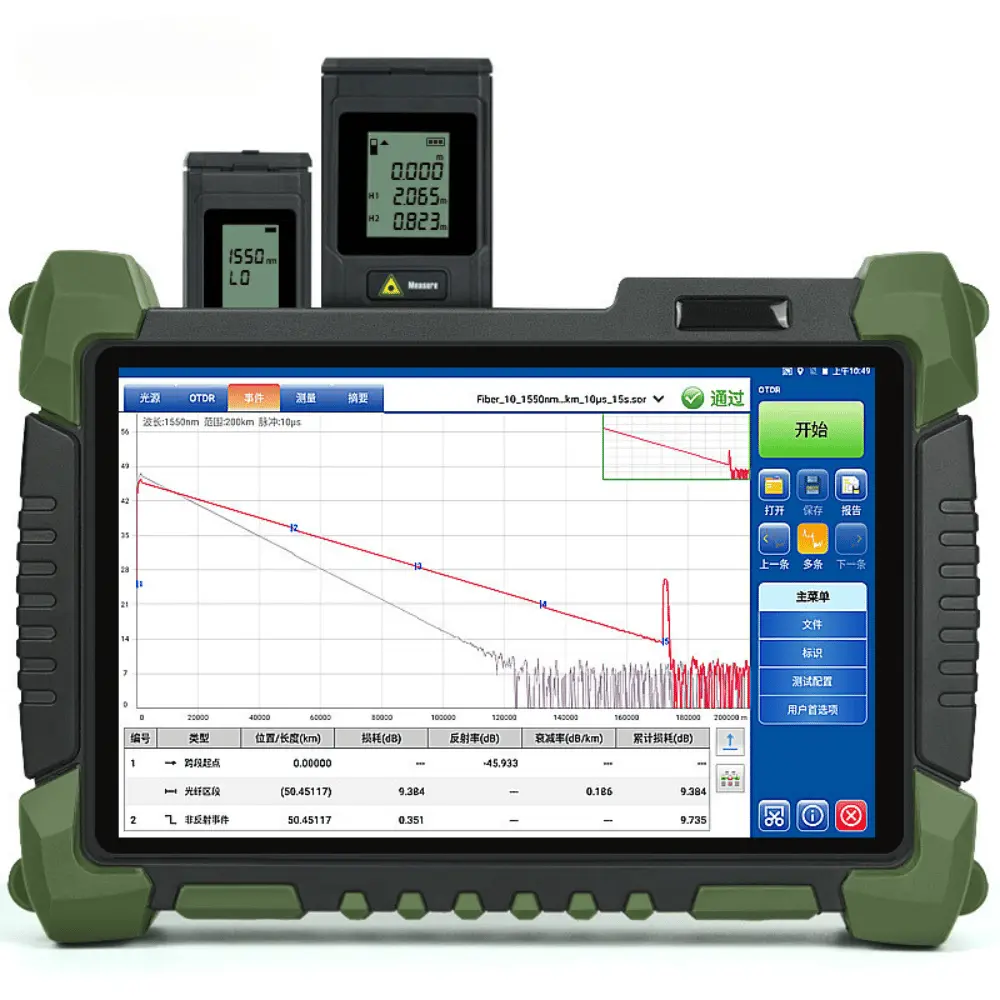





When maintaining or commissioning a fiber optic network, the Optical Time Domain Reflectometer is the primary tool used to assess link quality, detect fiber faults, and verify network integrity. Choosing the correct OTDR test range is essential for achieving precise and efficient results.
Test range directly affects measurement precision, resolution, and signal-to-noise ratio (SNR) — a range that’s too short may miss distant events, while one that’s too long can reduce detail clarity.
This guide uses the TFN RM7 OTDR Tester as an example to explain how to select the optimal test range for three common scenarios.
1. Short-Distance Precision Testing (<5km)
Typical Applications:
Data center jumpers, in-building vertical cabling, and other high-precision testing environments that require locating events at the meter level (e.g., connector degradation, micro-bend losses).
Recommended Settings (TFN RM7):
- Range: Choose ≥ 1.5 × the actual fiber length (e.g., for a 3km fiber, set the range to 5km).
- Pulse Width: Use a narrow pulse (10ns–30ns) — RM7 supports a minimum of 10ns for higher resolution.
- Wavelength: Select 1310nm for short-range testing, as stronger Rayleigh scattering makes fine events more visible.
Pro Tip: Avoid setting the range excessively high for short links — it increases attenuation of narrow pulses and may cause far-end noise to obscure real events.
2. Medium-to-Long Distance Full-Link Analysis (5km–100km)
Typical Applications:
Metropolitan area networks, enterprise backbones, or campus fiber verification where balancing dynamic range and event resolution is key.
Smart Configuration for RM7:
- AutoRange: Automatically selects the optimal range for accurate tracing.
-
Step Pulse Adjustment:
- Use 100ns pulses for the first 10km to locate near-end events precisely.
- Switch to 300ns pulses beyond 10km to improve SNR and view distant reflections.
-
Multi-Wavelength Coordination:
- 1310nm for near-end event detection.
- 1550nm / 1625nm for long-distance attenuation analysis.
3. Ultra-Long-Haul and High-Loss Links (>100km)
Typical Applications:
Transoceanic fiber routes, long-haul backbones, or high-loss environments where maximizing dynamic range and measurement depth is critical.
Advanced Settings for RM7:
- Range Redundancy: Set the range to 2× the actual distance (e.g., 150km → 300km).
- Pulse Width: Use 1μs–10μs (RM7 supports up to 20μs) for stronger backscatter returns.
- Preferred Wavelength: Choose 1625nm, which offers the lowest fiber attenuation coefficient.
- Noise Reduction: Extend testing duration to 180s+ for smoother, more accurate traces.
Based on TFN RM7 test data:
| Link Length | Recommended Range | Pulse Width | Test Time |
| <2km | 5km | 10-30ns | 15s |
| 2-50km | Distance X 1.8 times | 100-500ns | 30-60s |
| >50km | Distance X 2 times | 1μs-10μs | 90-180s |
Expert Tip: The RM7’s multi-wavelength parallel testing feature captures 1310nm / 1550nm / 1625nm data simultaneously, generating a complete full-band analysis report in one operation — ideal for long-distance or multi-span networks.
Common OTDR Setup Mistakes to Avoid
- Setting the range equal to fiber length → May truncate far-end events.
- Using a single pulse width throughout → Causes near-end saturation and high far-end noise.
- Ignoring fiber type → Multimode fibers require 850nm and short pulses (RM7 can auto-detect fiber type).
Key Takeaway: Intelligent Range Matching Is the Real Precision
By precisely matching test range, pulse width, and wavelength, the TFN RM7 Series OTDR achieves event location accuracy within ±0.5 meters, significantly improving diagnostic efficiency.
Just remember that a longer range isn’t always better — smarter, intelligent range matching ensures the best performance in every scenario.