





Power cables are widely used to connect circuits and transmit electricity, and their demand continues to grow with the expansion and upgrading of power grids. However, complex construction, challenging installation environments, and difficult cable joints make cable faults inevitable. As a result, power supply companies and related organizations are increasingly focused on analyzing the causes of cable faults and applying effective solutions.
Types of Cable Faults
Cable faults are generally categorized into three main types:
- Open circuit faults: These occur when the resistance between cables, or between a cable and the ground, is within the expected range, but the voltage cannot fully reach the load, or only a minimal portion is transmitted. Common examples include short circuits and disconnections.
- Low-resistance faults: When the insulation between cables or between a cable and the ground is damaged, insulation resistance decreases. If the resistance drops below ten times the cable’s characteristic impedance, this is classified as a low-resistance fault. Such faults can lead to excessive current, overheating, or even fire.
- High-resistance faults: When the insulation resistance is lower than normal but still higher than ten times the cable’s characteristic impedance, a high-resistance fault occurs. These faults can cause localized heating, insulation breakdown, and other hazards.
Common Methods to Detect Cable Faults
Several methods are commonly used to locate and diagnose cable faults:
- Time Domain Reflectometry (TDR): TDR sends a pulse signal through the cable and measures the time and amplitude of reflected signals to locate faults. It is effective for detecting open circuits, short circuits, low-resistance, and high-resistance faults.
- Impulse High-Voltage Flashover: This method applies high voltage to the cable, causing the fault point to generate a flashover. The resulting sound or light helps identify high-resistance faults, such as insulation breakdown or sheath damage.
- Low-Voltage Pulse Reflection: By sending low-voltage pulses through the cable, reflections or responses at fault points help pinpoint low-resistance faults like short circuits, open circuits, or poor contacts.
- Bridge Method: This technique uses the principle of circuit balance. By adjusting certain components to achieve balance, the properties of the cable can be measured. While precise and convenient, it is unsuitable for high-resistance or flashover faults and requires prior knowledge of cable length.
Different faults require different methods, which is why a comprehensive cable fault testing system is essential. TFN cable fault testers provide an all-in-one solution for identifying and locating cable faults efficiently.
TFN Solution: Cable Fault Testers
TFN cable fault testers consist of four main units: Fault Distance Measurement, Path Finding and Identification, Fault Location, and High-Voltage Signal. Here’s how to use them effectively:
- Prepare and Inspect: Understand the cable’s basic details, including length, type, age, previous faults, joints, and laying method.
- Ensure Safety: Disconnect both ends of the cable from other circuits and ensure it is completely de-energized.
- Discharge the Cable: Connect each phase line to the ground using a short-circuit line before testing. Always ground one end of the short line first.
-
Measure Fault Distance:
- Use the Fault Distance Measurement unit with low-voltage pulse reflection to detect low-resistance or disconnection faults and measure distance.
- Apply high-voltage flashover to detect high-resistance faults.
- The device displays waveform samples and automatically identifies the fault type and location.
- Trace Cable Path: The Path Finding and Identification unit, equipped with an underground pipeline detector, allows precise tracing of the cable route for accurate fault localization.
- Apply High-Voltage Signals: The High-Voltage Signal unit delivers a high-voltage pulse to induce intermittent discharge at the fault point, enabling precise distance measurement and localization.
-
Precisely Locate Faults: The Fault Location unit offers two modes:
- Step Voltage Mode: Ideal for single-phase grounding faults in direct-buried, low-voltage, unarmored cables.
- Acoustic-Magnetic Mode: Detects discharge sounds to subjectively determine the exact fault position.
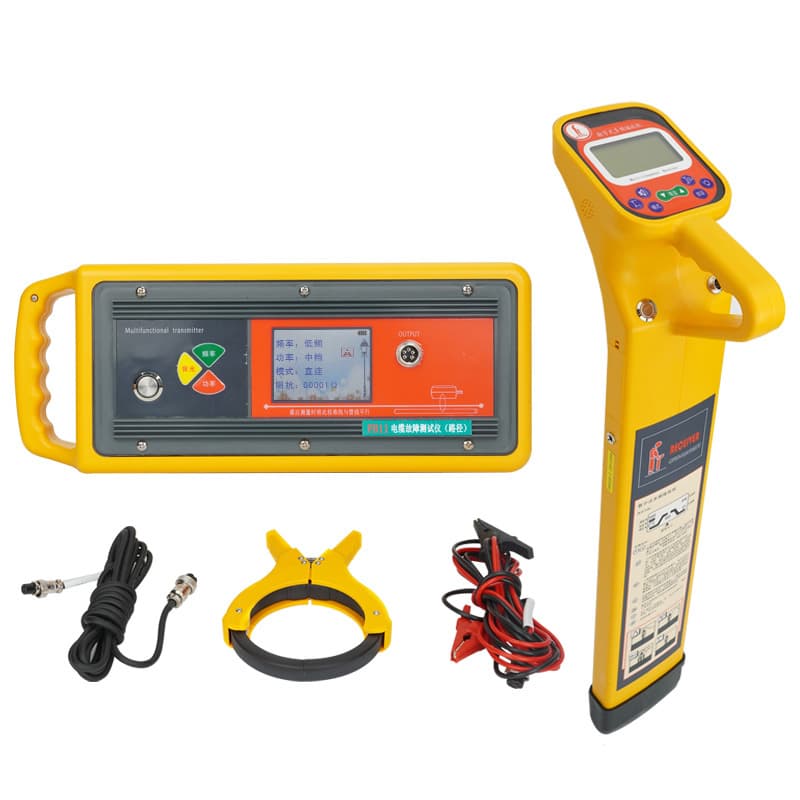
TFN cable fault testers can handle high- and low-resistance faults on all cables up to 35KV. With intuitive software, tutorials, high detection success rate, and accurate measurements, these cable fault testers are a reliable choice for power utilities and maintenance teams.