





In modern fiber optic network construction and maintenance, fiber optic fusion splicers play a vital role. Their job is to align and fuse two optical fibers so that light can pass through with minimal signal loss. Achieving this seamless connection requires extremely precise positioning, and the key technology behind it is the motor system inside the fusion splicer.
Today’s mainstream fusion splicers fall into two categories: Four-Motor splicers and Six-Motor Splicers. These two types differ significantly in alignment precision, performance, and suitable application scenarios.
The Core of Fusion Splicing: Precision Alignment
While the operating principle of a fusion splicer seems simple, the process demands highly accurate control. A typical splicing workflow includes:
- Fiber preparation
The coating is removed using a precision stripper, and a cleaver produces a smooth, perpendicular end face. - Fiber core alignment
The processed fibers are fixed in left and right V-grooves. Alignment accuracy at this stage determines the final splice loss. - Fusion and fiber advancement
The motor system moves the fibers along X, Y, and Z axes until their cores overlap precisely. The electrodes then release a high-voltage arc to melt the fiber ends, and the motors push the fibers together to complete the splice. - Protection
A heat-shrink sleeve reinforces the joint.
Throughout the process, the biggest challenge is compensating for fiber geometry variations such as core eccentricity and out-of-roundness. The number and precision of the motors directly determine the alignment capability of the splicer.
Four-Motor vs. Six-Motor Splicers: Key Differences
The essential difference between the two types lies in how many axes they drive and how they perform alignment.
Four-Motor Splicers
Four-Motor splicers typically use an XY single-side drive. The left fiber remains fixed. Two motors move the right fiber in the X and Y directions for alignment. Two additional motors control Z-axis movement for both fibers. Only one fiber moves while the other stays stationary. This design is simpler and more cost-effective.
Four-Motor splicers provide reliable performance for:
- Standard single-mode fibers (SMF)
- Common multimode fibers (MMF)
They deliver dependable splice results as long as the fiber geometry is well-controlled.
Six-Motor Splicers
Six-Motor Splicers use an XY dual-side drive system. Both fibers have independent X and Y movement. Two additional motors control Z-axis propulsion. Both fibers move actively, allowing the system to compensate for:
- Core eccentricity
- Geometry variations
- Small bending radius fiber challenges
This results in true core-to-core alignment.
Six-Motor Splicers achieve significantly higher alignment accuracy and are ideal for low-loss or specialty fiber applications, often achieving splice losses ≤0.02 dB.
Comparison Table
| Key Features | Four-Motor Splicers | Six-Motor Splicers |
|---|---|---|
| Motor System | XY single-side drive + Z | XY dual-side drive + Z |
| Alignment Mode | One fiber moves | Both fibers actively align |
| Precision | Standard accuracy | Highest precision, ultra-low loss |
| Suitable Fibers | Standard SMF, common MMF | Standard SMF, specialty fibers, tight-bend fibers |
| Typical Loss | Meets general requirements | Easier to achieve ≤0.02 dB |
How to Choose the Right Splicer?
Modern fusion splicers offer far more than basic splicing. Advanced six-motor models usually include:
- Intelligent end-face inspection
- Dust detection and cleaning reminders
- Pre-loaded splicing programs for G.652.D, G.657.A1/A2/B3, OM3/OM4/OM5
- Long-lasting battery capacity for field use
- Fast heating for protection sleeves
Choosing the right splicer depends on your project needs:
Scenario 1: FTTH Access Networks / Standard LAN
Applications:
Majorly G.652.D standard SMF
Acceptable loss typically <0.05 dB
Recommended:
Four-Motor splicer (e.g., TFN S3)
Cost-effective and efficient for high-volume FTTH deployment.
Scenario 2: Long-Haul Backbone, Metro Networks, DCI
Characteristics:
Long-distance transmission
Extremely strict loss requirements (<0.03 dB or even <0.02 dB)
Possible use of G.654.E or specialty fibers
Recommended:
Six-Motor Splicer
Essential for ultra-low-loss and high-capacity systems.
Scenario 3: Complex Construction Environments
Common fibers:
G.657.A2/B3 tight-bend fibers
Fibers with greater geometric tolerance challenges
Recommended:
Six-Motor Splicer
Handles difficult fibers more accurately.
Scenario 4: Multimode Fiber Applications
Use case:
Short-reach, high-speed data center connections
OM4, OM5 wideband multimode fibers
Recommended:
Six-Motor Splicer
Provides the precision needed for optimal modal bandwidth.
Professional Recommendation: TFN S5 Six-Motor Splicer
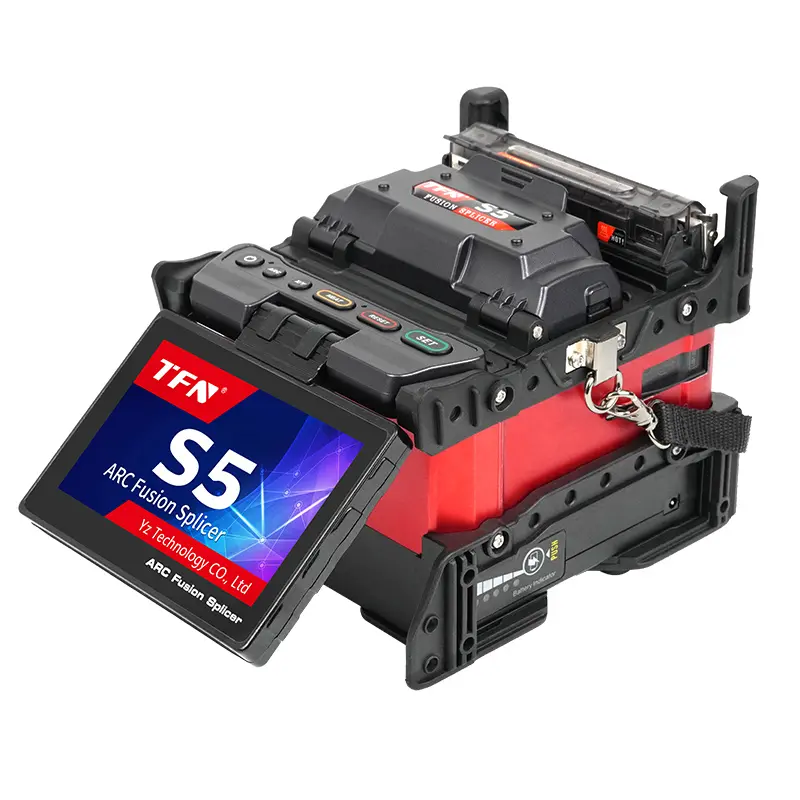
The TFN S5 represents the advantages of Six-Motor Splicers at a high level.
It combines:
A full six-motor core alignment system
High-resolution optical imaging
Intelligent alignment algorithms
Typical splice loss ≤0.02 dB
Lightweight body (~300 g)
Over 500 splicing/heating cycles per charge
A clear and intuitive UI
These features make it ideal for:
5G fronthaul
Backbone network upgrades
High-speed data center interconnects
Conclusion
Motor count is one of the most important factors when choosing fiber optic fusion splicers.
Four-Motor splicers offer reliability and great value for FTTH and general network builds.
Six-Motor Splicers provide superior precision for backbone networks, data centers, and specialty fiber applications.
Understanding the fiber type and project requirements will help you select the right tool and ensure a stable, low-loss, high-performance optical network. Hope this article help you.