





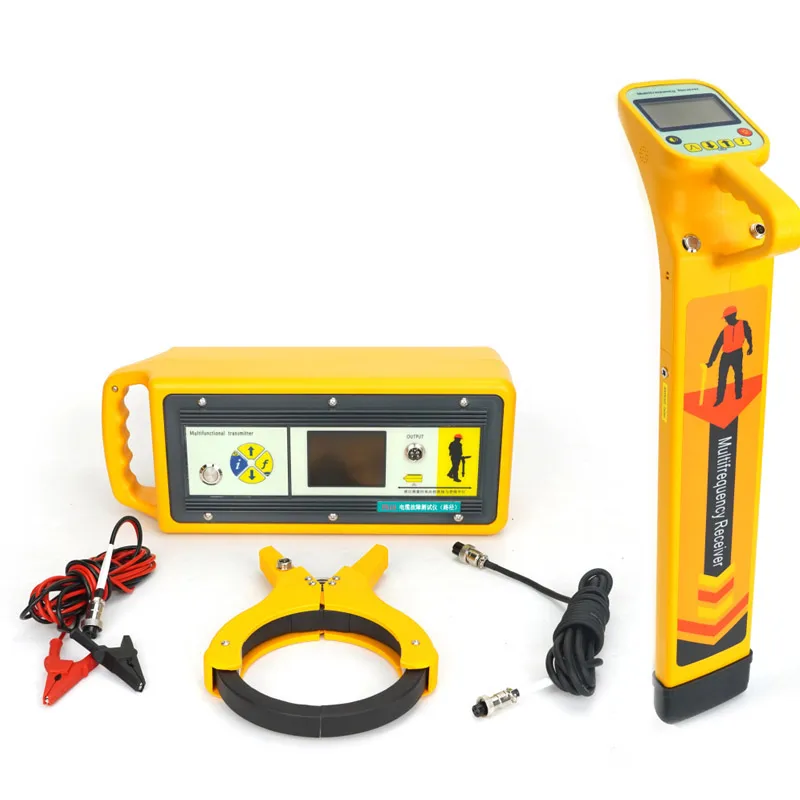
As an engineer involved in the development of the TFN FB18 Cable Fault Tester Distance Measuring Host, I am well aware that Time Domain Reflectometry (TDR) serves as the core technical foundation for pre-locating power cable faults. However, in practical engineering applications, the choice between the Low-Voltage Pulse Method (LVP) and the High-Voltage Flashover Method (HVF)—both branches of TDR technology—is not simply a matter of “which one is better.” Instead, it is a systematic trade-off involving fault characteristics, site conditions, and measurement accuracy. This article examines the physical principles and applicable scenarios of both methods from an R&D perspective, using the actual design logic of the TFN FB18 cable fault test system as a case study to explore how a cable fault tester achieves mode collaboration on a single hardware platform.
Time Domain Reflectometry—The Common Foundation of Both Methods
Whether using the low-voltage pulse or the high-voltage flashover method, the ranging principle is based on the fundamental TDR equation:
L= v × t / 2
Where L is the fault distance, v is the propagation velocity of the electromagnetic wave in the cable, and t is the time difference between the transmitted pulse and the reflected pulse. The velocity v is determined by the dielectric constant of the cable—a non-linear system error that any cable fault location mainframe must eliminate through wave velocity calibration [1].
In the design of the TFN FB18, the TDR engine supports a maximum sampling rate of 200 MHz and a reading resolution of 1 meter. The underlying logic employs adaptive pulse width matching for different ranges—this is the foundation that enables the low-voltage pulse method and the high-voltage flashover method to share the same receiving front end.
Low-Voltage Pulse Method—”Snapshot” Location of Low-Resistance Faults
Physical Principles and Waveform Characteristics
The low-voltage pulse method injects a low-amplitude (typically ±5V), width-adjustable (0.05μs–8μs) pulse signal into the cable and directly captures the reflection generated at impedance discontinuities. For an open circuit fault, the reflection coefficient is positive, and the waveform shows a rising step in the same direction; for a short circuit fault or low-resistance ground fault, the reflection coefficient is negative, and the waveform exhibits a reverse drop.
The TFN FB18 cable fault test system provides seven pulse width options in low-voltage pulse mode. The design logic is: short pulse widths (0.05μs) are used for high-resolution ranging over short distances, while long pulse widths (8μs) compensate for energy loss in long cables up to 50 km. This parameter linkage mechanism directly influences the practical engineering realization of cable fault tester accuracy.
Applicable Test Scenarios and Equipment Requirements
The greatest advantage of the low-voltage pulse method is that it requires no high-voltage source. As stated in Section 6.1 of the TFN FB18 user manual: “When using the low-voltage pulse method to test cables for low-resistance grounding, short circuits, and open circuits, no other auxiliary equipment is required. The test leads can be connected directly to the faulty phase conductor and the cable’s outer sheath ground conductor” [3]. This characteristic makes it the preferred method for cable path identification, length verification, and open circuit location. It is also the design basis that enables a built-in power supply cable fault tester to operate continuously for more than three hours in environments without mains power.
High-Voltage Flashover Method—The Only Path to Overcoming High-Resistance Faults
Physical Mechanism of the Impulse Flashover Method and Sampling Challenges
When the insulation resistance at the fault point exceeds several hundred ohms or even reaches the megohm level, the low-voltage pulse method fails to detect effective echoes due to an extremely low reflection coefficient. In such cases, the high-voltage flashover method (also known as the impulse flashover method) must be employed: a high voltage signal generator applies DC high voltage to the cable until the fault point breaks down, instantly generating a steep traveling wave signal.
This process involves two key physical events: first, the voltage step caused by ionization breakdown at the fault point; second, the round-trip propagation of this traveling wave between the fault point and the test end. The TFN FB18 extracts the traveling wave signal from the ground wire via magnetic coupling using an external current sampler. Its protection circuit must withstand transient current surges of nearly several hundred amperes—Section 7.3 of the manual specifically warns: “If the flashover mode is mistakenly selected as low-voltage pulse mode, the instrument’s internal pulse output will short-circuit with the external high-power flashover signal, causing malfunction or even damage”.
“Dimensionality Reduction” in Waveform Interpretation
A long-standing criticism of the traditional high-voltage flashover method is the complexity of its waveforms: due to the nonlinear characteristics of the arc, multiple reflections, and variations in coupling methods, beginners are prone to misjudgment. A core technological breakthrough of the TFN FB18 is its normalization of high-resistance fault waveforms to resemble low-voltage pulse short-circuit fault waveforms. As stated in Section 3.8 of the manual: “All high-resistance fault waveforms are of a single type, similar to the short-circuit fault waveform used in the low-voltage pulse method”. This design significantly reduces the experience threshold required for cable fault waveform interpretation, enabling high resistance fault location without relying solely on the visual discrimination of senior engineers.
Method Comparison—The Engineering Logic of TDR Path Selection
| Comparison Dimension | Low-Voltage Pulse Method | High-Voltage Flashover Method |
| Applicable Fault Types | Low resistance (<200Ω), short circuit, open circuit | High-resistance leakage, flashover, insulation deterioration |
| Signal Source | Built-in pulse generator | External high-voltage generator + energy storage capacitor |
| Reflection Mechanism | Active transmission, reflection at impedance mismatch | Passive triggering, traveling wave generated by fault breakdown |
| Waveform Characteristics | Single reflection, clear polarity | Damped oscillation, requires wavefront extraction |
| On-Site Complexity | Standalone operation, completed within 5 minutes | Requires connection to high-voltage equipment, strict grounding requirements |
| Measurement Accuracy | ±0.5m (1m resolution) | Affected by wave velocity calibration; usually verified with a locator |
From an R&D perspective, the coexistence of the two methods in the TFN FB18 is not merely a functional stack. It represents a high degree of reuse across the sampling front end, power management, and waveform algorithms. For example, the sampling rate of 200 MHz serves both the narrow pulse sampling of the low-voltage pulse method and the transient capture of the high-voltage flashover method; the waveform zoom and scroll functions uniformly handle local detail extraction for both data types.
Field Case Study—An On-Site Decision Tree for Method Selection
Consider a fault in a 10 kV cross-linked polyethylene cable:
- Scenario A: An insulation resistance tester shows 15 Ω to ground on phase A. The cable fault tester is switched directly to low-voltage pulse mode. With a 1 μs pulse width, a clear negative reflection is displayed. Cursor positioning indicates 327 m. Excavation verifies the fault at 329 m. Absolute error: 2 m.
- Scenario B: Insulation resistance is 500 MΩ, and the cable breaks down at 3 kV during a withstand voltage test. The system is switched to high-voltage flashover mode. The sphere gap is adjusted to 1.5 mm (breakdown voltage approximately 4.5 kV). The TFN FB18 captures the waveform on the third flashover, automatically displaying a fault distance of 512 m. Subsequent verification using an acoustic-magnetic synchronous locator confirms 515 m.
This case illustrates the core logic of cable fault diagnosis: the low-voltage pulse method resolves 80% of low-resistance faults, while the high-voltage flashover method covers the remaining 20% of high-resistance problems—together forming a complete closed loop for fault pre-location.
Conclusion: From Tool Thinking to Systems Thinking
The essence of cable fault testing is not a contest of superiority between individual technologies, but rather the alignment of fault characteristics with measurement methods. By transforming high-voltage flashover waveforms into low-voltage-pulse-like patterns, the TFN FB18 distance measuring host significantly reduces the learning curve for cable fault tester operation while preserving the traditional impulse flashover method’s capability to address high-resistance faults. In the future, as machine learning in TDR waveform analysis advances, the boundaries between these two methods may further blur—but for now, understanding their fundamental distinctions remains a prerequisite for engineers to select the appropriate approach and troubleshoot efficiently.
If you want to know more knowledge of the principle of cable fault tester or want to know more about TFN FB18 Cable Fault Tester, welcome to contact TFN Support Team:
Email: info@tfngj.com
WhatsApp: +86-18765219251
Or you can leave messages Here