




When choosing an OTDR (Optical Time Domain Reflectometer), most people focus on dynamic range, test distance, or wavelength. However, one specification that is often overlooked—but can greatly affect measurement accuracy—is the OTDR dead zone.
If you’re new to fiber optic testing, this guide explains what an OTDR dead zone is, why it happens, how it affects your measurements, and how to minimize it.
What Is an OTDR Dead Zone?
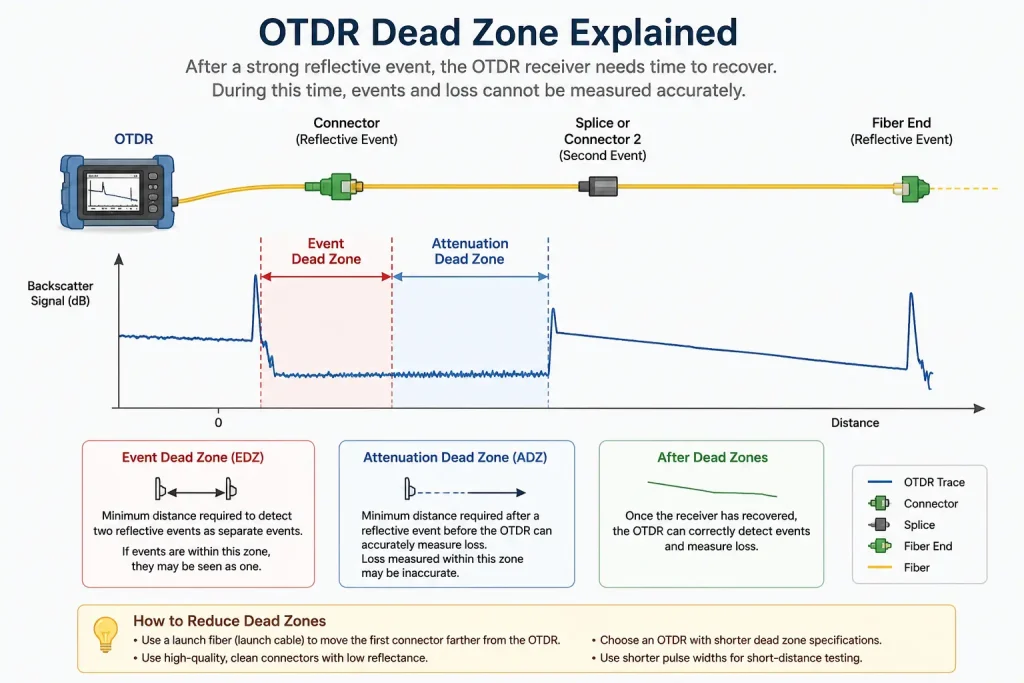
Simply put, an OTDR dead zone is the section of fiber that the OTDR cannot accurately measure immediately after a strong reflective event.
A simple analogy:
Think about your eyes. You can clearly see objects in the distance, but if something is extremely close to your face, it becomes difficult to focus on.
An OTDR works in a similar way. Events occurring very close to the OTDR’s launch point can be difficult—or even impossible—to distinguish accurately.
Why Does an OTDR Dead Zone Occur?
An OTDR works by:
- Launching a pulse of light into the fiber
- Receiving the light that is reflected and scattered back
- Analyzing the returned signal to determine the location and condition of events along the fiber
The problem begins when the OTDR encounters a highly reflective event, such as:
- Fiber connectors
- Mechanical splices
- Fiber end faces
- Highly reflective interfaces
These reflections generate an extremely strong optical signal.
As a result:
- The OTDR receiver becomes temporarily saturated.
- The detector needs a short recovery time.
- During this recovery period, weaker returning signals cannot be detected accurately.
- The fiber section corresponding to this recovery time becomes the dead zone.
Two Types of OTDR Dead Zones
Understanding the difference between the two dead zones is essential when comparing OTDR specifications.
1. Event Dead Zone
Définition
The minimum distance required for the OTDR to distinguish two closely spaced reflective events as separate events.
In simple terms
How far after one connector or splice must another event be before the OTDR can recognize them as two different events?
Why it matters
A shorter event dead zone allows the OTDR to:
- Detect closely spaced connectors
- Identify multiple splices
- Test short fiber links more accurately
- Analyze high-density fiber installations
Smaller is better.
2. Attenuation Dead Zone
Définition
The minimum distance after a reflective event before the OTDR can accurately measure fiber attenuation (loss).
In simple terms
How far after a connector or reflective event must the fiber continue before the OTDR can calculate insertion loss correctly?
Why it matters
A shorter attenuation dead zone provides more accurate loss measurements near the beginning of the fiber.
Again, smaller is better.
Why Does Dead Zone Matter in Real Applications?
A large dead zone can hide important problems, especially near the beginning of the fiber link.
Common issues include:
- Faults in patch cords or launch fibers
- Problems inside fiber distribution frames (ODF)
- Connectors that are too close together to distinguish
- Small bends or breaks near the OTDR connection
- Inaccurate loss measurements close to the fiber entrance
In other words, a test report may appear normal while critical faults remain undetected.
How to Reduce OTDR Dead Zone
Fortunately, there are several practical ways to minimize the impact of dead zones.
1. Use High-Quality Connectors and Patch Cords
Clean, low-reflectance connectors significantly reduce reflected power and improve measurement quality.
2. Use a Launch Fiber (Launch Cable)
This is the most common and effective solution.
A launch fiber (also called a launch cable, pulse suppressor fiber, or dead zone eliminator) moves the first connector away from the OTDR, allowing the receiver sufficient time to recover before measuring the fiber under test.
3. Choose an OTDR with Shorter Dead Zone Specifications
Premium OTDRs feature:
- Faster optical receivers
- Higher-speed electronics
- Advanced signal processing
- Intelligent measurement algorithms
These technologies significantly reduce both event and attenuation dead zones, making it easier to inspect short links, FTTH networks, and data center cabling.
4. Use Shorter Pulse Widths and Appropriate Test Settings
Shorter pulse widths generally improve spatial resolution and reduce dead zones, making them ideal for short-distance fiber links. The trade-off is a lower dynamic range, so pulse width should be selected according to the application.
5. Keep Fiber End Faces Clean
Dust, oil, or contamination increases reflections, enlarges dead zones, and may even damage connectors. Always inspect and clean connectors before testing.
OTDR Dead Zone FAQs
Yes. A shorter dead zone allows the OTDR to detect events closer together and improves measurement accuracy near the beginning of the fiber.
Event Dead Zone: Determines whether two nearby events can be identified separately.
Attenuation Dead Zone: Determines where accurate loss measurement can begin after a reflective event.
No. A launch cable cannot eliminate the OTDR’s internal dead zone, but it effectively shifts the measurement start point so that the fiber under test is outside the dead zone, enabling accurate measurement of the first connector and nearby events.
Final Thoughts
Understanding the OTDR dead zone is essential for obtaining reliable fiber optic test results. A shorter dead zone means better resolution, more accurate loss measurements, and improved fault detection—especially in FTTH, data centers, enterprise networks, and other short or high-density fiber installations.
When comparing OTDRs, don’t look only at dynamic range. Be sure to compare event dead zone and attenuation dead zone specifications as well. These parameters often determine whether your OTDR can detect the faults that matter most.