




As metropolitan area networks and IP backbone networks continue to expand, performance validation of network equipment and links has become a core task in the daily operations of communications engineers. Whether it is acceptance testing for newly deployed networks or troubleshooting existing ones, the lack of standardized testing methods often leads to biased results and disputes over responsibility. RFC2544 was developed precisely to address this issue and has since become an internationally recognized benchmark testing methodology. This article will explore the four core dimensions of RFC2544 testing and their engineering value from a practitioner’s perspective, using the TFN T3000A 10G Ethernet tester as a reference.
What Is the RFC2544 Testing Standard
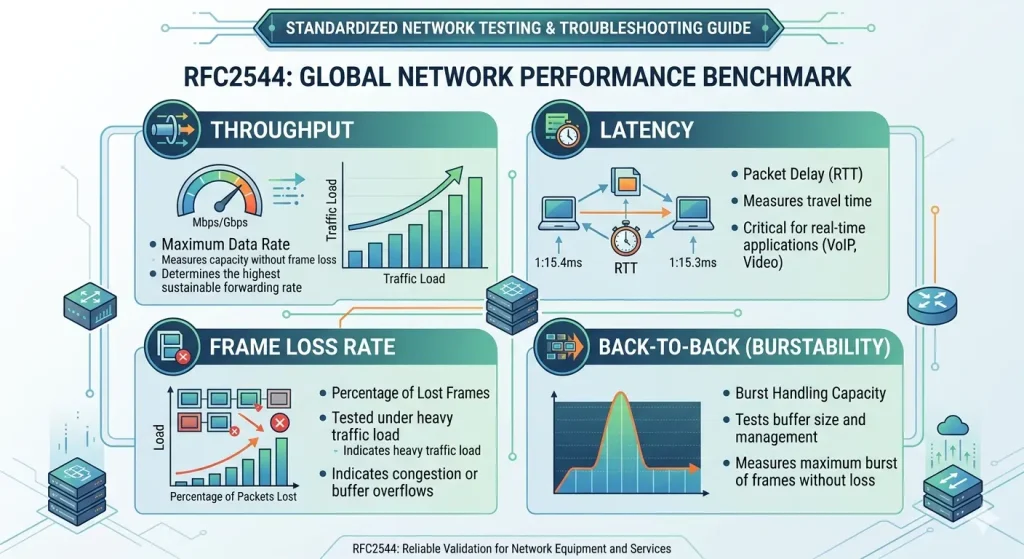
RFC2544 is a performance testing benchmark for network equipment developed by the Internet Engineering Task Force (IETF), first defined in 1999 [1- IETF RFC 2544-1999]. The standard specifies four key metrics: throughput, latency, frame loss rate, and back-to-back burst, aiming to provide repeatable and comparable performance evaluation methods for equipment from different vendors. For field engineers, RFC2544 testing is not only a prerequisite for network equipment acceptance but also a fundamental guarantee for meeting network Service Level Agreements (SLAs).
Engineering Interpretation of the Four Testing Dimensions
Throughput Testing: Determining Maximum Carrying Capacity
Throughput is defined as the maximum data rate at which a device can forward frames without any loss. In practice, engineers typically use a binary search approach: transmitting at line rate, then reducing the rate if frame loss occurs until the loss-free threshold is found. The TFN T3000A Ethernet tester supports automatic throughput discovery at 10G line rates, allowing engineers to set the maximum rate, resolution, and duration. After the test, the system directly outputs the maximum forwarding rate for various frame sizes. This data directly determines the actual usable bandwidth ceiling of the network.
Latency Testing: Measuring Data Forwarding Efficiency
Latency testing measures the time it takes for a data frame to travel from the ingress to the egress port. For store-and-forward devices, latency is defined as the time interval from when the last bit of a test frame arrives at the input port to when the first bit leaves the output port. The TFN T3000A supports multiple latency measurement modes defined in RFC2544, presenting results in milliseconds that can be compared against preset thresholds. This metric is critical in latency-sensitive applications such as VoIP or financial trading.
Frame Loss Testing: Assessing Stability Under Congestion
Frame loss testing observes the device’s behavior during overload by gradually reducing the transmission rate. Engineers can set the starting rate, step size, and duration, with the system automatically calculating the frame loss percentage at each rate. The TFN T3000A displays frame loss test results in a clear table, helping engineers quickly identify the device’s overload threshold and providing data support for network rate-limiting strategies.
Back-to-Back Testing: Verifying Buffering Capacity
Back-to-back testing (burst testing) measures the maximum number of burst frames a device can process without dropping frames. This test simulates common burst traffic scenarios in networks, such as video keyframes or TCP acknowledgment bursts. The TFN T3000A supports burst durations of up to 5 seconds, presenting results in terms of frame count—a key metric for evaluating device buffering capacity.
Practical Testing Workflow with the T3000A
In practice, engineers begin by completing basic configurations such as port speed and IP addresses through the T3000A’s interface setup module. The device supports 10/100/1000BASE-T electrical ports, 100/1000BASE-X SFP optical ports, and 10GE SFP+ optical ports, covering testing requirements from 100 Mbps to 10 Gbps. In the RFC2544 test configuration interface, engineers need to sequentially configure frame type selection (supporting Ethernet, UDP, MPLS-TP), VLAN/MPLS layer settings, selection of test sub-items, and parameters such as rate, duration, and threshold for each sub-item. The T3000A supports saving common configurations as preset files, significantly improving testing efficiency for repetitive tasks.
During test execution, the T3000A’s touchscreen interface displays the progress and pass/fail status of each sub-item in real time. Upon completion, the system automatically generates PDF or HTML reports containing detailed test data, facilitating archiving or submission. Additionally, the device integrates remote loopback control functionality. When a remote device is required for coordination, engineers can directly control a remote T3000A to enter loopback mode via IP address, enabling single-ended testing.
Evolution of Testing Standards and the T3000A’s Expanded Capabilities
It is worth noting that while RFC2544 is a classic benchmark, its testing process interrupts normal traffic, leading to the gradual adoption of the ITU-T Y.1564 standard for service activation scenarios. Y.1564 can validate SLA parameters for multiple services simultaneously without interrupting traffic. The TFN T3000A supports both RFC2544 and Y.1564 standards, and also features built-in BERT bit error rate testing, multi-stream traffic generation, intelligent discovery, and other functions, providing engineers with a comprehensive testing toolkit spanning traditional TDM to modern IP networks.
Conclusion
For communications engineers, RFC2544 represents not just a set of testing instructions, but a rigorous engineering mindset. It replaces subjective speculation in performance evaluation with quantifiable metrics, establishing a unified yardstick for network planning, acceptance, and troubleshooting. Professional Ethernet testers like the TFN T3000A, which integrate multiple testing standards with user-friendly operation, enable engineers to focus on problem-solving rather than cumbersome test configurations. In the era of ubiquitous connectivity, relying on standardized testing tools is the only way to build truly reliable network foundations.
If you want to know more about RFC2544 test standard and Testeur TFN T3000A 10G Ethernet, Vous pouvez contacter l'équipe d'assistance du TFN :
Courriel : info@tfngj.com
WhatsApp : +86-18765219251
Ou vous pouvez leave messages here
Questions fréquemment posées
RFC2544 is a performance testing benchmark developed by the IETF for network interconnect devices. It provides a standardized methodology for evaluating equipment from different vendors using four key metrics: throughput, latency, frame loss rate, and back-to-back bursts. It is the industry’s go-to standard for network acceptance and SLA verification.
Débit : The maximum data rate a device can forward without dropping any frames.
Temps de latence : The time it takes for a frame to travel through the device (critical for VoIP and high-frequency trading).
Taux de perte d'images : The percentage of frames a device drops during periods of heavy traffic.
Back-to-Back (Burst): The maximum number of frames a device can handle at full line rate in a single burst without loss.
While RFC2544 is the classic benchmark for device performance, it is an “out-of-service” test that interrupts traffic. ITU-T Y.1564 was developed for modern service activation; it allows for simultaneous testing of multiple services (like data, voice, and video) and can validate QoS (Quality of Service) parameters without completely halting traffic. Professional tools like the TFN T3000A typically support both standards.
Efficiency in the field is best achieved by using testers with “Auto-Discovery” and “Remote Loopback” features. For example, the TFN T3000A allows engineers to control a remote unit via IP, enabling single-ended testing of a complete link. Preset configuration files and automated PDF/HTML report generation also significantly reduce the time spent on manual setup and documentation.