





In the field of urban infrastructure construction and maintenance, the accuracy of underground pipeline detection directly impacts project safety and construction efficiency. As a communication engineer with extensive field experience, I understand that the technical core of any advanced underground pipe locator lies in the precise coordination of signal transmission and reception. Among all operational points, one is most fundamental and critical: the frequency of the receiver must be strictly consistent with that of the transmitter. This article will use the TFN A1500 underground pipe locator as an example to delve into how, through the coordinated work of signal transmission and reception, the precise direction and burial depth of underground metal pipelines can be determined.
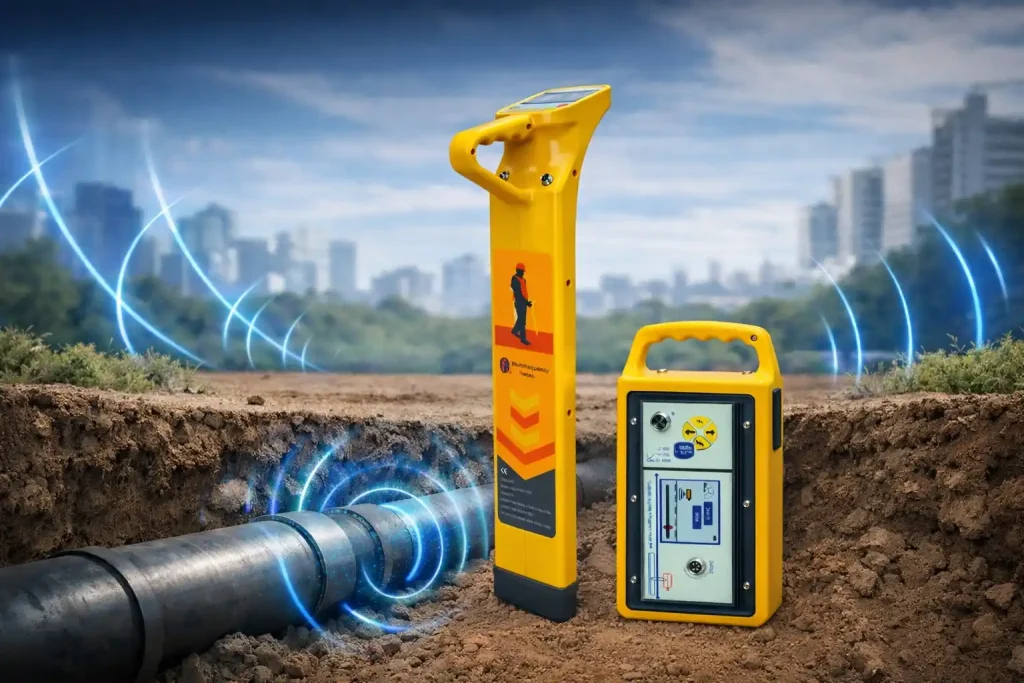
Electromagnetic Induction: The Physical Foundation of Pipeline Detection
From the perspective of communication principles, the essence of pipeline detection lies in the establishment and analysis of electromagnetic fields. When a transmitter applies an AC signal of a specific frequency to the target pipeline, according to Faraday’s law of electromagnetic induction, an electromagnetic field of the corresponding frequency is generated around the current-carrying conductor. The receiver of an underground pipe locator captures this magnetic field through its built-in antenna and converts it into a readable electrical signal. Research indicates that the accuracy of pipeline detection depends not only on the transmission power but also critically on the matching degree of the transmitting and receiving frequencies.
The TFN A1500 strictly adheres to this principle. Its transmitter can output various frequencies including 577 Hz, 8 kHz, 33 kHz, 82 kHz, and 133 kHz. In practical operation, if the frequency set on the receiver does not match the transmitter’s frequency, it will be unable to correctly demodulate the target signal, leading to data deviation or even complete loss of the pipeline’s position. This is the fundamental reason why frequency consistency is so important.
Transmission Modes and Frequency Selection: The Art of Signal Injection
As field engineers, our primary concern is how to effectively “inject” the signal into the target pipeline. The TFN A1500 offers three coupling methods, and regardless of the method chosen, the frequency selection directly determines the success or failure of the underground pipe locator’s detection.
Direct Connection Method: The Preferred Choice for Strong Signals
The direct connection method provides the strongest signal application. Connect the red clip to the exposed point of the target pipeline and the black clip to an independent grounding electrode. The transmitter then automatically detects the loop impedance (optimally 1-3000Ω) to ensure output matching. The operator must select the appropriate frequency based on the pipeline’s length and burial depth—low frequencies (e.g., 577 Hz) are suitable for long-distance tracking, while high frequencies (e.g., 33 kHz) can be used for short-distance precise positioning.
Coupling and Induction Methods: Non-Contact Detection
When direct connection is not feasible, the coupling clamp or induction mode becomes crucial. The coupling clamp acts like a transformer, coupling the signal onto a live cable, enabling identification without a power outage—a vital feature for ensuring urban power supply safety. The induction method relies entirely on the transmitter’s built-in antenna radiating electromagnetic waves underground, inducing a secondary magnetic field in the target pipeline for positioning.
It is worth noting that regardless of the mode used, the operator must ensure the frequency selected on the receiver is exactly the same as the transmitter’s output frequency—this is a prerequisite for the equipment to function correctly.
Frequency Consistency: The First Rule of Receiver Operation
Throughout the equipment operation, frequency consistency is paramount. The TFN A1500 receiver features a dedicated frequency key on its panel, allowing cyclic selection of 50 Hz, 577 Hz, 815 Hz, 8 kHz, 33 kHz, 65.5 kHz, 82 kHz, and 133 kHz. The default power-on frequency is 577 Hz. This means if the transmitter is operating at 82 kHz, the operator must manually adjust the receiver to 82 kHz.
This adjustment, while seemingly simple, is often a point of field error. When frequencies are mismatched, the receiver cannot recognize the specific signal emitted by the transmitter. The numerical values displayed on the screen might originate from environmental interference sources, leading to misjudgment. Modern detection techniques emphasize multi-frequency verification and multi-antenna arrays to suppress noise, but the prerequisite remains: the transmitter and receiver must “speak the same language.”
The TFN A1500’s blind test preparation phase also reflects this principle: the operating instructions explicitly state that after the transmitter selects 82 kHz or 133 kHz, the receiver must “select the frequency corresponding to the transmitter” before gain adjustment and baseline setting. This is the starting point for all subsequent operations and cannot be ignored.
Signal Tracing and Depth Measurement: Practical Verification of Frequency Consistency
The importance of frequency consistency is evident throughout the pipeline tracing process. Using the peak mode as an example, the signal is strongest, and the sound is loudest when the receiver is directly above the pipeline. The operator can confirm the pipeline’s direction by moving left/right and rotating—but this all relies on the receiver correctly receiving the target signal.
Depth measurement similarly depends on frequency matching. The TFN A1500 supports direct depth reading and can be verified using the 80% method. When the receiver is directly above the pipeline with the body vertical, the system calculates the burial depth in real-time by comparing field strength differences at various heights. If the frequencies are mismatched, the depth reading becomes meaningless.
In practical engineering, we make it a habit to immediately check the receiver’s settings after each transmitter frequency adjustment, ensuring both are synchronized. This is not just respect for the equipment, but responsibility for project quality.
Conclusion
Underground pipeline detection is not a simple “point-and-locate” task; it is a systematic engineering effort based on electromagnetic field theory, signal processing, and field experience. The TFN A1500 provides communication engineers with reliable technical support through its flexible transmission modes, multi-frequency selection, and intelligent receiving algorithms. However, no matter how advanced the equipment, the “iron law” of frequency consistency must never be violated—it is the foundation for the coordinated work of signal transmission and reception and the first line of defense ensuring detection accuracy.
Si vous êtes intéressé par TFN A1500 Underground Utility Locator, Vous pouvez contacter l'équipe d'assistance du TFN :
Courriel : info@tfngj.com
WhatsApp : +86-18765219251
Ou vous pouvez laisser des messages Ici
FAQ
An underground pipe locator is a specialized device used to detect and trace buried metal pipelines or cables. It works by transmitting and receiving signals to measure electromagnetic field variations, helping determine the pipeline’s route and depth. The TFN A1500 is a high-precision locator suitable for urban infrastructure construction and maintenance.
If the receiver frequency does not match the transmitter, it cannot correctly demodulate the signal from the pipeline. This can lead to inaccurate readings or complete signal loss. Frequency consistency is the core requirement for reliable signal transmission and reception.
It operates on electromagnetic induction principles. The transmitter injects an AC signal of a specific frequency into the target pipeline, creating a corresponding electromagnetic field. The receiver captures this field through its antenna and converts it into readable data, showing the pipeline’s location and direction. Frequency matching between transmitter and receiver is crucial for accurate detection.
Yes. The A1500 pipe locator provides real-time depth measurement, verified using the 80% method or peak mode. Frequency consistency is essential; mismatched frequencies will result in inaccurate depth readings.
Key practices to ensure accuracy:
1. Always check that transmitter and receiver frequencies match.
2. Select the appropriate signal transmission mode.
3. Perform multi-frequency verification to minimize interference.
4. Use peak mode or multi-angle measurements to confirm pipeline direction.