





As an engineer who has been deeply involved in network test instrument R&D for years, I am often asked by our distributors and frontline maintenance personnel the same question: “Should I choose the portable T200K or the fully-featured T6300A?”
This is indeed a topic worth exploring in depth. The TFN product line covers a wide range of needs, from entry-level to professional. The T200K Gigabit Ethernet Tester et le T6300A Network Comprehensive Tester perfectly represent our ultimate pursuits in two directions: “specialized precision” and “versatile mastery”.
Today, I won’t delve into obscure circuit designs or complex underlying code. Instead, I’ll analyze these two devices purely from the dual perspectives of an R&D engineer and a user, helping you figure out which Ethernet tester is better suited for your work scenarios.
T200K: The Ultimate “Palm-Sized Network Doctor”
If you are an engineer primarily responsible for the activation and maintenance of metro networks or enterprise networks, the T200K is likely to become a handheld Ethernet tester you won’t want to put down.
Our original intention in designing the T200K was to solve the pain point of “carrying bulky equipment for packet capture.” Its dimensions are only 190x130x65mm, weighing in at 800g, and it comes with a wrist strap and stand, truly enabling one-handed operation. Don’t underestimate this portability. In cramped cable vaults or base station environments that require climbing, this can significantly boost work efficiency.
In terms of professional performance, the T200K is definitely a “little powerhouse.” It supports 10/100/1000Mbps electrical and optical ports (dual copper, dual fiber), meaning it seamlessly integrates whether you’re dealing with traditional copper cabling or modern fiber access. For scenarios requiring network admission and performance evaluation, the T200K has built-in comprehensive RFC 2544 testing capabilities, allowing for one-click automated testing of throughput, packet loss, latency, and back-to-back frames.
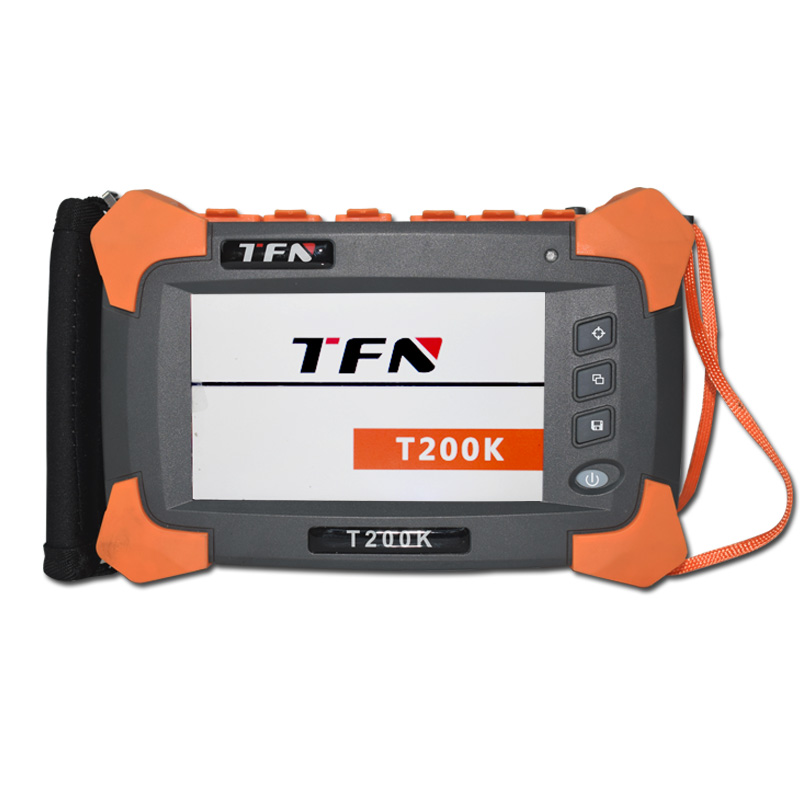
Additionally, it supports Y.1564 testing standards, which is crucial for verifying complex mobile backhaul and business services today. Many long-time users appreciate the T200K’s “Virtual Cable Test (VCT)” feature the most. Plugging in an RJ45 cable allows it to identify shorts, opens, and even accurately measure cable length – it’s an absolute lifesaver for troubleshooting physical layer faults.
Simply put, if 90% of your work is focused on Ethernet activation and maintenance, and you prioritize extreme portability and rapid fault localization, the T200K, with its excellent network performance testing capabilities, is tailor-made for you.
TFN T6300A: The “Aircraft Carrier” for All-Service Scenarios
The T6300A, on the other hand, was born from the demands of another group of “power users.” They needed to test not only Ethernet but also E1 lines, PRI signaling, and even the fiber optic links themselves. So, we essentially condensed a testing lab into this single device.
The T6300A is a multifunctional network tester, and its primary characteristic is its comprehensiveness. It integrates 10/100/1000M Ethernet testing (dual electrical + dual optical ports), and more impressively, it also incorporates E1, PRI, V.35/V.24 interfaces, and even integrates an OTDR and an optical power meter.
Imagine this scenario: You receive a fault report suspecting a base station transmission issue. You arrive with the T6300A. First, you use the OTDR to test the fiber and confirm the external cable isn’t broken. Next, you use the E1 interface for BERT error testing, analyzing G.821, G.826 metrics, and discover slip errors on the 2M link. Finally, you use the Gigabit port to simulate service traffic and perform RFC 2544 standard testing to verify IP layer throughput. With one device, you can tackle everything from the physical layer to the network layer.
Particularly worth mentioning is its support for PRI (30B+D). Although many services have transitioned to IP, ISDN PRI signaling remains robust in voice leased lines and certain financial network nodes. The T6300A can emulate TE or NT, perform call channel monitoring, and even listen to voice quality directly through a headphone jack. This TDM over IP or traditional TDM testing capability is something pure Ethernet testers like the T200K cannot replace.
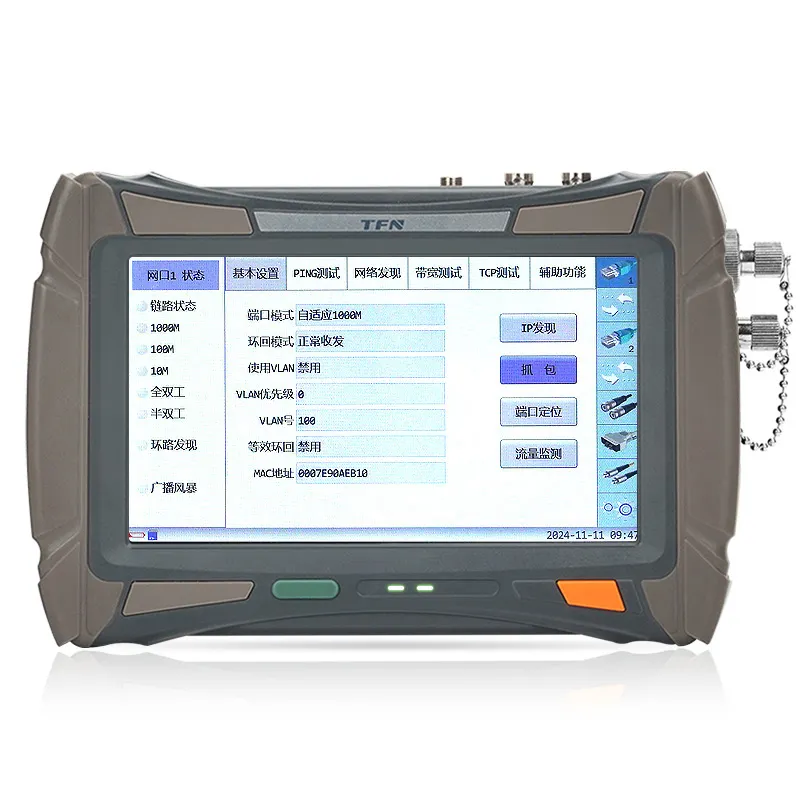
In terms of usability, the T6300A features a large 7.0-inch touchscreen, making it much more intuitive to display network discovery topology maps. You can clearly see the hierarchical structure of the inner network link layer, which is extremely helpful for troubleshooting loops and detecting rogue DHCP servers.
Side-by-Side Comparison and Selection Advice
So, back to the initial question: T200K or T6300A – which one suits you better?
From a Professionalism Perspective:
If you work in a communication engineering company, specializing in FTTx activation or enterprise network maintenance using an Ethernet tester, the T200K is sufficiently professional. Its compact size allows you to visit more sites in a single day. Its performance in multi-stream generation (10 streams) and packet capture analysis is excellent, handling the vast majority of IP RAN and MSTP circuit testing requirements.
Conversely, if you work in the core network maintenance department of an operator or a large maintenance company, needing to maintain transmission (SDH/MSTP), data (IP), and access (fiber) networks simultaneously, the T6300A is definitely a productivity multiplier. It’s not just an Ethernet tester; it’s also a PRI analyzer, an OTDR, and an optical power meter.
From a Technical Depth Perspective:
Both devices support wire-speed throughput on Gigabit tests and include comprehensive RFC2544 and Y.1564 test suites. However, in terms of interface richness, the T6300A’s dual SFP ports, combined with the built-in OTDR, add an extra dimension for optical power testing and fiber link quality analysis compared to the T200K. The T6300A supports jitter testing and handles up to 16 streams for multi-stream generation, slightly ahead of the T200K’s 10 streams.
An R&D Engineer’s Opinion:
As developers, our greatest pride isn’t in piling on features, but in ensuring each device precisely hits its target audience. The T200K is our interpretation of “portability” and “focus.” Its loopback testing and pass-through mode operations are incredibly simple, and the smart navigation menu helps even beginners get up to speed quickly. The T6300A is our interpretation of “versatility.” When you need to handle VLAN stacking, complex signaling analysis, or fiber break location, you’ll find every aspect of its design is perfectly suited to the task.
Conclusion
In summary, there is no inherently better product, only the tool that’s better suited for your needs.
If you seek ultimate portability, fast Ethernet activation and maintenance, and your budget leans towards specialized tools, then the TFN T200K will be your capable assistant.
If your work environment is complex, requiring you to tackle testing challenges involving E1, V.35, OTDR, and Gigabit Ethernet simultaneously, hoping to have one device for all tasks, then the TFN T6300A is undoubtedly the higher-value choice.
Whichever you choose, speaking as a member of the TFN R&D team, I can responsibly say that both devices have undergone rigorous lab testing and field validation. Their data measurement accuracy, stability, and durability stand the test of time.
I hope this comparison helps clarify your thoughts and guides you to find the “network touchstone” that best suits your needs.
Welcome to contact TFN Support Team to get more information of TFN T200K and T6300A Ethernet testers.
Courriel : info@tfngj.com
WhatsApp : +86-18765219251
Ou vous pouvez laisser des messages Ici