





En el diseño y despliegue de redes de comunicación globales, la selección de los cables de alimentación es una decisión fundamental que incide directamente en la integridad de la señal, el coste del sistema y la eficacia operativa a largo plazo. Para los operadores de comunicaciones, las diferencias regionales en las normas técnicas complican esta elección. Este artículo ofrece una perspectiva global, comparando las características técnicas, las normas internacionales aplicables y las aplicaciones de ingeniería del cable coaxial, el cable de alimentación plano y el cable de fibra óptica, ofreciendo una referencia profesional para el despliegue de redes multinacionales.
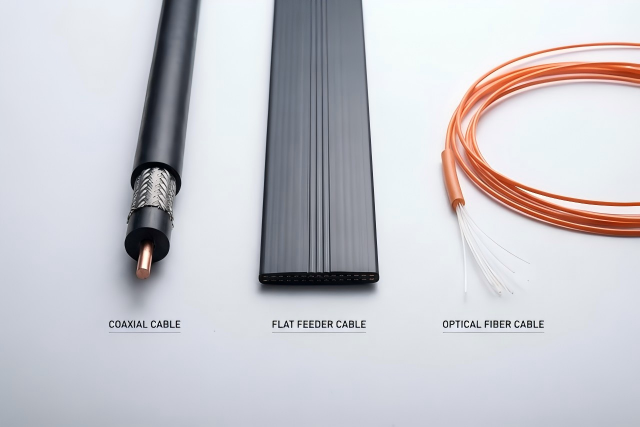
1. El cable coaxial: La piedra angular de la conectividad global de RF y sus variaciones estándar
1.1 Principios técnicos y modelos de rendimiento
Los cables coaxiales transmiten señales eléctricas de alta frecuencia a través de una estructura concéntrica formada por un conductor interior, un dieléctrico, un conductor exterior y una cubierta. Su atenuación de señal (pérdida de inserción) es una métrica de rendimiento clave, que puede aproximarse mediante la fórmula:
α ≈ (k1 * √f + k2 * f) / 100, donde α es la pérdida (dB/100m), f es la frecuencia (MHz), y k1 y k2 son constantes dependientes de la estructura del cable y del material dieléctrico [1- IEEE TRANSACTIONS ON ELECTROMAGNETIC COMPATIBILITY - 2018]. Este modelo explica por qué la pérdida del cable coaxial tradicional aumenta drásticamente en las bandas de ondas milimétricas 5G, limitando su aplicación.
1.2 Diferencias en las normas mundiales e impacto en la selección
Las normas internacionales para el cable coaxial no son uniformes, lo que obliga a los operadores a prestar atención a la compatibilidad durante la adquisición y despliegue multinacional:
- Norteamérica y partes de Asia: Se adhieren ampliamente a la norma MIL-C-17 y a las clasificaciones de la serie RG (por ejemplo, RG-6, RG-58). Aunque tienen su origen en el ejército estadounidense, las normas RG se han convertido en referencias habituales en el sector comercial.
- Europa y muchos proyectos internacionales: Adoptan habitualmente las normas internacionales de la serie IEC 61196 y las normas DIN. Las especificaciones establecidas por el Instituto Europeo de Normas de Telecomunicaciones (ETSI) suelen imponer requisitos más estrictos en materia de prestaciones medioambientales y de seguridad contra incendios (por ejemplo, cumplimiento de la normativa CPR).
- China y regiones específicas: Disponen de sus propias normas industriales (por ejemplo, YD/T), cuyos parámetros de rendimiento pueden presentar diferencias sutiles pero críticas con respecto a las normas IEC o MIL, especialmente en lo que se refiere a la pérdida de retorno y la eficacia del apantallamiento.
Por tanto, especificar un “cable coaxial de bajas pérdidas” en proyectos globales es insuficiente. Es esencial definir claramente el número de norma específico que cumple la ubicación del proyecto o los requisitos del cliente, como IEC 61196-1 frente a MIL-DTL-17.
2. Cable de alimentación plano: Una solución flexible para retos de despliegue específicos
2.1 Innovación en el diseño y ventajas de la ingeniería
Los cables de alimentación planos mejoran notablemente el aprovechamiento del espacio y la flexibilidad del cableado al comprimir los conductores en forma de cinta plana. Su radio de curvatura puede ser tan bajo como unas pocas veces el grosor del cable, lo que los hace muy adecuados para escenarios con limitaciones de espacio, como sistemas de distribución en interiores (DAS), huecos de ascensor y edificios históricos. Aunque sus características de atenuación son similares a las de los cables coaxiales, la estructura plana exige una mayor precisión de fabricación para mantener estable la impedancia característica.
2.2 Aceptación global y estado de normalización
Los cables de alimentación planos aún no han alcanzado normas unificadas a nivel mundial como sus homólogos coaxiales redondos. Su adopción depende en gran medida de las prácticas regionales de ingeniería:
En Norteamérica y Europa, se utilizan principalmente como soluciones personalizadas o de nicho para resolver retos de instalación únicos. Las evaluaciones de rendimiento correspondientes suelen hacer referencia a normas generales sobre cables de comunicación, como la EN 50117 (Europa), o combinarse con certificaciones de seguridad UL.
Su principal ventaja radica en la comodidad de la instalación, no en su rendimiento eléctrico. Un estudio sobre infraestructuras inalámbricas señala que, a la misma frecuencia, el cable plano de alta calidad puede rivalizar con el cable coaxial estándar, pero su fiabilidad mecánica a largo plazo (por ejemplo, la estabilidad de su rendimiento tras doblarse repetidamente) es un punto clave que requiere validación sobre el terreno [2- International Journal of Antennas and Propagation - 2020].
3. Cable de fibra óptica: La red troncal mundial del futuro y el estándar fronthaul 5G
3.1 Ventajas técnicas y límites de rendimiento
Los cables de fibra óptica guían la luz a través del núcleo utilizando el principio de reflexión interna total, ofreciendo un inmenso potencial de ancho de banda y una atenuación extremadamente baja. El coeficiente de atenuación de la fibra monomodo puede ser inferior a 0,2 dB/km en la ventana de 1550 nm. Su capacidad de transmisión está limitada por efectos no lineales (como el efecto Kerr y la dispersión Raman). El límite teórico clásico de su capacidad de canal se describe mediante variantes de la fórmula de Shannon aplicadas a la fibra óptica, con investigaciones en curso que impulsan nuevas tecnologías como la multiplexación por división espacial [3- Journal of Lightwave Technology - 2019].
3.2 Sistema global altamente estandarizado
El cable de fibra óptica es el tipo de cable de alimentación más estandarizado a nivel mundial, lo que facilita enormemente el despliegue multinacional:
- Normas básicas: Las series G.65x (monomodo) y G.65x (multimodo) del UIT-T son las normas mundiales absolutamente dominantes, que definen las propiedades geométricas, de transmisión y mecánicas de las fibras ópticas.
- Suplementos regionales: Europa cuenta con la norma EN 60793 (equivalente a las normas CEI) y Norteamérica con la serie TIA-492. Estas normas coinciden en gran medida con las del UIT-T en los parámetros básicos, con diferencias principalmente en los métodos de ensayo o los requisitos ambientales adicionales.
- Nuevas normas impulsadas por 5G: Para cumplir los estrictos requisitos de latencia y sincronización del fronthaul 5G, las normas UIT-T G.652.D (fibra de baja pérdida y baja PMD) y G.657.A1/B3 (fibra insensible a las curvaturas) se han convertido en la opción preferida de los operadores mundiales que construyen nuevas redes. La labor de normalización de la Unión Internacional de Telecomunicaciones (UIT) garantiza la interoperabilidad entre fibras de distintos proveedores, lo que constituye la base de la cadena de suministro mundial.
4. Comparación exhaustiva y estrategia global de selección de redes
4.1 Análisis comparativo tridimensional
| Dimensión | Cable coaxial | Cable de alimentación plano | Cable de fibra óptica |
| Rendimiento técnico | Ancho de banda limitado, las pérdidas aumentan considerablemente con la frecuencia | Rendimiento cercano al coaxial, menos sensible a la flexión | Ancho de banda casi ilimitado, pérdidas extremadamente bajas, inmune a las interferencias |
| Globalización estándar | Variaciones significativas de las normas regionales (RG, IEC, DIN, normas nacionales) | Carece de normas mundiales unificadas, a menudo son productos específicos para cada aplicación | Altamente unificado a nivel mundial (dominante en el UIT-T) |
| Coste total de propiedad (TCO) | Bajo coste inicial, pero alto coste energético debido a las pérdidas a altas frecuencias | Coste inicial moderado, bajo coste de instalación | Alto coste inicial, bajo coste de mantenimiento y ampliación a largo plazo |
4.2 Recomendaciones de despliegue global basadas en escenarios
- Elija el cable coaxial: Adecuado para mantenimiento de redes tradicionales, puentes de corta distancia o proyectos de presupuesto limitado en bandas de baja frecuencia 2G/3G/4G (< 2,5 GHz). Acción clave: Aclarar las normas de RF y seguridad obligatorias en la ubicación del proyecto.
- Elija el cable de alimentación plano: Como solución complementaria para escenarios especiales, como DAS en interiores que requieren un despliegue rápido o con vías extremadamente estrechas, o emplazamientos temporales. Acción clave: Exigir a los proveedores informes completos de pruebas de rendimiento basados en normas IEC o EN, y realizar una validación de fiabilidad in situ.
- Elija el cable de fibra óptica: Es la opción fundamental para todas las nuevas redes troncales, redes de área metropolitana, redes fronthaul 5G de banda de frecuencia media-alta (por ejemplo, 3,5 GHz, mmWave) y cualquier red diseñada para futuras actualizaciones. Acción clave: Especifique los tipos de fibra ITU-T habituales (por ejemplo, G.652.D) y asegúrese de que todos los conectores y cables de conexión cumplen las normas de la serie IEC 61754.
Conclusiones: Hacia una arquitectura global unificada y centrada en la fibra óptica
Con el telón de fondo de la evolución de las redes de comunicación mundiales hacia 5G-Advanced y 6G, la selección de cables de alimentación muestra una tendencia clara: La fiberización se está extendiendo inexorablemente desde la red central a la red de acceso e incluso al lado de la antena. Aunque los cables de alimentación coaxiales y planos conservan su valor en escenarios heredados específicos o aplicaciones de nicho, la fragmentación regional de sus estándares aumenta la complejidad de las operaciones globales.
Para los operadores que buscan eficiencia, garantía de futuro y facilidad de gestión global, la construcción de una arquitectura híbrida centrada en cables de fibra óptica estandarizados (conformes con la serie ITU-T G.65x/G.657), complementada sólo cuando es necesario en el lado del usuario final con alimentadores coaxiales o planos estandarizados, se ha convertido en la opción más estratégica. Esto no sólo garantiza un rendimiento superior de la red, sino que también minimiza los riesgos técnicos y los costes operativos a largo plazo del despliegue multinacional al confiar en una cadena de suministro y un sistema estándar unificados a nivel mundial.