





In core scenarios such as optical cable operation and maintenance, resource inventory, cable splicing, and emergency repair for communication operators, the OCID testers have become the mainstream solution to replace traditional damaging detection methods including bending, freezing, and cutting. OCID (Optical Coherence Identification) technology relies on high-precision optical interference and digital vibration signal demodulation to achieve non-destructive, long-distance, and high-reliability optical cable identification on a single fiber. It provides strong support for communication operators to reduce costs, improve efficiency, and ensure stable service transmission in optical networks.
1. Principles of OCID Technology: Optical Interference and Phase Demodulation
1.1 Optical Interference: The Sensing Core of Vibration Detection
OCID technology adopts a hybrid architecture combining Mach–Zehnder interference and Sagnac interference. The internal laser emits stable coherent light, which is divided into two beams by a 2×2 coupler and transmitted in the fiber to form a closed interference loop. When the cable is tapped or disturbed by external force, the fiber core produces micro-strain and transient refractive index changes, resulting in a stable phase difference between the two optical signals.
The phase difference can be expressed as: Δφ = 4πnΔL/λ + 4πLΔn/λ In the formula, λ represents the operating wavelength (usually 1550 nm), n is the refractive index of the fiber core, L is the fiber length, ΔL is the strain deformation, and Δn is the change of refractive index.
En OCID testers capture the intensity change of interference light and converts weak mechanical vibration into measurable electrical signals. It supports single-ended testing without loopback at the remote end, and can accurately identify broken fibers, APC connectors, UPC connectors and other complex end conditions.
1.2 Vibration Signal Demodulation: From Waveform to Accurate Identification
Demodulation is the key link of OCID technology. After photoelectric conversion by PD detector, the interference signal is processed by PGC (Phase Generated Carrier) and quadrature demodulation algorithm to filter out noise and extract effective features such as vibration amplitude, frequency and time sequence.
High-performance OCID tester equipment provides two intuitive output modes:
- Visual mode: ECG waveform and vibration amplitude histogram, which are synchronized with the tapping rhythm;
- Audio mode: the sound intensity changes with the disturbance strength, helping on-site personnel quickly confirm the target cable.
The demodulation system has strong anti-interference ability, which can effectively suppress environmental vibration and adjacent cable interference, ensuring accurate single-fiber identification and zero false judgment, which is an important indicator for large-scale application of operators.
2. Application Value of OCID Tester for Communication Operators
Traditional optical cable investigation methods have problems such as low efficiency, easy fiber damage and high risk of mis-cutting. OCID technology, with the advantages of non-destructive, long-distance and single-fiber accurate identification, has been widely used in the core business of communication operators:
- Cable splicing: quickly locate the target fiber in densely bundled cables to avoid service interruption;
- Resource census: check cable routing, attribution and length in batches to improve the accuracy of resource accounts;
- Fault repair: quickly locate broken fibers and degraded links to shorten the average repair time;
- Computer room renovation: sort out fiber sequences between ODN racks to improve operation standardization.
Field application data shows that the use of OCID tester can shorten the fault location time from hours to within 10 minutes, reduce operation and maintenance costs by more than 30%, and greatly improve the safety and efficiency of optical cable network management.
3. TFN GP200: A Professional OCID Tester for Communication Operators
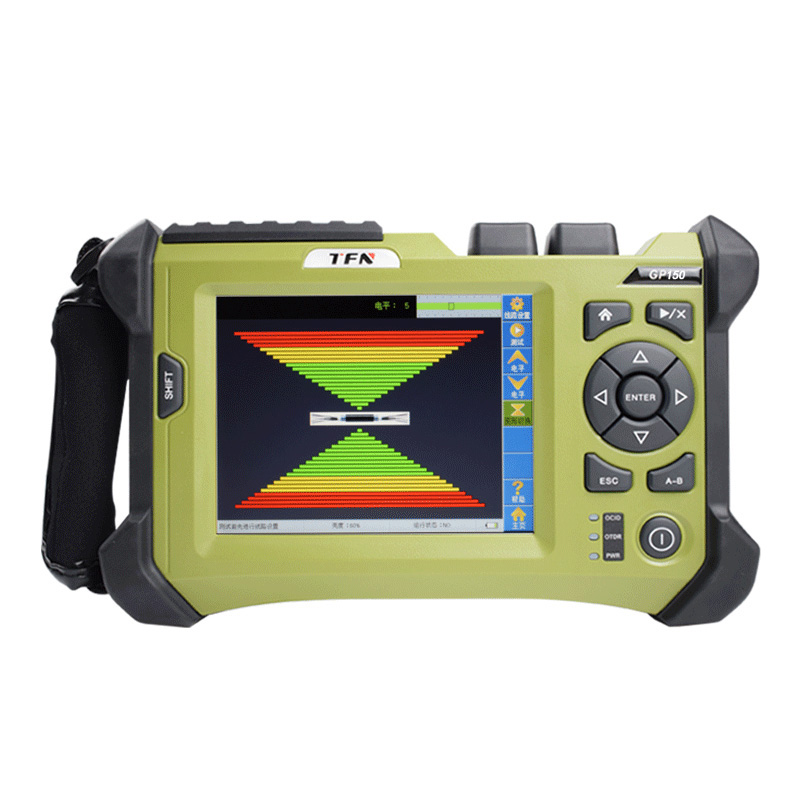
TFN GP200 is a high-performance integrated optical communication tester integrating OCID, OTDR, optical power meter, laser source, VFL and other functions. It is a preferred device for optical cable operation and maintenance of communication operators, and its OCID module fully meets telecom-level application requirements:
- Three detection distance versions: 40 KM / 60 KM / 80 KM, covering metropolitan area network, access network and local network scenarios;
- Dual-mode recognition: visual vibration waveform + audio prompt, which is convenient for rapid judgment on site;
- Full-end compatibility: accurate identification of broken fibers, APC, UPC and other states, no test blind area;
- Interface multiplexing: OCID is multiplexed with OTDR optical port, realizing one-device completion of census, loss test and fault location;
- Industrial-grade design: 8-inch high-definition touch screen, 15600mAh large-capacity battery, wide temperature operation of -10℃~50℃, suitable for long-term field work.
In actual cable splicing and maintenance, the GP200 OCID tester can quickly lock the target fiber without damaging the fiber core and affecting business, fully complying with the operation standards of communication operators for safety, efficiency and non-destructive.
4. Technology Development Trend and Operator Deployment Suggestions
With the large-scale construction of 5G-A and computing power network, the optical cable network is developing towards high density, large capacity and full coverage. OCID technology is gradually developing in the direction of long-distance distributed detection, AI intelligent diagnosis and mobile terminal collaboration.
TFN GP200 is equipped with self-diagnosis of test results, Bluetooth APP control, one-key generation of PDF test reports and other digital functions, helping operators realize the transformation from passive repair to active prevention.
For communication operators, large-scale deployment of OCID tester (represented by TFN GP200) is an effective way to improve the operation and maintenance level of optical cable network. It creates long-term value in cost reduction, efficiency improvement and safety guarantee, and lays a solid foundation for the high-quality development of optical communication network.
Si está interesado en Identificador de cable óptico TFN GP200 (OCID), welcome to contact TFN Support Team:
Correo electrónico: info@tfngj.com
WhatsApp: +86-18765219251
O puedes leave messages here