





Introduction: The New Frontier of the Millimeter Wave Spectrum
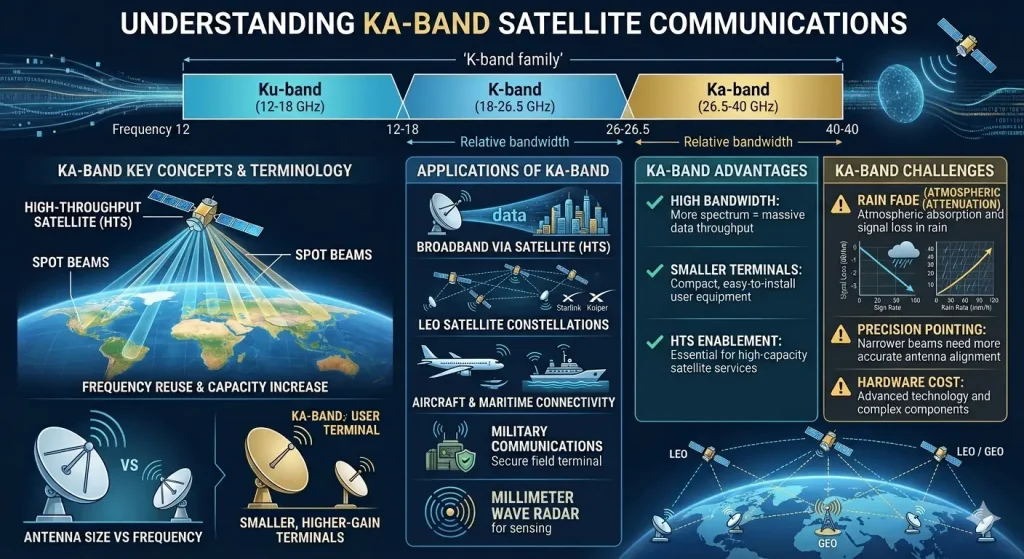
With the large-scale deployment of 5G networks globally, communications engineers are facing a common challenge: the depletion of spectrum resources. The Sub-6 GHz bands are already congested, while the millimeter wave bands, particularly the Ka-band (26.5-40 GHz), are becoming key to unlocking the full potential of 5G. As an engineer long engaged in wireless communication testing, I believe the Ka-band is not merely a supplement to 5G, but a proving ground for future 6G technology. However, the testing challenges brought by high frequencies are equally severe, and this is precisely the stage where high-performance spectrum analyzers demonstrate their value.
The Core Value of Ka-band: Bandwidth and Capacity
The fundamental reason millimeter wave bands are central to 5G Advanced and future 6G is bandwidth. Taking the Ka-band as an example, the available contiguous bandwidth often reaches hundreds of MHz or even GHz levels—something Sub-6GHz bands cannot match. According to the Shannon-Hartley theorem, channel capacity is directly proportional to bandwidth, which translates to an ultimate user experience with downlink peak rates exceeding 20Gbps.
In practical engineering deployment, the Ka-band is primarily used for enhanced Mobile Broadband (eMBB) and Fixed Wireless Access (FWA). For instance, deploying millimeter-wave micro-sites in dense urban areas and large venues can effectively offload traffic pressure from the macro network. Citing authoritative research, “Millimeter-wave frequencies above 24 GHz will be essential for meeting the 5G vision of multi-Gbps data rates, leveraging wide contiguous bandwidths not available at lower frequencies” (1- IEEE Communications Magazine, Vol. 57, Issue 1, 2019).
Engineering Challenges in Ka-band Testing
Path Loss and Beamforming
From an RF engineer’s perspective, Ka-band signal propagation faces two major physical bottlenecks: high free-space path loss and atmospheric absorption. Signal attenuation is particularly pronounced during rain or when obstructed by foliage. To counter this, 5G NR introduces Massive MIMO (Multiple-Input Multiple-Output) and beamforming technology, concentrating energy towards the user via narrow beams.
However, the dynamic scanning and switching of beams pose significant testing challenges. Traditional wideband scanning is no longer sufficient; we need tools capable of capturing and analyzing the time-domain behavior of beams in real-time. This is where high-end handheld spectrum analyzers like the RMT740A prove their worth.
RMT740A: The Ideal Tool for Ka-band Signal Analysis
Perfect Hardware Adaptation
Addressing the frequency demands of the Ka-band up to 40GHz, the RMT740A spectrum analyzer in TFN’s RMT series covers a frequency range from 9kHz to 40GHz, perfectly suiting Ka-band testing needs. In the field, carrying a handheld device weighing only 2.3kg to perform high-frequency analysis that once required benchtop instruments represents a revolutionary leap in efficiency for outdoor drive testing and interference hunting.
Citing another key study, “Accurate spectrum analysis in the millimeter-wave range requires instruments with low phase noise and high sensitivity to distinguish closely spaced beamforming signals” (2- IEEE Transactions on Microwave Theory and Techniques, Vol. 68, Issue 6, 2020). The RMT740A achieves a receiving sensitivity as low as -163dBm/Hz (with preamplifier) at 40GHz, sufficient to capture weak beam sidelobe signals, which is crucial for assessing the beamforming quality of base station antennas.
In-depth Analysis of Ka-band Signals
Real-Time Bandwidth and Beam Analysis
When analyzing 5G NR millimeter wave signals, looking only at the spectrum graph is far from sufficient. The RMT740A supports a real-time analysis bandwidth of up to 100MHz, which is critical for capturing the Synchronization Signal Block (SSB) and Physical Downlink Shared Channel (PDSCH) in the Ka-band.
Take beam analysis as an example. The beams from a millimeter-wave base station scan periodically in the time domain. The RMT740A’s 5G NR demodulation function can simultaneously demodulate up to 8 Beam IDs, intuitively displaying metrics like SS-RSRP, SS-RSRQ, and SINR for each beam. In engineering practice, we can use the “Persistence Spectrum” function to observe transient responses during beam switching, determining whether there’s beam loss-of-lock or interference. If the EVM (Error Vector Magnitude) for a specific Beam ID deteriorates, combining this with a handheld directional antenna allows for quick localization—whether it’s a base station hardware failure or external obstruction.
The Practical Significance of Interference Localization
Although the Ka-band offers ample bandwidth, interference tends to be directional and bursty due to narrow beams. Traditional sweepers struggle to detect such “hidden” interference. The RMT740A’s 3D waterfall plot function continuously records spectrum changes over time, aiding engineers in retrospective analysis. For example, in a 5G millimeter-wave Fixed Wireless Access scenario, if the user’s data rate suddenly drops, checking the waterfall plot might reveal a radar signal from a specific direction periodically raising the noise floor. At this point, using the RMT740A’s AOA (Angle of Arrival) direction-finding function, combined with triangulation algorithms, the interference source can be precisely pinpointed on an electronic map—one of the most practical features for field engineers.
Field Drive Testing and Future Evolution
Seamless Transition from Lab to Field
The biggest pain point in deploying Ka-band equipment is that “plug-and-play” is often unrealistic. Due to the narrow beams, even a slight misalignment in antenna orientation causes a sharp drop in signal quality. The RMT740A supports outdoor drive testing with GPS synchronization, allowing real-time tagging of Cell IDs and beam power at every geographic location during movement, generating coverage heatmaps. This provides the basis for network optimization teams: which intersection requires adjusting the beam’s downtilt, which building corner needs a new site—the data is clear at a glance.
Looking ahead, with 3GPP Release 18 and subsequent versions enhancing 5G-Advanced, the Ka-band will further integrate with Non-Terrestrial Networks (NTN), enabling convergence between Low Earth Orbit (LEO) satellites and terrestrial networks. By then, testing will no longer be limited to ground-based signal analysis but will encompass complex, integrated terrestrial-space electromagnetic environment monitoring. “The convergence of terrestrial 5G and satellite networks in Ka-band necessitates advanced test equipment capable of handling high Doppler shifts and long propagation delays” (3- IEEE Vehicular Technology Magazine, Vol. 17, Issue 3, 2022). The RMT series, with its high dynamic range and flexible triggering mechanisms, is clearly prepared for this challenge.
Conclusión
The Ka-band is far from a theoretical technology; it is the cornerstone for 5G and even 6G to achieve truly ubiquitous gigabit experiences. For frontline communications engineers, mastering the characteristics of millimeter-wave signals and skillfully utilizing high-performance handheld spectrum analyzers like the TFN RMT740A are essential skills to tackle the complex challenges of future networks. From interference hunting to beam verification, from indoor coverage to satellite communication testing, precise measurement tools empower us to navigate the millimeter-wave world with confidence and insight, rather than fumbling in the dark.
Si quiere saber más sobre RMT740A handheld spectrum analyzer, Póngase en contacto con el equipo de asistencia de TFN:
Correo electrónico: info@tfngj.com
WhatsApp: +86-18765219251
O puedes leave messages here
Referencias:
1- IEEE Communications Magazine, “Millimeter-Wave Communications for 5G: Fundamentals and Challenges,” Vol. 57, Issue 1, January 2019.
2- IEEE Transactions on Microwave Theory and Techniques, “Millimeter-Wave Over-the-Air Testing: Challenges and Solutions,” Vol. 68, Issue 6, June 2020.
3- IEEE Vehicular Technology Magazine, “5G From Space: An Overview of 3GPP Non-Terrestrial Networks,” Vol. 17, Issue 3, September 2022.