





En el cableado de redes, la construcción de centros de datos o los proyectos de comunicación a larga distancia, la elección entre fibra monomodo y fibra multimodo suele requerir una cuidadosa consideración por parte de los equipos de instalación y los responsables técnicos. Una elección correcta conduce a un sistema estable y eficiente que no da problemas durante años; una elección incorrecta no sólo afecta al rendimiento, sino que también puede suponer un coste de recableado a corto plazo. Como alguien que ha trabajado durante mucho tiempo en la primera línea de la instalación y las pruebas de fibra óptica, me gustaría compartir algunas experiencias prácticas y la lógica de la toma de decisiones, combinando las ideas de nuestros productos de uso común Comprobador OTDR F7-SM1 (un dispositivo que permite realizar pruebas integradas de fibra monomodo y multimodo).
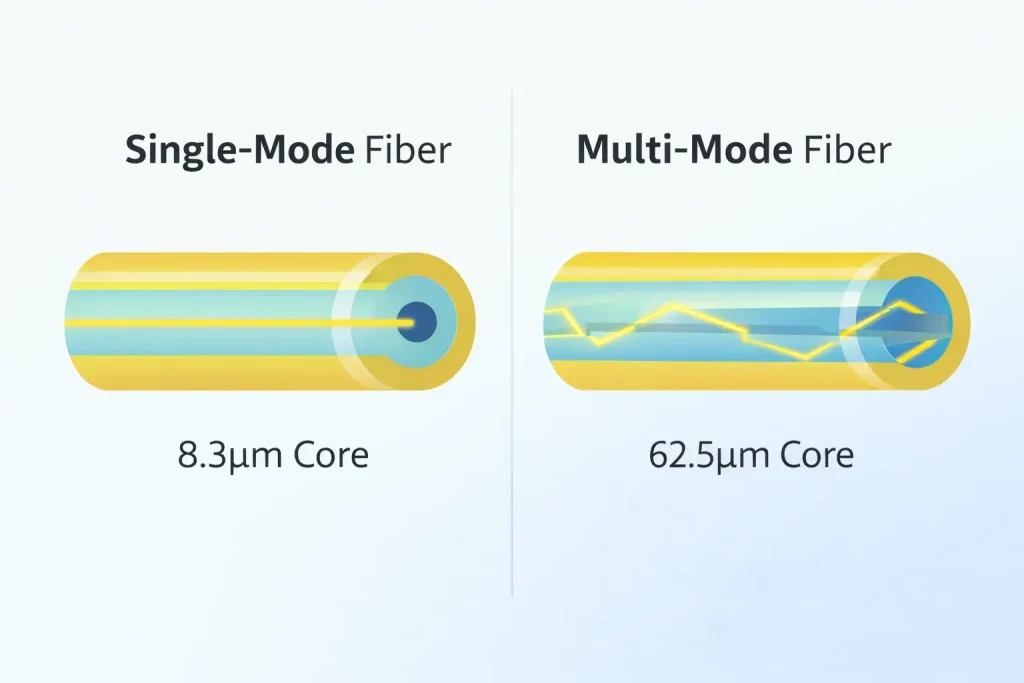
Diferencias fundamentales: Comprensión desde la naturaleza de la transmisión de señales ópticas
Antes de sumergirnos en los detalles de la selección, debemos comprender las diferencias fundamentales de su funcionamiento. Esto determina todas sus características.
La fibra monomodo tiene un núcleo extremadamente fino, normalmente de 8-10 micras de diámetro. Permite que sólo un modo de la señal luminosa viaje directamente a través de ella sin apenas reflexión ni dispersión. En consecuencia, ofrece distancias de transmisión extremadamente largas (hasta decenas o incluso cientos de kilómetros) y un ancho de banda muy elevado. Los tipos comunes de fibra monomodo como OS2 son la columna vertebral absoluta para troncales de largo recorrido, redes de área metropolitana, backhaul 5G y aplicaciones similares.
La fibra multimodo tiene un núcleo más grueso, normalmente de 50 ó 62,5 micras de diámetro. Permite que varios modos de señales luminosas viajen simultáneamente, pero debido a las diferentes trayectorias, se produce dispersión intermodal, lo que hace que los pulsos de señal se dispersen. Esto limita su distancia de transmisión y ancho de banda, por lo que suele ser adecuado para aplicaciones de corto alcance, desde unos cientos de metros hasta dos kilómetros, como en el interior de salas de centros de datos, cableado vertical/horizontal intraedificio y redes de campus empresariales.
¿Cómo elegir? Seis factores clave
La elección nunca es tan sencilla como “usa monomodo para larga distancia, multimodo para corta”. Se necesita una evaluación exhaustiva desde la perspectiva del coste total del ciclo de vida del proyecto y la evolución tecnológica.
1. Requisitos de distancia de transmisión y ancho de banda
Este es el criterio más directo.
- Si la distancia supera entre 500 metros y 1 kilómetro, o si se prevén claramente futuras ampliaciones del ancho de banda, debe darse prioridad a un sistema de fibra monomodo. Aunque las fuentes y los módulos láser son ligeramente más caros, proporcionan una vía de actualización casi ilimitada. Cuando se utiliza nuestro OTDR F7-SM1 para probar fibra monomodo de larga distancia, su alto rango dinámico y su capacidad de localización precisa de eventos pueden diagnosticar rápidamente la calidad del enlace, garantizando la fiabilidad.
- Si la distancia no supera los 550 metros, las necesidades de ancho de banda están entre 10G-40G y el presupuesto es limitado, la fibra multimodo OM3/OM4 es una opción rentable y madura. Por ejemplo, las interconexiones de corta distancia dentro de los centros de datos y las conexiones de servidores a conmutadores utilizan en gran medida la fibra multimodo.
2. Análisis del coste total de propiedad (no sólo del cable)
Muchos creen erróneamente que los sistemas multimodo son más baratos. En realidad, hay que calcular el coste total de propiedad:
- Fibra monomodo: El coste del cable es comparable, o incluso inferior, al de los multimodo de gama alta. Sin embargo, los transceptores de fibra monomodo (módulos ópticos) han sido históricamente más caros debido al uso de fuentes de luz láser. Sin embargo, con la proliferación tecnológica, especialmente impulsada por las aplicaciones monomodo en centros de datos (como los módulos 100G DR/FR), la diferencia de precios se está reduciendo rápidamente.
- Fibra multimodo: El cable en sí puede ser algo más caro, pero los módulos basados en láser VCSEL que se utilizan con él son más económicos. Hay que tener en cuenta, sin embargo, que a velocidades más altas (como 100G y superiores), superar las limitaciones de distancia puede requerir costosas técnicas de fibra paralela o multiplexación multi-longitud de onda, lo que añade complejidad.
Consejos para la instalación: Cuando planifique, no se fije sólo en la lista de materiales. El verdadero “ahorro” está en utilizar una herramienta como el OTDR F7-SM1 para realizar estrictas pruebas de aceptación posteriores a la instalación y reducir así los costes futuros de solución de problemas y reparación. Puede identificar claramente eventos como puntos de empalme, pérdida de conectores y dobleces tanto en enlaces monomodo como multimodo, evitando defectos ocultos.
3. Futura ruta de actualización y evolución tecnológica
Este es el factor que más fácilmente se pasa por alto, pero que resulta crítico. El ancho de banda de la red crece aproximadamente 10 veces cada 5 años.
- La fibra monomodo está preparada para el futuro. La fibra OS2 actualmente desplegada puede soportar fácilmente la evolución de 1G a 400G o incluso 1,6T simplemente sustituyendo el equipo en ambos extremos, sin necesidad de recablear.
- La fibra multimodo tiene un techo de mejora. De OM1 a OM5, cada generación mejora el ancho de banda y la distancia, pero siguen existiendo límites físicos. Dejar núcleos de fibra monomodo de reserva para el futuro se ha convertido en una práctica habitual en muchos diseños de centros de datos con visión de futuro.
4. Consideración de escenarios de aplicación específicos
- Dentro de los centros de datos (DCI), cableado intraedificio: La fibra multimodo ha dominado tradicionalmente, especialmente para cables de conexión cortos. Sin embargo, el uso de fibra monomodo en centros de datos está creciendo rápidamente, sobre todo en arquitecturas de espina de hoja, donde las distancias pueden superar los límites de la multimodo.
- Fibra hasta el hogar (FTTH), troncales de largo recorrido, transmisión metropolitana: La fibra monomodo es la única opción.
- Entornos industriales, redes de área local (LAN): Analizar en función de la distancia y la velocidad específicas. En el caso de las actualizaciones de fibra LAN de empresa, si la escala del edificio es grande o se consideran futuras redes convergentes, la ventaja de flexibilidad del modo único se vuelve significativa.
5. Matices en la instalación y el mantenimiento
Desde el punto de vista de la instalación:
- La fibra monomodo tiene un núcleo fino, por lo que requiere equipos de mayor precisión y habilidad para el empalme y la terminación. Pero precisamente porque es monomodo, al realizar las pruebas con el OTDR F7-SM1, la interpretación de las curvas es relativamente clara y la localización de fallos, precisa.
- La fibra multimodo tiene un núcleo más grueso, lo que facilita la alineación y el acoplamiento, y es menos sensible a contaminantes como el polvo. Sin embargo, durante las pruebas, debido a su naturaleza multimodo, es necesario ajustar la configuración de prueba del OTDR (como la anchura de pulso o la longitud de onda) para obtener resultados representativos. El OTDR F7-SM1 admite la identificación automática del modo y ajustes optimizados, lo que simplifica enormemente el proceso para los técnicos que cambian entre las pruebas de los dos tipos de fibra.
6. Uso híbrido y despliegue paralelo
En los proyectos reales a gran escala, no es factible un planteamiento de “lo uno o lo otro”. Una práctica común es una “estrategia de cableado de fibra híbrida”: utilizar fibra monomodo para las redes troncales a fin de garantizar la longevidad, y utilizar fibra multimodo para subsistemas horizontales o conexiones específicas de corta distancia y alta densidad para controlar los costes actuales. Esto también plantea un reto para los equipos de prueba: se necesita un dispositivo que pueda conmutar sin problemas y probar con precisión ambos tipos de fibra. Nuestro OTDR F7-SM1 se diseñó precisamente para esta necesidad; su compatibilidad con modo dual evita al personal la molestia de llevar varios comprobadores.
Pruebas y verificación: Garantía de calidad tras la selección
Independientemente de la opción elegida, las pruebas rigurosas son la última línea de defensa de la calidad del proyecto. Los problemas habituales en la instalación de la fibra, como una curvatura excesiva, una elevada pérdida por empalme o la contaminación de los conectores, pueden anular los márgenes de rendimiento que usted diseñó cuidadosamente.
- En las pruebas de fibra monomodo, hay que centrarse en la pérdida total, los eventos reflectantes y la suavidad de la traza del OTDR.
- En las pruebas de fibra multimodo, además de la pérdida, preste atención a la uniformidad de la atenuación. El uso de un dispositivo como el OTDR F7-SM1 compatible con la optimización multimodo puede reflejar con mayor precisión el rendimiento real de los enlaces multimodo.
Resumen y recomendaciones finales
- La fibra monomodo es su “vía estratégica”, construida para el futuro, adecuada para redes troncales, enlaces de larga distancia y cualquier escenario con demandas futuras inciertas.
- La fibra multimodo es una excelente “herramienta táctica”, con un excelente rendimiento en escenarios definidos de corta distancia, gran ancho de banda y costes sensibles.
Un último consejo para los instaladores y responsables de la toma de decisiones:
1. Evalúe la distancia y el ancho de banda: para distancias superiores a 500-1.000 metros, opte directamente por el monomodo.
2. Calcular los costes a largo plazo: Teniendo en cuenta las actualizaciones en 3-5 años, el monomodo puede tener un coste total de propiedad más bajo.
3. No rehúya las arquitecturas híbridas: Mezcle y combine con flexibilidad según las capas de la red.
4. Invierta en herramientas de comprobación profesionales: Un comprobador como el OTDR F7-SM1 que admite ambos modos salvaguarda la calidad de la instalación en varios proyectos de fibra: una inversión única con beneficios a largo plazo.
En el mundo de la fibra óptica, no existe “lo mejor”, sólo “lo más adecuado”. Con unos conocimientos técnicos claros, una planificación con visión de futuro y una verificación de pruebas fiable, podrá tomar la decisión más acertada y construir una infraestructura de red que resista el paso del tiempo.