




The Hidden Crisis Beneath Our Cities
Urban infrastructure is growing faster than the maps that document it. Power cables, fiber optic lines, and communication conduits are packed ever deeper and denser under city streets — yet accurate as-built records often don’t exist. The result: construction crews accidentally sever critical cables, and maintenance teams spend days searching for a fault that could be in any of dozens of buried lines.
Conventional underground cable locators struggle in these conditions. In areas with dense pipeline clusters or heavy electromagnetic interference — near substations, cell towers, or busy transit corridors — traditional equipment generates confusing multi-line responses. Operators can’t distinguish one cable from another, and a wrong cut can trigger a major outage or worse, a serious safety incident.
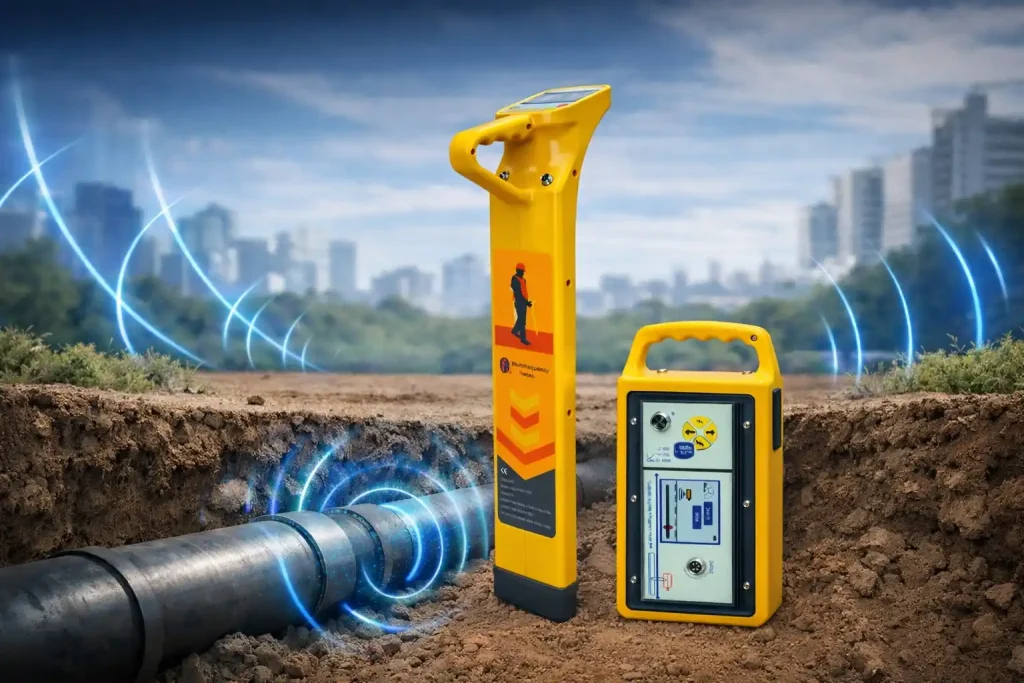
إن TFN T6000 underground pipe and cable locator was engineered specifically to solve these industry pain points. It is now a go-to instrument for power utilities and telecommunications operators worldwide. This article breaks down the physics behind the technology and explains why it outperforms the competition in real-world field conditions.
Core Technology: How the TFN T6000 Works
1. Multi-Frequency Signal System — Built on Faraday’s Law
All electromagnetic pipe locators work on the same fundamental principle — Faraday’s Law of Electromagnetic Induction:
ε = −N · (ΔΦ/Δt)
Where:
- ε = the induced voltage (signal strength) picked up by the receiver antenna
- N = the number of coil turns in the receiver antenna
- ΔΦ/Δt = the rate of change of magnetic flux through the coil (directly linked to signal frequency)
In plain terms: more coil turns and faster flux changes produce a stronger, cleaner signal. The TFN T6000 optimizes both variables simultaneously.
Dual-axis antenna array: The T6000 uses both horizontal and vertical antenna coils, effectively multiplying the active coil count (N). This alone delivers a 3× improvement in signal sensitivity compared to single-axis designs.
9 selectable frequencies with simultaneous 3-frequency transmission: Each frequency corresponds to a different ΔΦ/Δt — giving operators a full toolkit for any field scenario:
| نطاق التردد | Behavior | Best Application |
|---|---|---|
| Low (< 1 kHz) | Slow flux change, low attenuation | Long-distance power transmission lines (15 km+) |
| High (> 80 kHz) | Fast flux change, high coupling efficiency | Fiber optic cables with metallic strength members; shallow utilities |
A 140 dB dynamic signal range and advanced digital filtering algorithms suppress electrical noise from nearby substations and base stations, raising the signal-to-noise ratio by 40%. Even millivolt-level signals from targets buried 5 meters deep are detected with clarity.
2. Current Direction & Phase Identification — The Industry’s Most Accurate Pipe Separation Technology
This is the TFN T6000’s most distinctive capability, and the one that makes it uniquely valuable in congested utility corridors.
The problem with conventional locators: When multiple cables run in parallel, stray capacitive coupling causes signal “bleed” between lines. A conventional locator picks up responses from several cables at once — operators see multiple peaks and cannot confidently identify the target.
How T6000 solves it: The T6000 detects not just signal presence, but signal flow direction and phase angle.
- The target cable carries the transmitted signal flowing outward from the transmitter. Its phase angle falls between −45° and +45°.
- Adjacent cables with induced interference carry return signals flowing in the opposite direction. Their phase angle falls between −135° and +225°.
This creates a fixed 180° phase separation between target and interfering signals — a reliable, physics-based discriminator that no amount of cable congestion can obscure.
Result: Even in trenches with dozens of co-routed power cables and fiber lines, the T6000 achieves a 99.9% cable identification accuracy rate. Wrong cuts become a thing of the past.
Applications in the Power Industry
1. Energized High-Voltage Cable Identification — No Shutdown Required
Inside substations and cable vaults, it’s common to find dozens of 10 kV–500 kV cables running side by side. Traditional identification methods require taking the circuit out of service — disrupting supply to homes and businesses. Attempting identification on live cables without proper tools risks fatal errors.
The TFN T6000 uses an inductive coupling clamp that wraps around the cable sheath and injects a signal via electromagnetic induction — without any electrical connection, and without de-energizing the circuit. Operators can then confidently identify the target cable from among dozens of parallel live conductors.q
The instrument meets CJJ 61-2003 national industry standards and carries the appropriate insulation ratings for high-voltage field work.
2. Cable Fault Location — Pinpoint Accuracy, Faster Repairs
Cable sheath damage and ground faults are among the most common power distribution failures. Conventional fault-finding methods can only narrow the fault to a general section of the route, requiring extensive excavation across a wide area.
The T6000 pairs with an A-frame ground probe to achieve centimeter-level fault pinpointing, based on Ohm’s Law:
U = I × R
Where:
- U = voltage difference between the two probe tips
- I = fault current leaking from the damaged point into the ground
- R = soil resistance between the probe and the fault
As the A-frame moves closer to the fault, the voltage differential between the probes increases. Directly above the fault point, both probes are equidistant from the source — the differential drops to zero. This null-point principle gives field crews a precise, repeatable fix on the exact fault location.
Field impact: Fault-finding jobs that previously took hours or even days are now completed in under 30 minutes, dramatically reducing outage duration and restoration costs.
Applications in the Telecommunications Industry
Long-Haul Fiber Optic Route Tracing
Provincial and national backbone fiber cables are typically buried at depths of 6–8 meters. Most conventional locators cannot reach this depth reliably, leaving crews unable to confirm the exact route before excavation.
The TFN T6000 transmits at 82 kHz and 133 kHz, frequencies that couple with high efficiency to the metallic strength members inside fiber optic cables. Direct depth readings are available to 13.1 meters — well beyond any backbone cable installation depth — and signal transmission range exceeds comparable products.
Underground Utility Surveys and Network Inventory
Before road reconstruction projects or 5G base station installation, project planners need to know exactly what is already buried in the ground. Unknown utilities are the leading cause of construction delays and costly damage incidents.
The T6000 supports both area scanning and point detection survey modes. A single operator can sweep a corridor and map all subsurface utilities within a 2.5-meter horizontal range. Integrated GPS positioning allows survey data to be exported directly as a digital utility map — ready for BIM integration or GIS platforms.
This capability streamlines permitting, reduces pre-construction risk, and is particularly valuable for 5G rollout programs where dense small-cell installation requires rapid, accurate ground surveys across urban areas.
Who Should Use the TFN T6000?
The TFN T6000 underground pipe locator is designed for professional utility operations teams at city-level and above — including:
- Municipal and regional power distribution companies
- Telecommunications network operators and backbone carriers
- Underground utility survey contractors
- Emergency cable repair crews
It is particularly well-suited for urban core environments with high utility density and strong electromagnetic interference, and for long-distance linear infrastructure such as transmission lines and backbone fiber routes.
Field Tips for Best Results
- Fully close the coupling clamp before transmitting — a partial closure significantly reduces signal injection efficiency.
- Insert ground stakes into moist soil to minimize loop resistance and improve signal return quality.
- In high-interference environments (near substations, rail infrastructure), default to low-frequency mode and phase discrimination for the most reliable results.
الخاتمة
The T6000 underground cable and pipe locator brings together rigorous electromagnetic physics and practical engineering to address the challenges that have long frustrated power and telecom maintenance teams.
Its combination of multi-frequency transmission, dual-axis antenna sensitivity, and patented phase-based cable discrimination delivers a level of accuracy and reliability that conventional locators cannot match. Whether the job is identifying a live high-voltage cable in a crowded substation, pinpointing a ground fault before roads are torn up, or mapping unknown utilities ahead of 5G construction — the T6000 gives field crews the confidence to work safely, quickly, and precisely.
For teams responsible for the underground infrastructure that keeps modern cities running, the TFN T6000 is not just a better locator. It is the right tool for the job.
Interested in learning more about the TFN T6000 or requesting a demonstration? Contact our team for specifications, pricing, and regional availability.