






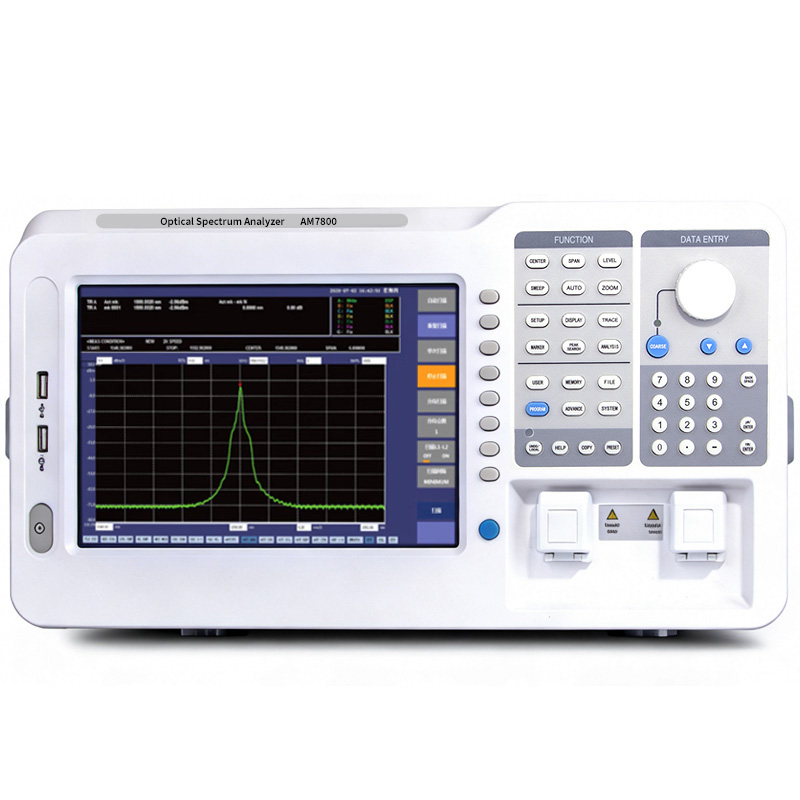
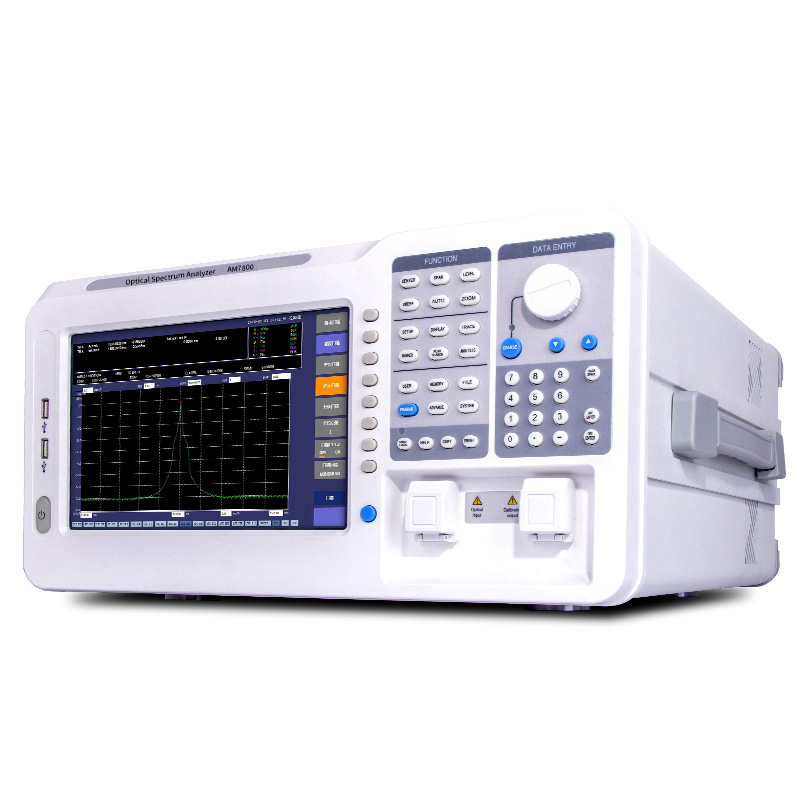
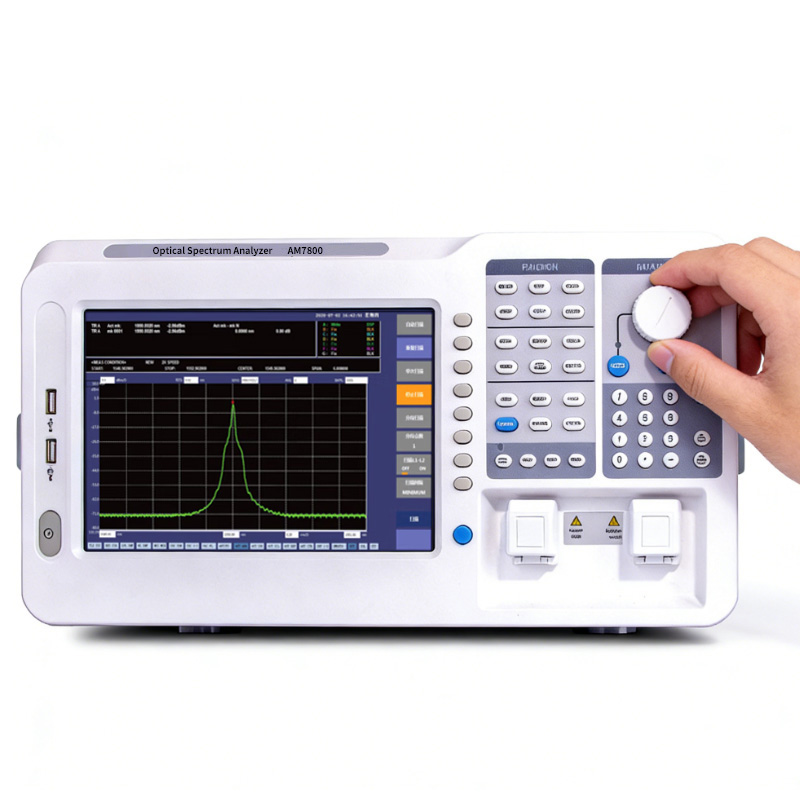
AM7800 Optical Spectrum Analyzer
for professional spectral analysis across the 600–1700 nm wavelength range
أبرز الملامح
-
Wide Wavelength Range: 600–1700 nm
Covers visible to near-infrared, ideal for telecom C/L-band, silicon photonics, and optical amplifier testing. Supports both legacy and next-gen networks, reducing the need for multiple instruments. -
Ultra-High Sensitivity: -90 dBm
Detects very weak signals, critical for low-power amplifier outputs, high-insertion-loss components, and accurate OSNR measurements in dense WDM systems. -
Adjustable Resolution: 0.02–2 nm
Seven selectable steps (0.02, 0.05, 0.1, 0.2, 0.5, 1, 2 nm) for precise DFB laser SMSR analysis or fast WDM channel scans, balancing speed and accuracy. -
75 dB Dynamic Range & Low Stray Light
Monochromator-based design ensures clear separation of close spectral lines and accurate detection of weak side-mode signals near strong carriers. -
Built-in Automated Analysis Functions
Pre-configured tests for EDFA gain/noise figure, WDM channel analysis (up to 1024 channels), DFB/FP laser characterization, reducing manual errors and accelerating testing workflows. -
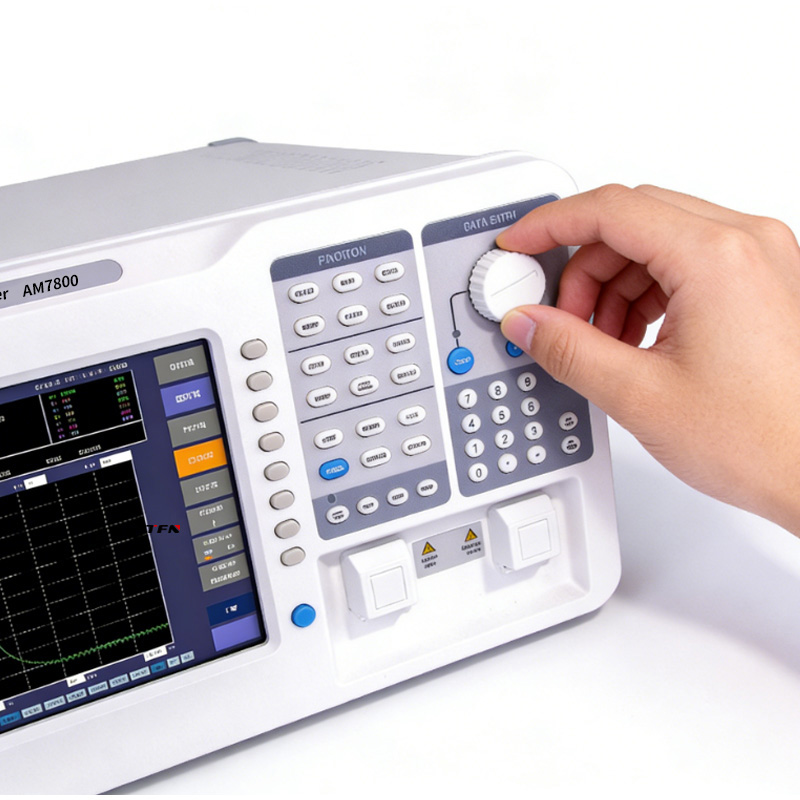
User-Friendly Interface & Connectivity
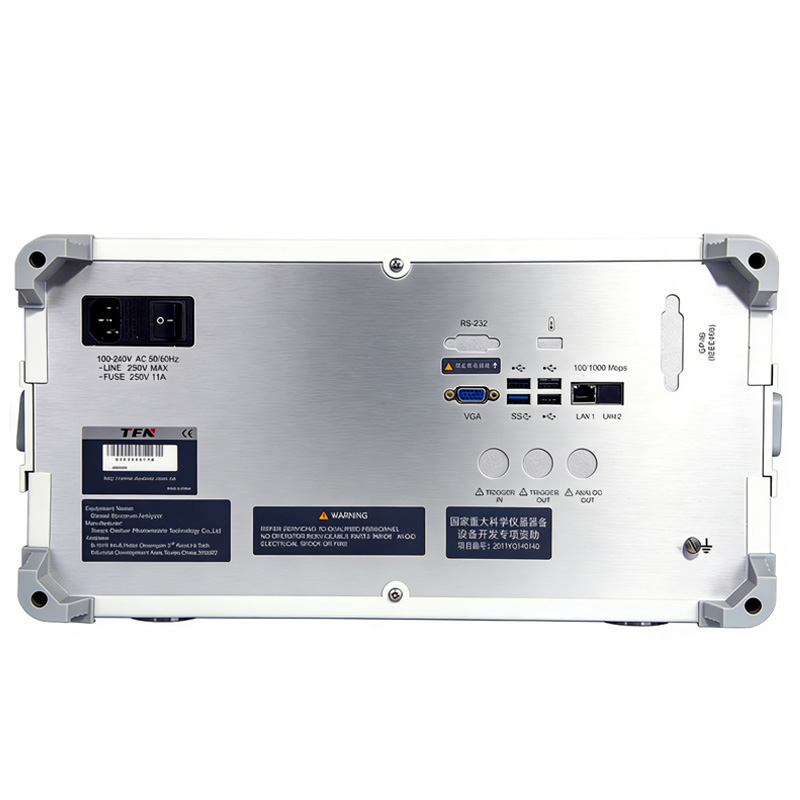
10.1-inch capacitive touchscreen, plus Ethernet, USB, and GP-IB for seamless integration into labs, telecom networks, and industrial environments.
المواصفات
| Optical Spectrum Measurement | |
| Input Fiber | SM (9.5/125 μm), MMF (50/125 μm, 62.5/125 μm) |
| Wavelength Range | 600 ~ 1700 nm |
| Resolution Bandwidth | 0.02 ~ 2 nm |
| Resolution Settings | 0.02 nm, 0.05 nm, 0.1 nm, 0.2 nm, 0.5 nm, 1 nm, 2 nm |
| Wavelength Accuracy | ±0.02 nm (1520-1620 nm); ±0.04 nm (1450-1520 nm); ±0.1 nm (Full Range) |
| Wavelength Repeatability | ±0.005 nm (1 minute) |
| Wavelength Linearity | ±0.01 nm (1520-1580 nm); ±0.02 nm (1450-1520 nm, 1580-1620 nm) |
| Minimum Sampling Resolution | 0.001 nm |
| Power Measurement | |
| Power Sensitivity | -90 dBm (1300-1620 nm, Resolution≥0.05 nm, HIGH3); -85 dBm (1000-1300 nm, Resolution≥0.05 nm, HIGH3); -60 dBm (600-1000 nm, Resolution≥0.05 nm, HIGH3) |
| Max Input Power | +23 dBm (All Channels, Full Range) |
| Power Accuracy | ±0.05 dB (Input Power: -50 to +10 dBm, HIGH1/HIGH2/HIGH3) |
| Optical Return Loss | >35 dB (with APC connector) |
| سرعة المسح | 0.3s (SPAN: 30nm; RES: 0.1nm; Sensitivity: MID) |
- EDFA Performance Characterization & Optical Amplifier Testing
The AM7800 features a dedicated EDFA-NF analysis function that automates the complex process of measuring Erbium-Doped Fiber Amplifier performance. By capturing input and output spectra simultaneously, the system calculates gain, noise figure (NF), and amplified spontaneous emission (ASE) power with precision compliance to IEC standards. This eliminates manual data extraction errors and reduces measurement time from minutes to seconds. For optical component manufacturers and telecom operators, this capability ensures amplifier modules meet specifications before deployment, preventing costly network failures and reducing return merchandise authorization (RMA) rates. The built-in curve-fit algorithm accurately interpolates ASE levels between WDM channels, providing reliable NF measurements even in densely packed multi-channel systems.
- WDM Channel Analysis & DWDM System Validation
Supporting up to 1024 simultaneous channel measurements, the AM7800’s WDM analysis function automatically detects peak wavelengths, power levels, and optical signal-to-noise ratios (OSNR) across entire C-band and L-band spectrums. The system calculates channel spacing, center wavelength deviations from ITU-T grids, and total system power with single-button operation. For network operators deploying 100G/400G coherent systems, accurate OSNR measurement is critical because signal degradation directly impacts bit error rates. The analyzer’s 75dB dynamic range enables precise noise floor measurement between closely spaced DWDM channels (50GHz spacing), ensuring compliance with stringent telecom standards and preventing channel crosstalk that causes data transmission errors.
- DFB Laser Source Characterization & Quality Control
The AM7800 provides comprehensive Distributed Feedback laser testing capabilities including center wavelength, peak power, 3dB bandwidth, side-mode suppression ratio (SMSR), and wavelength drift measurement. These parameters are essential for ensuring laser diodes meet specifications for telecom transceivers, LiDAR systems, and sensing applications. The high 0.02nm resolution enables detection of small side-modes that indicate manufacturing defects or aging degradation, while automated SMSR calculation eliminates operator interpretation variability. For photonics manufacturers, this functionality supports 100% production testing with pass/fail criteria, ensuring shipped lasers maintain stable single-mode operation throughout their operational lifetime and preventing field failures in critical communication infrastructure.
- FP Laser & Broadband Source Evaluation
For Fabry-Perot laser diodes and broadband light sources (SLD, ASE), the AM7800 measures RMS spectral width, full-width half-maximum (FWHM), mode spacing, and total integrated power. These measurements are critical for medical imaging systems, fiber optic gyroscopes, and optical coherence tomography (OCT) equipment where source characteristics directly impact system resolution and signal quality. The analyzer’s 600-1700nm range covers both standard 850nm/1300nm multimode applications and specialized 1064nm industrial laser testing. By providing accurate spectral shape characterization, the AM7800 helps engineers optimize coupling efficiency into optical fibers, minimize dispersion penalties in high-speed data links, and ensure consistent performance in precision measurement instruments.
- Gas Detection & Spectral Absorption Analysis
When paired with supercontinuum (SC) or superluminescent diode (SLD) broadband sources, the AM7800 enables spectroscopic analysis of gas mixtures by measuring absorption spectra across the near-infrared fingerprint region. This capability supports environmental monitoring, industrial process control, and medical breath analysis applications where specific molecular absorption lines must be identified with high wavelength accuracy. The instrument’s ±0.015nm wavelength precision ensures accurate identification of CO2, CH4, H2O, and other gas species, while the high sensitivity captures weak absorption features in low-concentration samples. For research institutions and industrial R&D labs, this transforms the AM7800 from a telecom tool into a versatile scientific instrument for photonics research and sensor development.
الأسئلة الشائعة
The AM7800 distinguishes itself through its combination of 600-1700nm ultra-wide wavelength coverage, -90dBm exceptional sensitivity, and comprehensive built-in analysis functions (EDFA-NF, WDM, DFB analysis) typically found only in premium instruments. The 10.1-inch capacitive touchscreen and multiple connectivity options (Ethernet, GP-IB, USB 3.0) provide superior usability and automation capabilities for production environments compared to entry-level models.
While the AM7800 has low polarization dependence (±0.05 dB) for accurate power measurements, it is not a full PDL measurement system. However, by using an external polarization controller and capturing multiple spectra with different polarization states, users can calculate PDL manually. For dedicated PDL testing, we recommend pairing the AM7800 with a polarization analysis accessory or considering specialized PDL measurement equipment.
The EDFA-NF function uses the ASE interpolation method (IEC 61290-3 compliant) to measure gain and noise figure. The analyzer captures two traces: input spectrum (Trace A) and amplified output spectrum (Trace B). It automatically detects laser peaks, calculates integrated signal power, interpolates ASE noise levels between channels using curve-fitting algorithms, and computes gain and NF values. This automated process eliminates manual calculation errors and provides results consistent with telecom industry standards.
The AM7800 features internal wavelength calibration using a built-in reference light source. For optimal performance, we recommend performing optical alignment and wavelength calibration monthly or when moving the instrument between environments. The system prompts users when calibration is needed. Annual factory calibration is recommended for maintaining guaranteed specifications, particularly for wavelength accuracy and power linearity critical in production testing environments.
Yes, the AM7800 supports comprehensive remote control via GP-IB (IEEE 488.2), Ethernet (TCP/IP), and RS-232 interfaces. SCPI command compatibility ensures integration with LabVIEW, Python, MATLAB, and other test automation platforms. The instrument can be programmed to perform sequential measurements, export data to network storage, and generate pass/fail reports without operator intervention—ideal for high-volume manufacturing lines and 24/7 production environments.