





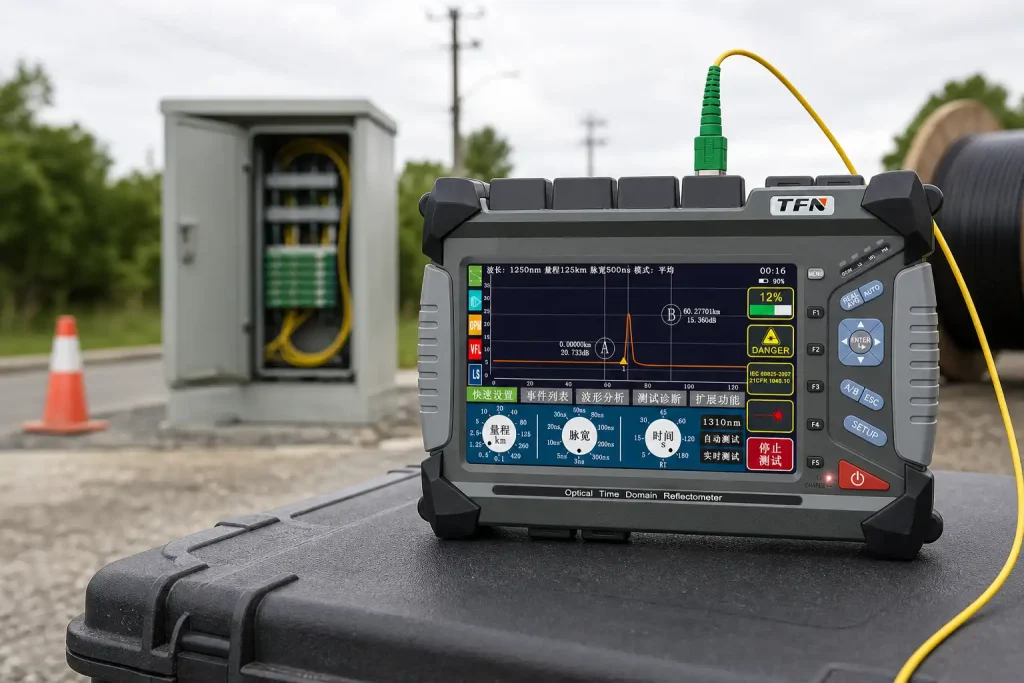
An OTDR, or Optical Time Domain Reflectometer, is a handheld or benchtop instrument that tests the health of a fiber optic cable from a single end — without needing access to the far end.
It sends short pulses of laser light into the fiber and measures how much light bounces back. From that returning signal, it can calculate:
- Fiber length — precisely, to the meter
- Total signal loss — measured in decibels (dB)
- Location of splices and connectors — and how much loss each one causes
- Faults, breaks, or sharp bends — pinpointed to within a few meters
The result is displayed as a graphical trace — a sloping line on a screen that represents the fiber link from start to finish. Each dip, spike, or step on that line tells a story about what is happening inside the cable.
One-sentence definition for easy recall: An OTDR is to fiber optic cables what a medical ultrasound is to the human body — it sends a signal in, listens to what comes back, and maps what is happening inside.
What Does OTDR Stand For?
- O — Optical
- T — Time
- D — Domain
- R — Reflectometer
The “time domain” part is key. The instrument measures how long it takes for light to return after a pulse is sent. Since light travels at a known speed through glass fiber, that time can be converted directly into distance. This is the same principle used in radar and sonar — just with light instead of radio waves or sound.
What Can an OTDR Measure?
Here is a quick summary of what the instrument tells you in a single test:
| Measurement | What It Means | Why It Matters |
|---|---|---|
| Fiber length | Total cable distance | Verifies installation against design specs |
| Overall attenuation | Total signal loss (dB) | Confirms the link meets loss budget |
| Splice loss | Loss at each fusion or mechanical splice | Identifies poor splices before commissioning |
| Connector loss & reflectance | Loss and back-reflection at each connector | Finds dirty or misaligned connectors |
| Fault location | Distance to a break or high-loss point | Pinpoints damage for fast repair |
| Fiber end | Where the fiber terminates | Confirms end-to-end continuity |
What Is an OTDR Used For?
OTDRs are used across three main workflows:
1. Installation & Acceptance Testing
After a new fiber link is installed, an OTDR verifies that every splice is within the specified loss limit and that the total link loss matches the design. This test result becomes the official acceptance report handed to the client or network operator.
2. Certification & Documentation
Most fiber standards (TIA-568, IEC 61280-4) require bidirectional OTDR measurements for certified links. The OTDR trace provides permanent documentation of the link’s baseline condition — useful for future troubleshooting.
3. Fault Finding & Troubleshooting
When a fiber link goes down, an OTDR immediately tells you exactly how far down the cable the problem is — a cut, a crushed section, or a water-damaged splice. Instead of digging up the entire route, technicians dig only at the precise location.
Who Uses an OTDR?
- Fiber optic contractors — for installation testing and client sign-off
- Telecom and FTTH network operators — for maintenance and fault response
- Data center engineers — for short-link certification and troubleshooting
- Outside plant (OSP) crews — for long-haul cable testing
- Instrument distributors — to demonstrate and support the equipment they sell
OTDR vs. Other Fiber Test Tools
An OTDR is powerful, but it is not the only tool on a fiber technician’s kit. Here is how it compares to two common alternatives:
| Tool | Measures | Best For | Limitation |
|---|---|---|---|
| OTDR | Loss profile along entire link + fault location | Troubleshooting, certification, long links | Less accurate on very short links (< 10 m) |
| Optical Power Meter + Light Source (OLTS) | Total end-to-end insertion loss | Quick pass/fail on short links | Cannot locate where loss occurs |
| Visual Fault Locator (VFL) | Visible red light for breaks/bends | Short-range break finding | No distance or dB measurement |
For most professional fiber installations, an OTDR and an OLTS (optical loss test set) are used together: the OLTS for a quick pass/fail measurement, and the OTDR for a full trace and documentation. For more on this, see our guide: OTDR vs Power Meter (OLTS): Which Fiber Test Do You Actually Need?.
Key OTDR Specifications to Know
When selecting an OTDR, these are the core specs that affect what it can test:
- Dynamic Range (dB): How far the OTDR can “see” into a fiber link. Higher is better for long-haul testing. A 30 dB dynamic range typically covers 60–100 km of single-mode fiber.
- Dead Zone (m): The distance at the start of the fiber where the OTDR is temporarily “blinded” after sending a pulse. Events within this zone cannot be resolved. A shorter dead zone is better for testing near connectors.
- Wavelength (nm): Single-mode fiber is typically tested at 1310 nm and 1550 nm. Multimode fiber at 850 nm and 1300 nm. Some OTDRs support multiple wavelengths in one unit.
- Pulse Width (ns/µs): Shorter pulses give better spatial resolution for short links; longer pulses increase dynamic range for long links.
Frequently Asked Questions
They serve different purposes. A power meter tells you how much total loss there is. An OTDR tells you where the loss is and what is causing it. For fault finding or detailed certification, you need an OTDR.
Yes. OTDRs are available for both single-mode (SMF) and multimode (MMF) fiber. Make sure the wavelength of the OTDR matches the fiber type you are testing.
A single automated measurement typically takes 30 seconds to 3 minutes per fiber, depending on link length and the number of averages the instrument takes. Full documentation and reporting adds time on top.
Yes — that is one of its key advantages. You do not need a technician at the far end. However, for the most accurate splice loss measurements, bidirectional testing (from both ends) is recommended by most standards.
Summary
An OTDR is the standard diagnostic instrument for fiber optic networks. It tests from one end, maps the entire link, measures loss at every splice and connector, and locates faults with meter-level precision. Whether you are commissioning a new FTTH installation, certifying a data center backbone, or tracking down a fault in a buried cable, an OTDR gives you the visibility no other tool can match.