





Fiber optic testing is not only about technical specifications. In real-world network deployment and maintenance, precision is measured by how efficiently engineers can operate the instrument, interpret results, and make reliable decisions in the field.
The TFN RM7 Series OTDR is designed to transform advanced hardware capabilities—including up to 50 dB dynamic range, a 0.6 m event dead zone, and multi-wavelength testing—into a seamless testing experience from startup to final report generation.
This article explores how the RM7 delivers a practical high-precision OTDR experience throughout the entire testing workflow.
1. Better Usability Starts with Better Interaction
10.1-Inch Touchscreen with Synchronized Information Display
Many traditional OTDRs suffer from small displays and complex menu structures that slow down field operations.
The TFN RM7 features a 10.1-inch 1280 × 800 high-brightness TFT touchscreen, providing excellent visibility even in outdoor environments under direct sunlight.
Its user interface simultaneously displays:
- OTDR trace
- Event table
- Fiber link overview
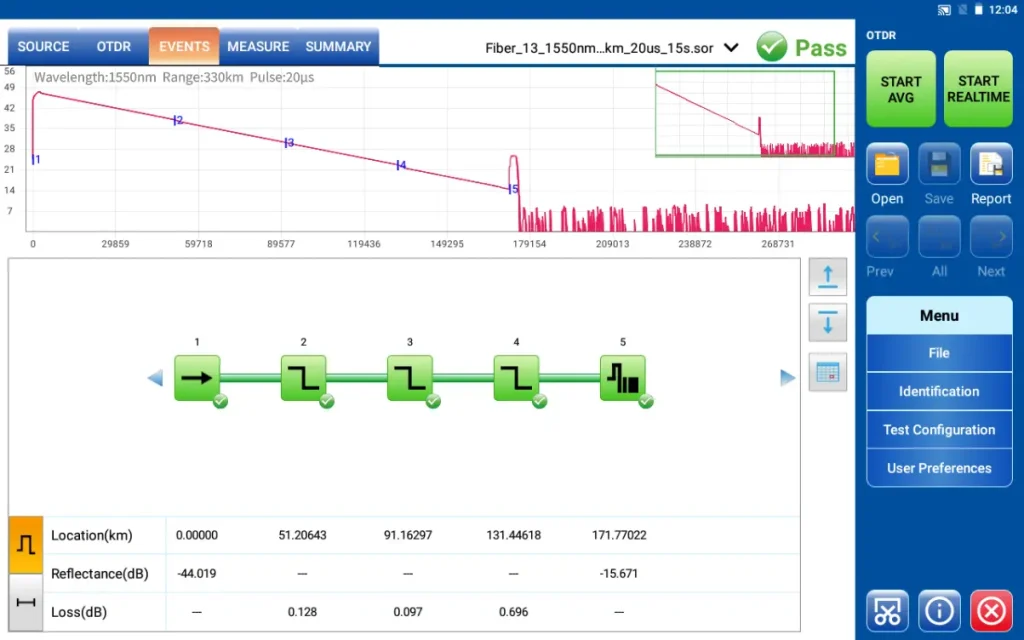
Engineers can monitor the entire fiber link without switching between screens, reducing operational complexity and improving workflow efficiency.
As optical pulses travel through the fiber, the OTDR trace is generated in real time while key events—including splice points, connectors, attenuation points, and fiber sections—are automatically analyzed and displayed.
This synchronized visualization minimizes the need to constantly alternate between graphs and numerical data.
Multi-Touch Gesture Control
The RM7 adopts a capacitive multi-touch interface that enables intuitive operations such as:
- Pinch-to-zoom trace analysis
- Cursor positioning
- Event marker navigation
- Precise A/B distance measurements
Compared with traditional button-based navigation, touch control significantly improves operational speed and reduces fatigue during extended field testing.
2. Simplified Testing from Setup to Results
AUTO Mode for Intelligent Parameter Optimization
One of the most valuable features of the RM7 is its AUTO testing mode.
When testing an unknown fiber link, engineers no longer need to manually configure critical parameters such as:
- Measurement range
- Pulse width
- Averaging time
The OTDR automatically determines optimal settings based on the detected network conditions.
Intelligent Range Selection
The instrument automatically matches the testing range to the actual fiber length, preventing:
- Oversized ranges that reduce resolution
- Undersized ranges that miss end-of-link events
Dynamic Pulse Width Adjustment
Pulse width is optimized according to testing distance and required resolution.
- Narrow pulses improve short-distance event resolution.
- Wider pulses increase dynamic range for long-haul fiber links.
Automatic Averaging Time
The RM7 balances acquisition speed and signal quality by automatically selecting the appropriate averaging duration.
For experienced technicians, AUTO mode accelerates routine inspections. For newer users, it minimizes the risk of incorrect parameter settings and ensures reliable test results.
Real-Time (RT) Monitoring Mode
During fiber splicing, connector inspection, or troubleshooting, engineers often need immediate feedback.
The RM7’s Real-Time (RT) Mode continuously refreshes the OTDR trace, allowing users to observe changes as they occur.
When adjusting a fiber bend radius or reworking a splice, attenuation changes and reflection events are displayed instantly on the screen.
Instead of performing repeated measurements, technicians can make adjustments and verify results simultaneously, significantly reducing troubleshooting time.
3. Smarter Diagnostics and Easier Interpretation
iOLA Intelligent Optical Link Analysis
Obtaining accurate measurements is only part of the testing process. Interpreting those results quickly is equally important.
The RM7 integrates iOLA (Intelligent Optical Link Analysis), which converts complex OTDR traces into a visual fiber link topology.
Color-Coded Event Identification
Green Indicators
- Events within predefined loss and reflectance thresholds
Red Alerts
- Events exceeding thresholds are automatically highlighted
By selecting an event, engineers can instantly view:
- Event location
- Insertion loss
- Reflectance
- Cumulative loss
This visualization enables faster fault identification compared with manually reviewing lengthy event tables.
Multi-Wavelength Comparison for Macrobend Detection
The RM7 supports dual-, triple-, and quad-wavelength OTDR testing, providing a powerful tool for identifying macrobending losses.
When comparing traces at 1310 nm and 1550 nm:
- The 1550 nm wavelength typically shows significantly greater attenuation at bend locations.
- The 1310 nm trace remains relatively stable.
By overlaying multiple wavelength traces on the same graph, the RM7 makes macrobending issues immediately visible without requiring complex interpretation.
This visual approach helps engineers detect fiber degradation faster and with greater confidence.
4. From Measurement to Report: A Complete Workflow
Automatic File Naming and Efficient Data Management
High-volume fiber testing projects often generate hundreds of OTDR traces.
The RM7 simplifies data management with automatic file naming based on predefined rules such as:
- Location
- Cable ID
- Fiber number
This reduces manual input errors and improves traceability across large-scale projects.
The instrument includes:
- 16 GB internal storage
- USB export capability
- TF card support
allowing convenient backup and long-term data archiving.
Standard .SOR File Format and PC-Based Analysis
All test results are stored in the industry-standard .SOR format, fully compatible with Telcordia GR-196 specifications.
Data can be imported directly into OTDR Assistant software for:
- Advanced trace analysis
- Report generation
- Project documentation
- Long-term record management
This creates a complete workflow from field acquisition to office-based reporting.
Why the RM7 Delivers a True High-Precision OTDR Experience
High precision is more than dynamic range, dead-zone performance, or measurement accuracy. It is the confidence engineers gain throughout every step of the testing process.
The TFN RM7 Series combines advanced hardware capabilities—including up to 50 dB dynamic range and a 0.6 m event dead zone—with intelligent software features such as:
- AUTO parameter configuration
- Real-Time monitoring
- iOLA intelligent link analysis
- Multi-wavelength fault diagnostics
- Automated reporting workflow
The result is a professional OTDR that transforms technical performance into practical productivity.
Whether you are deploying FTTH networks, maintaining backbone infrastructure, troubleshooting long-haul fiber links, or performing acceptance testing, the RM7 provides the speed, accuracy, and usability required for modern fiber optic testing.