





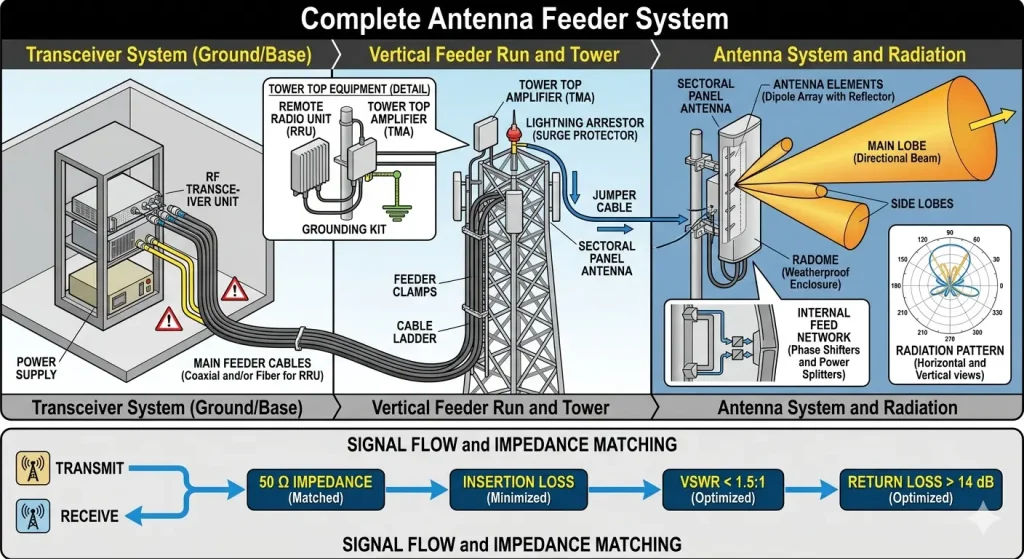
In mobile communication networks, the base station serves as the hub connecting users to the core network, and its operational stability directly determines network quality. One essential yet often overlooked component within the base station is the antenna feeder system. Many network faults—such as coverage holes, call drops, and reduced data rates—often originate not from the main equipment but from degradation in the antenna feeder system. Therefore, gaining a deep understanding of this system’s critical role and mastering the methods to evaluate its performance are core competencies for communication engineers to ensure network reliability.
Antenna Feeder Systems: The Physical Foundation of Network Coverage
An antenna feeder system mainly consists of antennas, feeders, and associated RF connectors. It is responsible for converting and transmitting RF signals between the base station transceiver and electromagnetic waves in free space. The system’s performance directly affects coverage range, interference levels, and user experience. From an engineering perspective, any problem in any part of the antenna feeder system can lead to systemic network performance degradation.
Studies show that in base station field maintenance, about 60% of RF performance issues are caused by poor connections or aging components in the antenna feeder system. This is because the antenna feeder system is exposed to outdoor environments for long periods—wind, rain, temperature fluctuations, and lightning strikes can change its physical characteristics. For example, water ingress in a feeder connector can cause a sharp rise in VSWR, which may lead to base station power back-off in mild cases or even burn out the power amplifier in severe cases. Therefore, periodic, precise inspection and diagnosis of the antenna feeder system are indispensable in network operations and maintenance.
Core Performance Parameters and Failure Mechanisms of Antenna Feeder Systems
In engineering evaluation, the quality of an antenna feeder system is mainly quantified by three core parameters: voltage standing wave ratio (VSWR), return loss, and cable loss.
VSWR is a key indicator of RF port matching. Ideally, VSWR should be close to 1, meaning all signal power is transmitted to the antenna and radiated. When VSWR exceeds 1.5, approximately 4% of the power is reflected back to the transmitter, which not only reduces coverage efficiency but also may cause overheating due to reflected power. Return loss is the logarithmic ratio of reflected power to incident power; a higher value indicates better matching. Cable loss reflects the attenuation of signals as they travel through the feeder—excessive cable loss directly reduces the base station’s coverage radius.
These parameters typically degrade gradually. A study on coastal base stations pointed out that salt spray corrosion can increase contact resistance of RF connectors by more than 300% within 18 months, causing VSWR to rise from 1.1 to 1.8 and triggering base station output power reduction. The qualitative “working or not” approach cannot capture this gradual degradation; therefore, quantitative measurement tools and periodic inspection routines must be introduced.
The 150H Antenna Feeder VSWR Tester: A Professional Tool for Field Diagnostics
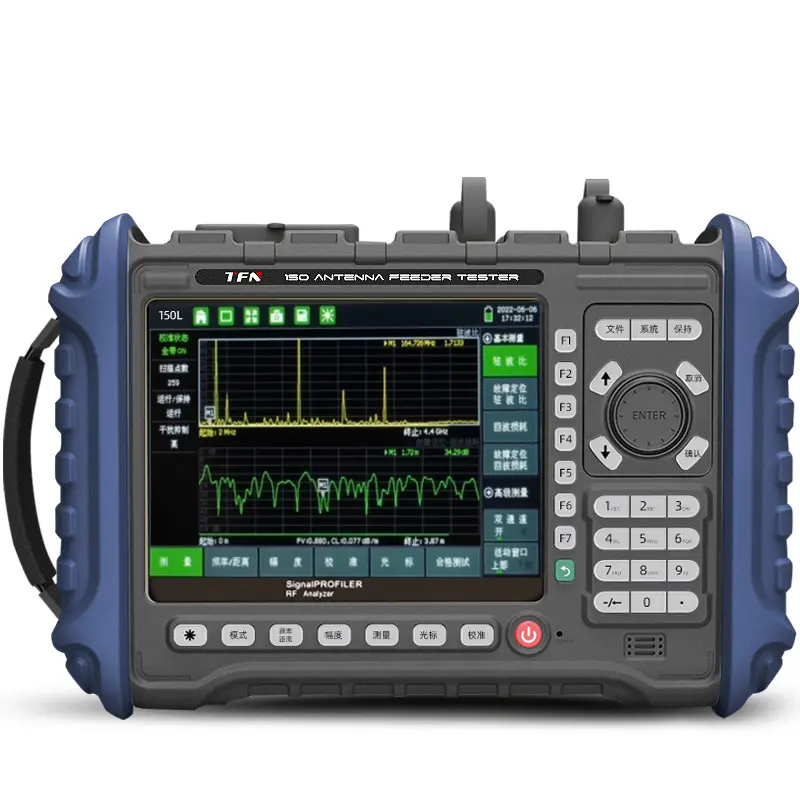
For communication engineers to quickly and accurately assess the status of antenna feeder systems in the field, professional measuring instruments are essential. The 150H Cable Antenna VSWR Analyzer is a comprehensive handheld test platform designed for this purpose. Covering a frequency range from 2 MHz to 6,100 MHz, it supports full-scenario testing of antenna feeder systems from low-band to Sub-6 GHz.
The key engineering value of this instrument lies in its ability to accurately measure the three core parameters mentioned above. In field operations, engineers can use the 150H to perform the following critical diagnostics:
First, conduct VSWR and return loss testing. The engineer connects the tester’s RF output port to the antenna feeder system under test via an RF cable, sets the start and stop frequencies, and the instrument directly displays the VSWR curve on the screen. Using the built-in marker functions, the frequency point with the highest VSWR across the band can be quickly located to determine whether it exceeds the design threshold (typically VSWR < 1.5). If anomalies are found, the “Distance to Fault” mode can be used for further investigation.
Second, perform Distance-to-Fault (DTF) measurements. This is one of the most engineering‑valuable applications in antenna feeder system diagnostics. When VSWR testing reveals reflection anomalies, engineers can switch the instrument to DTF mode, input the propagation velocity of the feeder (automatically obtained by selecting the cable type) and the distance range to be tested. Using frequency-domain reflectometry, the instrument accurately calculates and displays return loss or VSWR at different locations along the feeder. For example, if a prominent reflection peak appears at a connector location, it can be determined that the connection is loose or water‑ingressed. This “radar-like” fault location capability reduces troubleshooting time from days to hours.
Third, perform through‑type power meter and cable loss measurements. During base station commissioning or after maintenance, the power meter option can be used to measure forward and reflected power in real time, verifying that the base station’s transmit power meets planning requirements. At the same time, using the tester’s cable loss mode allows precise assessment of feeder aging, providing data support for preventive replacement.
To ensure the authority of measurement results, the 150H provides a complete calibration solution. Before performing precision measurements, engineers can perform OSL (open‑short‑load) calibration or use an electronic calibration module for full‑band calibration, minimizing systematic errors. After calibration, the instrument’s directivity can be better than –42 dB, ensuring measurement fidelity even in high‑VSWR scenarios.
Engineering Practices to Ensure Stable Operation of Antenna Feeder Systems
In communication engineering, antenna feeder system troubleshooting is a routine task that requires standardization. With the 150H tester, a complete quality assurance process can be established:
During the acceptance phase of new base stations, VSWR “baseline” measurements should be performed on the antenna feeder systems of all sectors using the tester, and the measurement curves should be saved as initial baselines. During routine inspections, comparing current measurement curves with the baselines allows rapid detection of minor degradation trends. According to research published by IEEE, regular VSWR testing of antenna feeder systems can reduce site outages caused by RF path failures by approximately 40%.
Furthermore, when a base station receives interference‑related complaints, engineers should first use the tester to check for passive intermodulation (PIM) issues in the antenna feeder system. Although the 150H does not directly measure PIM, its accurate VSWR measurements can help eliminate impedance‑mismatch‑related intermodulation, narrowing the scope of fault location. This layered testing methodology reflects an efficient approach to network operations and maintenance.
Conclusion
The antenna feeder system acts as a “throat” in base stations—its performance directly affects network coverage, capacity, and stability. For communication engineers, being proficient with professional tools such as the 150H Antenna Feeder VSWR Tester, and using parameters such as VSWR, return loss, cable loss, and distance‑to‑fault to “examine” the antenna feeder system, is not only a necessary skill for troubleshooting but also a core capability for achieving proactive network maintenance and enhancing user experience. As 5G network construction continues to advance, high‑frequency bands and multi‑antenna configurations place even higher demands on antenna feeder systems. Only by adhering to precision testing and data‑driven maintenance principles can we ensure the physical layer of base stations remains solid and reliable.
If you want to know more about the knowledge of antenna feeder system and TFN 150H cable and antenna analyzer, welcome to contact TFN support team:
Email: info@tfngj.com
WhatsApp: +86-18765219251
Or you can leave messages here
Frequently Asked Questions
The antenna feeder system acts as the physical bridge between the base station transceiver and free space. While often overlooked, it is responsible for approximately 60% of RF performance issues. Problems like coverage holes, dropped calls, and slow data rates usually stem from physical degradation in this system—such as aging connectors or water ingress—rather than software or main equipment failures.
Engineers primarily use three quantitative metrics to assess system health:
VSWR (Voltage Standing Wave Ratio): Measures RF port matching. Ideally, this should be close to 1.0; a value above 1.5 indicates significant signal reflection.
Return Loss: The logarithmic ratio of reflected power to incident power. Higher values indicate better impedance matching.
Cable Loss: Measures signal attenuation as it travels through the feeder. Excessive loss directly shrinks the base station’s effective coverage radius.
Traditional troubleshooting often requires manual inspection of the entire cable run. DTF measurements use frequency-domain reflectometry to create a “radar-like” map of the feeder. By calculating signal reflections at specific points, a tester can pinpoint the exact location of a loose connector or damaged cable section, reducing troubleshooting time from days to hours.
Since antenna systems are exposed to the elements, they are prone to gradual degradation. For example, in coastal environments, salt spray corrosion can increase contact resistance in RF connectors by over 300% in less than two years. Regular testing is essential to catch these gradual increases in VSWR before they lead to power amplifier burnout or total site failure.
Yes. Research indicates that establishing a “baseline” measurement during site acceptance and performing periodic inspections can reduce outages caused by RF path failures by approximately 40%. Proactive maintenance allows engineers to replace aging components before they reach a critical failure point.