





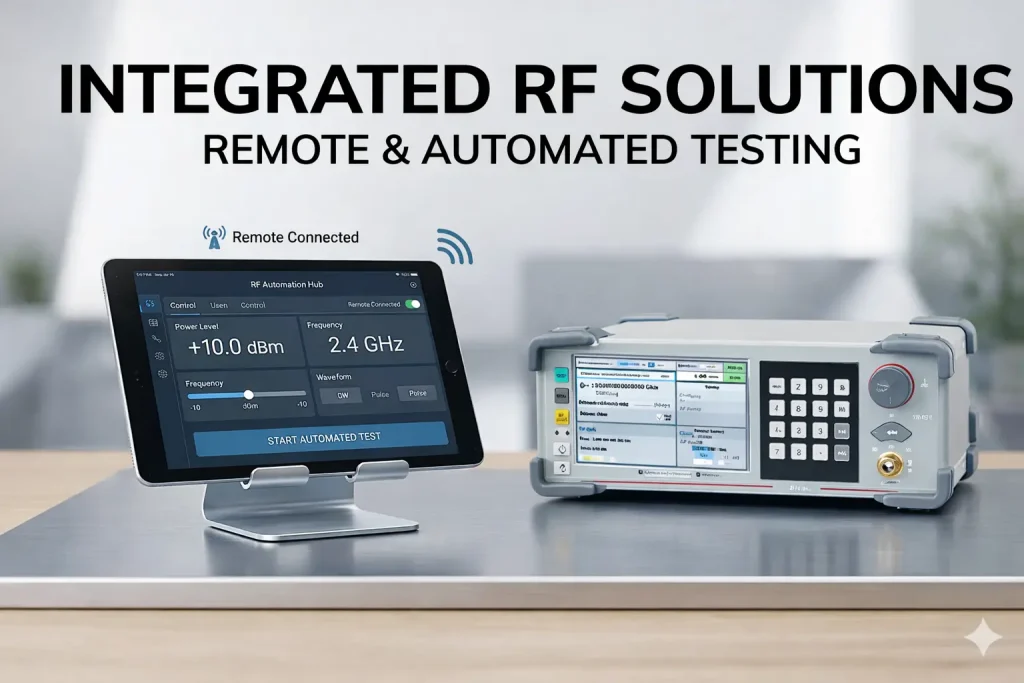
In the R&D and production lines of 5G communications, satellite payloads, and automotive radar, engineers face a common challenge: how to increase test system throughput while maintaining measurement accuracy. As the complexity of RF front-end modules continues to rise, the traditional method of manually turning knobs and recording data has become a bottleneck. Integrating an RF signal generator into an automated test system is not only a matter of efficiency but also a necessary means to ensure product consistency. This article will explore remote control solutions based on the TFN TG20A RF signal generator and its application in various industry scenarios from the perspective of a communications engineer.
Core Hardware: Signal Purity and Automation Foundation of the TG20A
To build a reliable automated test system, the source’s underlying performance determines the upper limit of the test results. Taking the TFN TG20A as an example, its frequency range covers 9 kHz to 21 GHz, meaning it can extend from low-frequency audio processing all the way to the microwave band, meeting testing needs from IoT modules to Ku-band satellite equipment. In automated testing, if the spurious signals from the signal source are too high, they often mask the true response of the Device Under Test (DUT). The TG20A achieves spurious suppression of -80 dBc at 10 GHz, a critical parameter for distinguishing between the source’s own spurious responses and the DUT’s nonlinear distortion.
Phase noise is equally critical, impacting modulation quality. This device achieves a phase noise of -114 dBc/Hz@10 kHz at a 10 GHz carrier offset. This low phase noise ensures that when testing high-speed modulated signals, the DUT’s Error Vector Magnitude (EVM) is not misjudged due to jitter from the source’s noise floor. Furthermore, its high-resolution power output of 0.01 dB provides finer steps when characterizing the response curve of Automatic Gain Control (AGC) circuits.
Remote Control Architecture: From SCPI Commands to System Integration
The core of automation lies in the communication bus and the command set. The TG20A is equipped with a LAN (RJ45) interface on its rear panel, allowing it to be easily integrated into existing rack-mount test environments. Through the LAN port, test engineers can write scripts using Python or LabVIEW to send SCPI commands controlling frequency switching, power output, and pulse modulation.
In a typical production line test scenario, a single industrial PC can control multiple TG20A units simultaneously via a switch. For example, during multi-channel receiver testing, the host computer program first resets and self-checks the TG20A through the LAN port, then sets different carrier frequencies according to the test case, and simultaneously reads values from a power meter. The RF signal generator’s fast response time directly dictates the production line’s takt time. The TG20A’s internal architecture optimizes frequency switching speed, reducing redundant delays inserted while waiting for the signal to stabilize.
Automotive Millimeter-Wave Radar Testing
With the proliferation of Advanced Driver-Assistance Systems (ADAS), the cost of 77 GHz millimeter-wave radars continues to decrease, but their production testing remains complex. Since the TG20A’s upper frequency limit is 21 GHz, directly testing 77 GHz radars requires using a frequency multiplier. However, this does not hinder its application in testing radar IF (Intermediate Frequency) circuits. During the testing of a radar’s IF processing board, engineers can use the TG20A to simulate the IF echo signal post-mixing. By injecting simulated target distance and speed information via the Pulse Signal Input/Output interface (BNC-Female), the correctness of the backend Digital Signal Processor’s algorithms can be verified.
Adjacent Channel Leakage Ratio Testing for Communication Modules
For R&D on IoT modules or mobile phone power amplifiers, the Adjacent Channel Leakage Ratio (ACLR) is a key indicator. During testing, a clean carrier from the RF signal generator is required to excite the amplifier into saturation or linear regions. The TG20A’s low phase noise characteristic ensures that the leakage measured during ACLR testing primarily originates from the amplifier’s nonlinearity, not the source’s broad noise floor. Engineers can write Python scripts to make the TG20A sweep across multiple frequency bands cyclically while simultaneously reading data from a spectrum analyzer connected via LAN, achieving automated ACLR monitoring of the amplifier across its entire operating frequency band.
Automated S-Parameter Measurement for Multi-Port Devices
In materials science or microwave device R&D, Vector Network Analyzers are expensive and often have limited ports. Using the TG20A paired with a broadband receiver allows for building a low-cost, multi-port S-parameter measurement system. By controlling the TG20A via LAN to sweep through individual frequency points and switching test ports via mechanical switches, the host software synchronously collects amplitude and phase data. While this scheme sacrifices some real-time performance, in a lab environment not demanding extreme speed, it can characterize four-port or even eight-port baluns or couplers at a relatively low cost.
Timing Control and Synchronization Mechanisms
In complex test sequences, time synchronization is a major challenge. The TG20A provides 10 MHz Input/Output interfaces and a Trigger Signal Input interface. In a coherent test system, the 10 MHz reference clocks of multiple TG20A units can be cascaded to ensure all sources are phase-locked. When pulse testing is required, the Pulse Signal Input/Output interface can be used to synchronize the signal source strictly with a pulse modulator, generating clean, glitch-free pulse-modulated waveforms. This hardware synchronization mechanism offers lower latency than purely software-based commands sent over LAN, making it more suitable for timing-sensitive test scenarios like radar simulation.
Conclusion
From 9 kHz low frequency to 21 GHz microwave, the TFN TG20A radio frequency signal generator, through its LAN remote control interface, high-purity signal output, and flexible triggering mechanisms, provides solid hardware support for modern electronic testing. Whether in automotive electronics, communications infrastructure components, or aerospace modules, embedding an RF signal generator into an automated system enhances not only efficiency but also test accuracy. Looking ahead, as test systems trend towards modularization and software-defined architectures, instruments like the TG20A with robust remote control capabilities will play an increasingly vital role in smart manufacturing and scientific research.
If you are interested in TFN TG20A microwave signal generator, welcome to contact TFN Support Team:
Email: info@tfngj.com
WhatsApp: +86-18765219251
Or you can leave messages Here
References
[1] Pozar, D. M. Microwave Engineering. 4th ed., John Wiley & Sons, 2012.
[2] Rohde, U. L., & Newkirk, D. P. RF/Microwave Circuit Design for Wireless Applications. Wiley-Interscience, 2000.
[3] Brooker, G. M. “Understanding Millimetre Wave FMCW Radars.” 1st International Conference on Sensing Technology, 2005, pp. 152-157.