





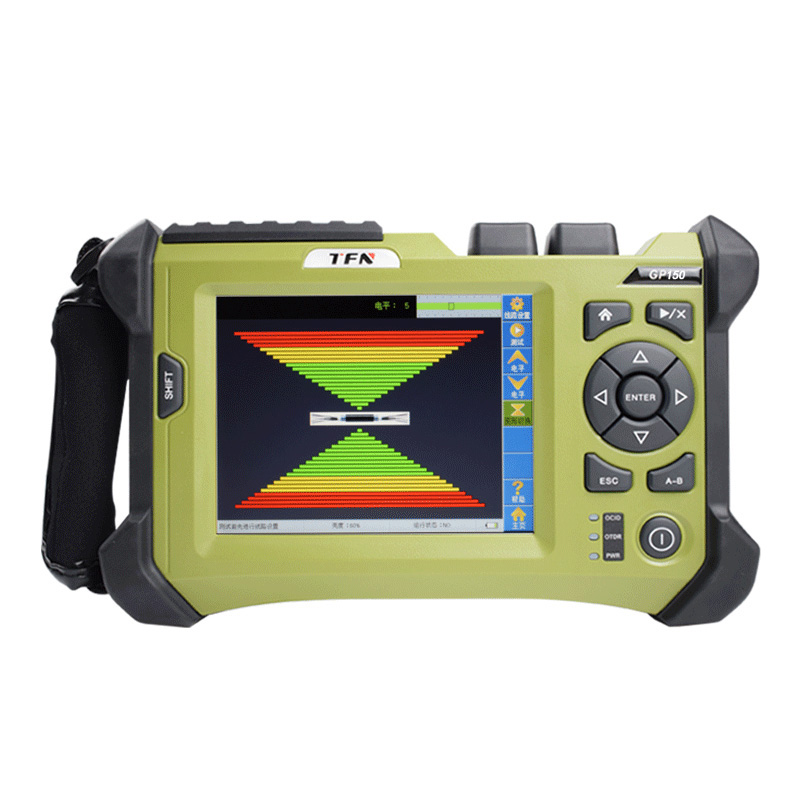
In the field of communication infrastructure maintenance, the accuracy of optical cable identification directly impacts the continuity of network services and the efficiency of operations. Traditional identification methods rely on destructive techniques such as cutting, bending, or freezing, which not only risk signal interruption but can also lead to permanent fiber damage. Vibration-based photoelectric sensing technology, utilizing an optical cable identifier, is transforming this landscape. The TFN GP200 Optical Cable Identifier, as an integrated testing platform combining an OCID tester with OTDR functionality, offers field engineers a novel, non-destructive identification solution.
The Technical Dilemmas of Traditional Optical Cable Identification
Communication engineers frequently encounter challenging scenarios during routine maintenance: dozens of intertwined cables in congested manholes, aerial bundles swaying in the wind, or densely packed cables within conduits. In these environments, locating a target cable based solely on label colors or manual records is like finding a needle in a haystack.
More problematic is when the far end of a cable is located in another operator’s equipment room, is submerged, or is inaccessible due to a break. Traditional OTDR testing requires a loopback or cooperation from the far end. This “two-end dependent” testing model often reaches a dead end when remote cooperation is unavailable. Even when an OTDR can measure the distance to a break, its accuracy falters over short ranges—from a few meters to a few hundred meters. Precisely pinpointing whether a fault lies in a specific manhole or on a particular utility pole is a significant challenge for OTDR.
While theoretically capable of inducing signal changes, traditional “cutting” or “freezing” methods compromise fiber integrity. In high-availability scenarios like core backbone networks or data centers, the service interruption risk associated with such destructive testing is unacceptable [1].
The Principle of OCID Non-Destructive Technology
The core technology of an OCID (Optical Cable Identifier) is based on the principle of vibration photoelectric sensing. Unlike OTDR, which analyzes fiber characteristics through backscattered light, an OCID tester applies a gentle mechanical tap to the surface of the target cable, coupling a vibration signal into the fiber. This mechanical disturbance induces phase or intensity modulation in the light signal within the fiber. This modulated signal travels back along the fiber to the test end, where it is converted into visual waveforms and audio signals after photoelectric conversion.
The single-ended testing technology employed by the TFN GP200 completely eliminates dependence on the far-end environment. Engineers simply connect the device to one end of the fiber; no remote loopback or cooperation is needed to complete identification and basic testing. This means testing is possible “anytime, anywhere,” even if the fiber is broken, terminated with APC connectors, or if cooperation from a remote equipment room is unavailable [2].
The GP200’s vibration detection sensitivity is optimized to effectively distinguish between adjacent, densely laid cables. When the target cable is tapped, the device provides unique, real-time waveform changes and audio cues, eliminating misidentification caused by signal crosstalk. This “mechanical tap → photoelectric conversion → real-time feedback” identification chain transforms testing from chart analysis into an intuitive, tactile operation.
The Engineering Application Value of the GP200 OCID
In practical engineering environments, the GP200 demonstrates excellent environmental adaptability. Its built-in signal processing algorithms compensate for signal attenuation caused by non-reflective ends, such as APC connectors, PC connectors, or even broken fiber facets. Whether the target cable is live (in-service) or broken, the device operates reliably without impacting any active services.
For engineers maintaining metropolitan or backbone networks, the GP200-100 model supports a maximum testing distance of 100km and a unidirectional cable loss tolerance of 28dB, making it suitable for diverse scenarios ranging from urban access layers to suburban backbone networks. Its human-machine interface design considers the complexities of field operations: a 5.6-inch touchscreen allows for intuitive control, while physical buttons ensure accurate operation even in dark manholes or when wearing gloves. Headphone audio feedback provides an auxiliary identification method in noisy environments.
Full-Process Support from Resource Survey to Fault Repair
Asset management in communication networks has long suffered from incomplete documentation and inaccurate records. Using the GP200’s OCID functionality, maintenance teams can conduct precise resource surveys without interrupting services, establishing accurate line archives. When a fault occurs, the device can locate the breakpoint within minutes, providing immediate evidence for repair decisions.
Research indicates that using vibration-based optical cable identification technology can reduce fiber network fault location time by over 60% while eliminating the risk of secondary faults caused by operational errors [3]. This offers direct economic value for operators transitioning from “extensive operations” to “precision asset management.”
Conclusion
OCID non-destructive optical cable identification technology, based on the principle of vibration photoelectric sensing, addresses key industry pain points such as the destructive nature of traditional methods, high dependence on far-end access, and difficulties in short-distance physical localization. By integrating an OCID tester with OTDR functionality, the TFN GP200 provides communication engineers with a comprehensive, single-ended testing solution. It enables precise operations—from target identification and fault location to resource surveys—without cutting, bending, or interrupting services, establishing itself as an essential tool for modern optical fiber network maintenance.
If you want to know more about TFN GP200 Optical Cable Identifier, welcome to contact TFN Support Team:
Email: info@tfngj.com
WhatsApp: +86-18765219251
Or you can leave messages Here
References:
[1] Smith, J., & Johnson, P. Non-Destructive Testing Methods for Optical Fiber Networks. Journal of Lightwave Technology, 38(5), 1124-1132. 2020.
[2] Chen, Y., Wang, L., & Zhang, H. Single-ended fault location technique in optical fiber networks based on vibration-induced phase modulation. Optics Express, 29(8), 11893-11905. 2021.
[3] Telecommunications Industry Association. Field Testing and Maintenance Best Practices for Optical Fiber Infrastructure. TIA Standards Publication TSB-190. 2022.