





In radio frequency testing, the K-band (18–26.5 GHz) plays a critical role in satellite communications, radar systems, 5G backhaul, and point-to-point microwave links. Its high frequency and short wavelength enable large bandwidth and compact antenna designs, but they also introduce significant measurement complexity.
As frequency increases, signal attenuation, phase noise, mixer nonlinearity, and instrument dynamic range limitations become more pronounced. Achieving reliable, high-precision results in the K-band is therefore not just a matter of hardware capability—it also depends heavily on signal processing architecture and overall system design.
This article explores the key challenges engineers face in K-band measurement and discusses practical approaches to improving accuracy and stability in real-world RF testing scenarios.
Challenges of K-band Measurement
In the K-band, the free-space path loss of signals increases significantly, meaning the signals reaching the input of the spectrum analyzer are often extremely weak. Simultaneously, the non-linear characteristics of high-frequency components, the phase noise of the local oscillator, and the flatness of the signal chain directly impact the confidence level of the measurement results. To capture such high-frequency signals, a high-performance spectrum analyzer must possess an extremely low noise floor and excellent phase noise performance.
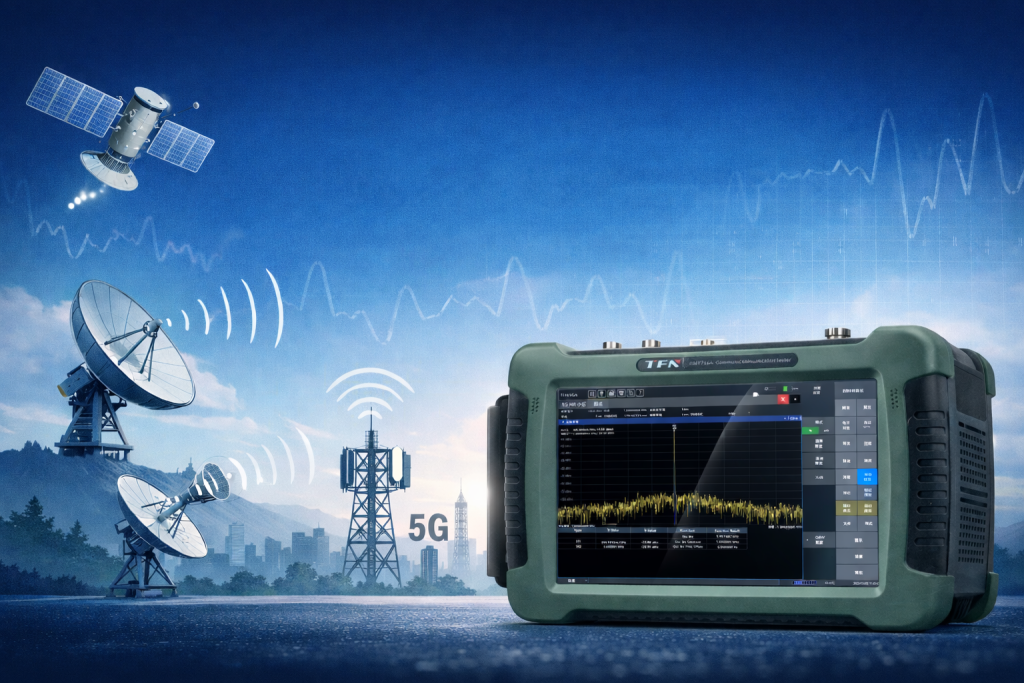
Taking the RMT740A as an example, when we tune its frequency close to the lower end of the K-band (e.g., around 26 GHz), its optimized front-end design effectively suppresses image interference. More importantly, its phase noise performance, better than -107 dBc/Hz at a 10 kHz offset from a 1 GHz carrier, provides a fundamental foundation for distinguishing weak signals near strong adjacent signals in the K-band. For the wideband modulated signals common in radar and satellite communications, the RMT740A is equipped with a maximum real-time analysis bandwidth of 100 MHz, enabling it to capture the complete signal energy and ensure the accuracy of Adjacent Channel Power Ratio (ACPR) and Occupied Bandwidth (OBW) measurements.
Engineering Implementation for High-Precision Measurement
During the R&D process, a key question we constantly pondered was: how to endow a portable spectrum analyzer with the precision of a lab-grade instrument? The answer lies in ensuring signal integrity across the entire chain. The RMT740A is not just a basic spectrum analyzer; it is a radio frequency signal analyzer integrating multiple measurement modes.
For field testing scenarios in the K-band, the transient characteristics of signals are often difficult to capture. The real-time spectrum analysis function of the RMT740A offers an effective solution for this. With a 100% Probability of Intercept (POI) time of ≤3µs, complemented by persistence spectrum and waterfall display, engineers can intuitively identify intermittent interference or pulsed signals. This capability is particularly crucial when troubleshooting transient spurious emissions in K-band radar systems. Traditional swept-tuned measurements might miss these short-duration signals, whereas the real-time analysis mode ensures the visualization of all signal events.
Furthermore, addressing the complexity of K-band digital communications, the RMT740A supports in-depth vector signal demodulation analysis. Although the K-band itself isn’t directly tied to a single standard, the 5G-NR millimeter-wave signals, FDD-LTE signals, and microwave link signals it carries all require precise modulation quality analysis. Leveraging its built-in demodulation capabilities, from BPSK, QPSK up to 256QAM, engineers can intuitively assess the signal’s Error Vector Magnitude (EVM) performance, thereby determining if the link suffers from interference or hardware impairments.
The Convergence of Lightweight Design and Complex Scenarios
In traditional K-band testing, equipment was often bulky and heavy, making field deployment and handheld operation inconvenient. The RMT740A manages to control the overall weight to under 2.4 kg while maintaining high performance, which is uncommon for devices covering frequencies up to 40 GHz. Through high-density integration techniques and lightweight materials, we have ensured excellent RF shielding effectiveness while significantly enhancing the instrument’s portability.
In practical applications, whether for indoor production line testing or outdoor base station positioning, the RMT740A adapts flexibly. For instance, combined with its built-in mapping and GPS/Beidou positioning module, engineers can record the coverage strength and interference source locations of K-band signals in real-time during drive tests. This approach, integrating high-precision spectrum analysis with geolocation information, greatly enhances the efficiency of field troubleshooting.
Conclusion
As the critical frequency band connecting terrestrial networks with space-based information, the K-band imposes higher demands on measurement instruments regarding dynamic range, phase noise, and analysis bandwidth. From its inception, the TFN RMT740A was designed with the practical pain points of engineering work in mind. By integrating high-performance spectrum analysis, real-time signal capture, and vector demodulation capabilities, it strives to make every K-band measurement accurate and reliable. For test engineers, the instrument in hand is more than just a tool for data reading; it is the key to exploring the world of high-frequency signals. The RMT740A aims to be the reliable optical lens for these eyes, ensuring that the information hidden within high-frequency signals is brought to light.
If you are interested in TFN RMT Series Handheld Spectrum Analyzer, welcome to contact TFN Support Team:
Email: info@tfngj.com
WhatsApp: +86-18765219251
Or you can leave messages Here