





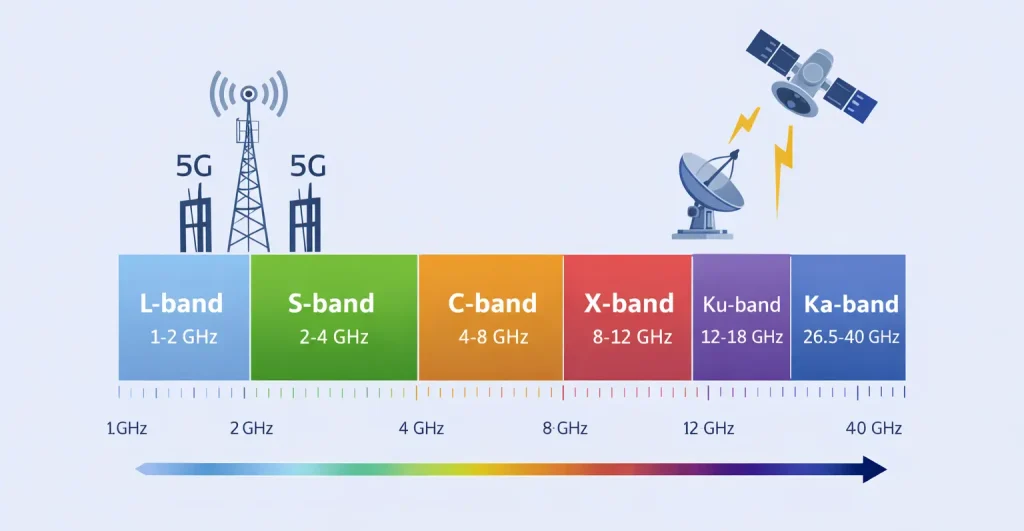
In wireless communication and radar systems, microwave frequency bands play a central role. The different characteristics of radio frequency signals determine their suitability for various applications. This article provides a systematic analysis of the major microwave bands from L-band to Ka-band, delving into the technical parameters, propagation characteristics, and typical applications of each band. It serves as a reference for engineers when selecting frequency bands for practical projects.
What are Microwave Frequency Bands?
Microwaves typically refer to RF signals with frequencies between 300 MHz and 300 GHz, corresponding to wavelengths from 1 meter down to 1 millimeter. Electromagnetic waves in this range combine the direct propagation properties of light with the penetration capabilities of radio waves, making them widely applicable in communications, sensing, and detection. Microwave bands are often designated by letter codes, a naming convention that originated from the need for radar secrecy during World War II and was later standardized by IEEE.
Detailed Breakdown of Major Microwave Bands
L-band: 1–2 GHz
The L-band is among the lower frequency microwave bands. Its radio frequency signals feature good atmospheric penetration and relatively long propagation distances.
Typical Applications:
- Civil aviation navigation (e.g., DME, TCAS)
- Military long-range surveillance radar
- Satellite communications (e.g., maritime satellites, some BeiDou navigation signals)
- Mobile communications (e.g., some 4G LTE bands)
Due to their longer wavelengths (approximately 15-30 cm), L-band RF signals experience minimal rain attenuation, making them suitable for critical communication and surveillance systems where high reliability is required.
S-band: 2–4 GHz
The S-band is considered one of the “golden bands” for radar and communication systems, offering a balance between resolution and propagation range.
Typical Applications:
- Airport Surveillance Radar (ASR)
- Weather radar (precipitation detection)
- Satellite communications (e.g., some links in NASA’s Deep Space Network)
- Wi-Fi 2.4 GHz band
Antenna sizes for this band’s radio frequency signals are moderate, making S-band common in scenarios requiring medium resolution and intermediate relay distances.
C-band: 4–8 GHz
The C-band is very common in satellite communications and medium-range radar. Its RF signals begin to show noticeable atmospheric attenuation but remain more stable than those in higher bands.
Typical Applications:
- Fixed Satellite Service (FSS) (downlink for many commercial satellites)
- Medium-range weather radar
- Some point-to-point microwave relay links
- Part of the Wi-Fi 5 GHz band
Notably, the C-band is a “crowded” segment for satellite communications. Engineers must carefully plan frequencies during system design to avoid interference.
X-band: 8–12 GHz
The X-band is renowned for its high resolution and precision targeting capabilities, making it a preferred choice for high-performance military and civilian radars.
Typical Applications:
- Fire-control radar and missile guidance
- Maritime navigation radar
- Airborne Synthetic Aperture Radar (SAR)
- Automotive collision avoidance radar (some systems)
Antennas for this band’s radio frequency signals can be made smaller, which is ideal for platforms requiring compact, high-precision sensors, such as drones and satellites.
Ku-band: 12–18 GHz
The Ku-band is the workhorse for Direct Broadcast Satellite (DBS) television and VSAT networks, with its RF signals supporting higher data transfer rates.
Typical Applications:
- Direct Broadcast Satellite (DBS) television (e.g., DirecTV, Dish Network)
- Enterprise VSAT networks
- High-definition Satellite News Gathering (SNG)
- Precision Approach Radar (some systems)
Compared to C-band, Ku-band antennas are smaller, but the radio frequency signals suffer more significantly from rain attenuation. System design must account for sufficient link margin.
K-band: 18–27 GHz
The K-band is often divided into the Ka and Ku sub-bands but sometimes refers specifically to the frequencies between them. Its RF signals are highly susceptible to absorption by water vapor (with a resonance peak around 23 GHz).
Typical Applications:
- Astronomical observation (studying water vapor distribution)
- High-speed point-to-point microwave communication
- Automotive radar (24 GHz ISM band)
Ka-band: 26.5–40 GHz
The Ka-band represents the cutting edge for satellite communications moving towards higher capacities, offering extremely wide bandwidths.
Typical Applications:
- High Throughput Satellite (HTS) communications
- Inter-satellite links (e.g., Starlink constellation)
- 5G millimeter-wave backhaul networks
- High-resolution airborne mapping radar
RF signals in this band can achieve multi-Gbps transmission rates but suffer from severe rain attenuation. They are often used in conjunction with lower frequency bands to ensure reliable service.
Microwave Band Selection: A Practical Guide for Engineers
Selecting the appropriate microwave band is a critical first step in system design. The following factors must be comprehensively considered:
1. Propagation Characteristics: Lower bands (L, S) have lower propagation loss, suitable for long-distance communication. Higher bands (Ka) offer large bandwidth but suffer significant attenuation, making them ideal for short-range, high-capacity links.
2. Antenna Size: Higher frequencies require smaller antenna apertures, which is crucial for platforms like satellites and drones.
3. Spectrum Availability and Cost: Mature bands like C and Ku are highly competitive with high licensing costs. Emerging bands like Ka may offer more available bandwidth.
4. Environmental Factors: In regions with heavy rainfall, using Ku or Ka bands requires significantly increased link budget to overcome rain fade.
5. System Resolution Requirements: The range and angular resolution of radar systems are directly related to the RF signal bandwidth and frequency. Higher bands typically provide finer detection capabilities.
Future Trends and Challenges
With the advancement of 5G/6G, Low Earth Orbit (LEO) satellite internet, and autonomous driving technologies, the demand for microwave spectrum is growing. The trend is shifting towards even higher frequency bands (e.g., Q, V bands) to access larger bandwidths. However, this introduces challenges such as increased radio frequency signal propagation issues, higher component costs, and greater system design complexity. Engineers must find the optimal balance between innovative applications and physical limitations.
Understanding the characteristic differences between bands from L to Ka is fundamental to designing efficient and reliable wireless systems. Correct frequency band selection not only optimizes performance and cost but also ensures system robustness in complex electromagnetic environments.