





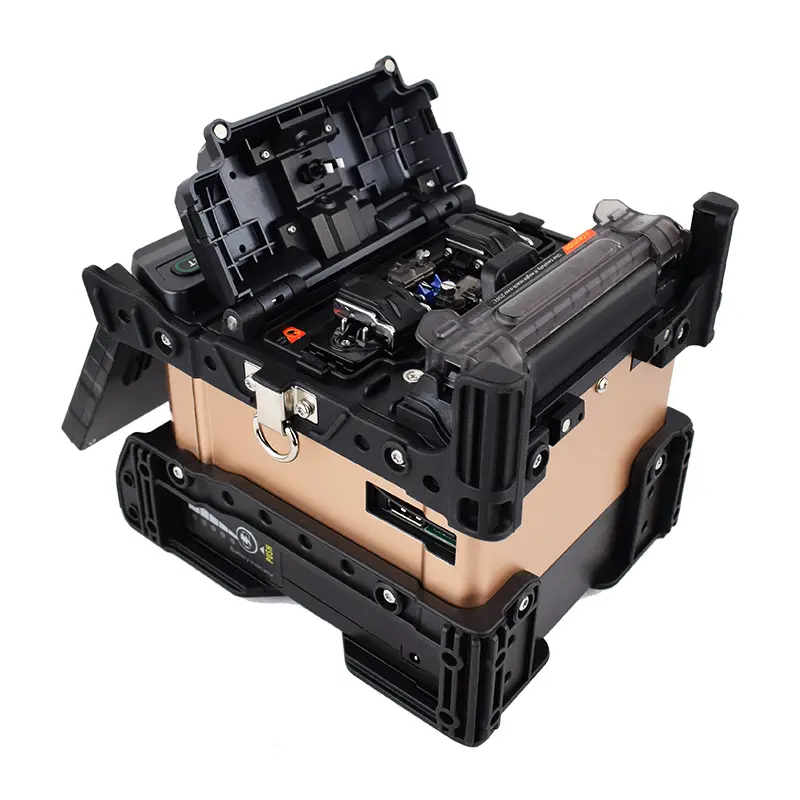
In today’s highly digitalized society, stable and high-speed optical fiber networks have become the cornerstone of operations across various industries. As a core tool for the deployment and maintenance of fiber networks, the performance of fiber fusion splicers directly impacts network quality, construction efficiency, and long-term operational costs. This article will analyze the application value and technical advantages of fusion splicers in different scenarios from the perspective of communication operators, with a focus on the industry-leading TFN S7 Six-Motor Fully Automatic Fiber Fusion Splicer, providing a reference for network planning, construction, and maintenance teams.
1. Long-Distance and Provincial Trunk Networks: Pursuing Ultra-Low Loss and High Reliability
Long-haul and provincial backbone networks often span hundreds or even thousands of kilometers. Any splice loss along the route can accumulate over distance, severely affecting signal transmission quality. Traditional splicing equipment often performs inconsistently in complex field environments, leading to rework, project delays, and increased costs.
The TFN S7, with its six-motor core alignment system, achieves an exceptional typical loss of 0.01dB, fully meeting the stringent near-zero loss requirements of long-haul trunk lines. Its FAST mode completes a splice in just 6 seconds, significantly improving construction efficiency—especially suitable for large-scale, time-sensitive projects such as optical cable expansion and trunk line upgrades. For operators, this translates to fewer signal relay points, lower operational investments, and extended network lifecycle.
2. Base Station Emergency Repair and Field Maintenance: Rapid Response and All-Weather Operation Capability
Base stations are often located in harsh environments such as suburbs, mountains, and remote areas, where network outages require quick restoration. Traditional equipment often suffers from short battery life, poor environmental adaptability, and complex operations, hindering repair progress and user experience.
Addressing the pain points of field operations, the TFN S7 features a removable 5200mAh battery that supports over 240 splicing and heating cycles, sufficient for a full day’s work. The device boasts a triple-proof (waterproof, dustproof, shockproof) design, coupled with a universal three-in-one clamp compatible with fibers ranging from 0.25mm to 3.0mm and flat indoor cables—no tool changes required for different connectors. Its dual operation modes (touchscreen + physical buttons) also support gloved operation, ensuring continuity in adverse weather conditions like rain, snow, or sandstorms, significantly reducing the Mean Time to Repair (MTTR).
FTTx and Last-Mile Fiber Deployment
Last-mile deployment involves various fiber types and cabling environments, such as tight-buffered indoor cables and drop cables, placing higher demands on the compatibility and ease of use of fusion splicers.
The TFN S7’s three-in-one clamp supports bare fiber, pigtails, and stripped cable wires without frequent clamp changes. Paired with an imported high-precision fiber cleaver, it ensures clean, low-angle end-face preparation for low-loss splicing of drop cables. With 41 preset splicing modes and 100 customizable storage modes, it flexibly adapts to different fiber types (e.g., G657A/B), enhancing construction standardization and efficiency, and helping operators rapidly achieve large-scale FTTH coverage.
4. Data Center and 5G High-Speed Network Upgrades
Data centers and 5G bearer networks require high-density, low-loss splicing quality, often within limited maintenance windows. Insufficient splicing precision or slow speeds can create network bottlenecks and disrupt service continuity.
The TFN S7 achieves a stable loss of 0.02dB on single-mode fibers and supports splicing in 6 seconds in FAST mode, making it suitable for high-demand, high-stakes environments such as data centers and backbone nodes. The device internally stores up to 2000 splice records, facilitating quality traceability and compliance audits, helping operators standardize and transparently manage engineering processes, and ensuring reliable high-speed network upgrades.
5. Outdoor and Industrial Environment Construction: Durability and All-Weather Adaptability
In industrial environments or long-term outdoor projects—such as railways, power grids, and oil fields—equipment is often exposed to extreme conditions like dust, humidity, and temperature variations. Ordinary fusion splicers are prone to failure, affecting project timelines and cost control.
The TFN S7 adopts a rubber-protected housing and triple-proof design, offering excellent shock and drop resistance. Its high-capacity battery with real-time power monitoring prevents unexpected shutdowns during field operations. The model also comes with a 3-year warranty and lifetime technical support, and a backup unit can be provided during repairs, significantly reducing operators’ equipment downtime risks and long-term ownership costs.
Conclusion
From long-haul trunk lines to base station emergency repairs, from FTTx deployment to data center upgrades, high-performance fiber fusion splicers have become indispensable tools for communication operators building high-quality networks. The TFN S7, with its six-motor core alignment, ultra-fast splicing speed, long-lasting battery life, all-scenario clamp compatibility, and robust environmental adaptability, demonstrates outstanding performance and reliability across multiple industries. It helps operators enhance network construction efficiency, ensure maintenance quality, and reduce lifecycle costs, making it a trusted professional choice for network engineers and construction teams.
> This article is written based on actual operational scenarios of communication operators, referencing technical materials and application cases of the TFN S7 Fully Automatic Fiber Fusion Splicer. It aims to provide professional analysis on equipment selection and scenario-based applications for industry users. For more technical details or test data, please contact the TFN Support Team for the latest specifications and on-site demonstrations.