





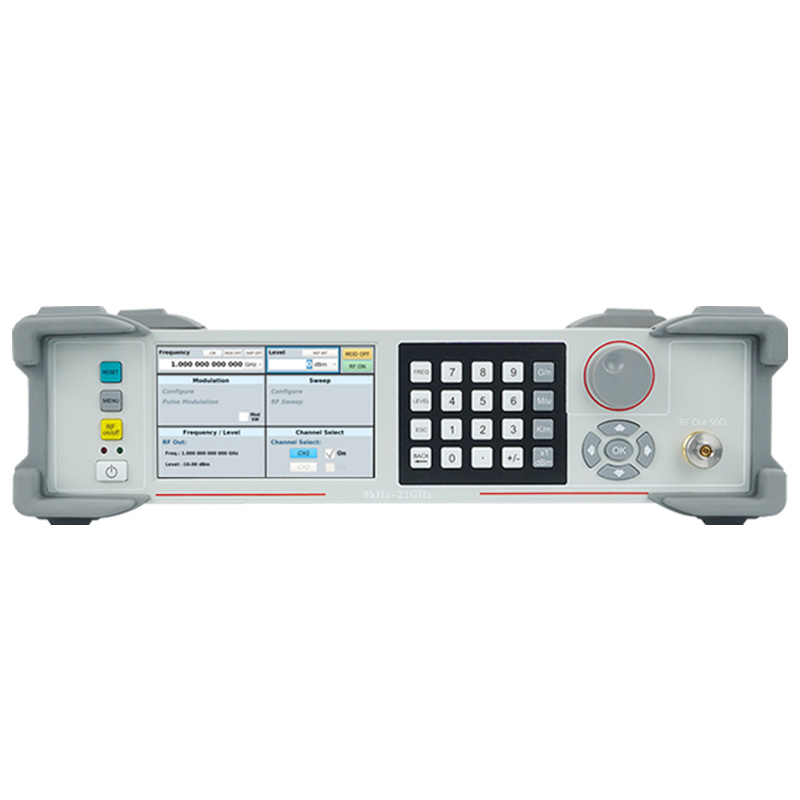
In cutting-edge fields such as radar, satellite communications, 5G/6G R&D, and quantum technology, high-precision RF signal analog modulation is an indispensable part of system testing and validation. The RF Signal Generator, as a core signal generation device, directly impacts modulation accuracy and test result reliability. This article will systematically explain, from an engineering practice perspective, how to use modern RF signal generators to achieve high-precision RF signal analog modulation, combined with the TFN TG20A Microwave Signal Generator. It will also explore key technical elements and operational practices.
I. Core Requirements for High-Precision RF Signal Analog Modulation
High-precision modulation requires not only wide frequency coverage and high power dynamic range from the signal source but also stringent performance in frequency stability, phase noise, harmonic suppression, and modulation flexibility. In practical applications, engineers typically focus on the following:
- Frequency accuracy and resolution: Affects the accuracy of applications such as local oscillator simulation and filter testing.
- Power control accuracy and dynamic range: Directly related to receiver sensitivity testing and amplifier compression characteristic analysis.
- Signal purity: Low phase noise and high spurious suppression are fundamental to ensuring modulated signal quality.
- Modulation types and speed: Including pulse modulation, analog modulation (AM/FM/ΦM), and fast frequency switching capability.
II. Key Technical Implementation and Features of the TFN TG20A
1. Frequency Accuracy and Fine-Tuning Resolution
The TFN TG20A offers an ultra-wide frequency range of 9kHz–21GHz with a frequency resolution as high as 0.001Hz. When simulating high-frequency system local oscillators or conducting frequency-agile testing, such high resolution allows engineers to make fine adjustments, avoiding test errors caused by large frequency steps. This is particularly suitable for frequency offset calibration in 5G NR and satellite communications.
2. Power Dynamic Range and Accuracy
This device provides an output power range of -120dBm to +17dBm with a resolution of 0.1dB. This wide dynamic range supports full-scenario coverage from low-noise receiver testing to high-power device stimulation. During modulation testing, fine power control can simulate real-channel attenuation variations, evaluating device modulation responses under different input levels.
3. Signal Purity and Low Phase Noise
The TG20A exhibits typical phase noise of -112dBc/Hz at 10kHz offset (10GHz), spurious suppression ≤ -80dBc, and harmonic suppression ≤ -50dBc. High-purity output signals provide a reliable foundation for high-order modulation formats (such as 256QAM) and phase-sensitive systems, effectively reducing test uncertainty.
4. Pulse Modulation and Fast Switching Capability
In radar and electronic warfare simulation, pulse modulation performance is critical. The TG20A supports a minimum pulse width of 100ns, an on/off ratio ≥ 65dB, and internal frequency switching as fast as 300μs. Users can implement complex pulse sequences via the internal pulse generator or external triggering, combined with adjustable trigger delays, meeting the needs of multi-mode radar signal simulation.
III. Practical Operation: Achieving High-Precision Modulation with the TFN TG20A
Step 1: System Connection and Initial Setup
Connect the TG20A’s 2.92mm RF output to the device under test and link it to the host computer via USB or LAN interfaces. After powering on, first set the reference clock (supports 10MHz external reference input) to ensure system-wide clock synchronization and improve long-term frequency stability.
Step 2: Basic Modulation Parameter Configuration
Configure via SCPI commands or the front panel:
- Set carrier frequency and power level, e.g., 10GHz, -10dBm.
- Select modulation type, such as pulse modulation, and set pulse width, period, and rise/fall times.
- For analog modulation (AM/FM), set modulation depth, modulation frequency, and source (internal/external).
Step 3: Advanced Modulation and Sweep Testing
Utilize the TG20A’s step sweep function to test the in-band modulation response of filters or amplifiers. Set start/stop frequencies, step interval, and dwell time (adjustable from 10ms to 10s) to observe modulated signal variations across the frequency band and evaluate device linearity and group delay.
Step 4: Automation Integration and Remote Control
With comprehensive SCPI command sets and USB/LAN interfaces, the TG20A can be easily integrated into automated test systems (ATE). Engineers can write scripts for batch parameter configuration, data acquisition, and result analysis, significantly improving production testing efficiency and consistency.
IV. Typical Application Scenarios
- Radar Pulse Simulation: Utilize its 100ns minimum pulse width and high on/off ratio to generate high-fidelity radar pulse sequences, testing receiver dynamic range and anti-jamming capability.
- Satellite Communication Carrier Simulation: Combine high frequency accuracy and low phase noise to generate pure satellite uplink/downlink carriers for modem performance verification.
- 5G Millimeter-Wave Signal Generation: In frequencies above 24GHz (with TFN TG40A Signal Generator (链接到TG40A详情)), simulate 5G NR signals through precise frequency and power control for beamforming and Error Vector Magnitude (EVM) testing.
V. Conclusion
Achieving high-precision RF signal analog modulation relies on a comprehensive, finely controllable RF signal generator. The TFN TG20A Microwave Signal Generator, with its ultra-wide frequency range, high dynamic power range, excellent signal purity, and flexible modulation capabilities, provides a reliable hardware platform for modern RF testing. By properly configuring device parameters and leveraging automation tools, engineers can achieve high-precision, repeatable modulation testing across R&D, production, and maintenance stages, effectively supporting the advancement of cutting-edge communication and radar systems.
If you would like to learn more about how to use the TFN TG20A signal generator to achieve high-precision modulation and other functions, please contact the TFN support team:
Email: info@tfngj.com
WhatsApp: +86-18765219251
Or you can leave a message for TFN here.