





Cables form the backbone of modern power transmission and communication networks. From underground power feeders to long-distance communication links, their reliability directly affects system stability and service continuity. Unfortunately, cable faults—such as open circuits, short circuits, insulation degradation, and joint failures—are unavoidable over long-term operation.
When a fault occurs, one key question determines how quickly service can be restored: where exactly is the fault located?
Among various diagnostic techniques, TDR (Time Domain Reflectometry) has become one of the most widely used and trusted methods for cable fault location due to its accuracy, speed, and non-destructive nature.
This article explains how TDR cable fault location works in practice, why it is so effective, and how modern instruments such as the FB18 Cable Fault Tester apply TDR technology in real-world field testing.
What Is TDR Time Domain Reflectometry?
TDR (Time Domain Reflectometry) is a cable testing method based on pulse signal propagation and reflection. In simple terms, the tester sends a fast electrical pulse into the cable. When this pulse encounters a point where the cable’s impedance changes—such as a fault, joint, splice, or cable end—part of the signal is reflected back toward the source.
By measuring the time it takes for the reflected signal to return and knowing the signal’s propagation speed in the cable, the tester can calculate the distance to the fault point.
This principle is very similar to radar or sonar systems. The signal travels along the cable, produces an “echo” at the fault location, and the system determines distance based on precise timing analysis.
How TDR Locates Cable Faults Step by Step
Pulse Injection and Signal Acquisition
In a typical TDR test, the instrument injects either a low-voltage pulse or a high-voltage pulse into the cable, depending on the fault type and cable condition. For example, the FB18 uses an ultra-lightweight, high-frequency high-voltage signal generator when flashover faults or high-resistance faults need to be activated.
At the same time, the distance measurement unit samples the returning signal at high speed—up to 100 MHz or higher—to capture fine waveform details. High sampling rates are critical for accurate fault identification, especially on long or complex cable routes.
Waveform Interpretation and Distance Calculation
The captured waveform is displayed in real time on the instrument’s screen. Reflections caused by faults appear as distinct changes in amplitude or polarity, depending on whether the fault is an open circuit, short circuit, or impedance anomaly.
The fault distance is calculated using the standard TDR formula:
Distance = (Propagation Time × Signal Velocity) / 2
In practical instruments such as the FB18, this process is largely automated. Built-in algorithms identify reflection points, apply the correct velocity factor, and directly display the fault distance. Engineers can also overlay fault waveforms with reference waveforms from healthy cables, making abnormal reflections easier to recognize and interpret.
Final Pinpointing and Route Verification
While TDR provides an accurate distance measurement, real-world field conditions often require further verification. After determining the fault distance, technicians typically use a cable route detector and a fault pinpointer to trace the cable path and locate the exact fault position on site.
Techniques such as acoustic-magnetic synchronization and step voltage detection allow the final fault point to be pinpointed with accuracy down to tens of centimeters. This combined workflow significantly reduces excavation time and prevents unnecessary digging.
Key Advantages of TDR Cable Fault Location
High Accuracy with No Blind Zone
Modern TDR systems can achieve location accuracy within 50 cm, with reading resolutions better than one meter. Unlike some traditional methods, TDR has virtually no measurement blind zone and can detect faults located very close to the test point.
Wide Applicability Across Fault Types
TDR technology is effective for locating:
- Open circuits
- Short circuits
- Low-resistance faults
- High-resistance and flashover faults
By supporting both low-voltage pulse testing and high-voltage flashover methods, instruments like the FB18 can handle fault diagnosis for power cables up to 35 kV, as well as communication and control cables.
Intelligent and User-Friendly Operation
Modern TDR cable fault locators are designed for field efficiency. Touchscreen interfaces, one-button operation, automatic waveform analysis, and clear fault distance prompts reduce reliance on operator experience and speed up troubleshooting—especially for frontline maintenance teams.
Data Storage and Traceability
Waveform storage and data export functions allow engineers to build historical records for each cable. This not only simplifies report generation but also supports long-term maintenance planning and trend analysis.
How the FB18 Cable Fault Tester Implements TDR Technology
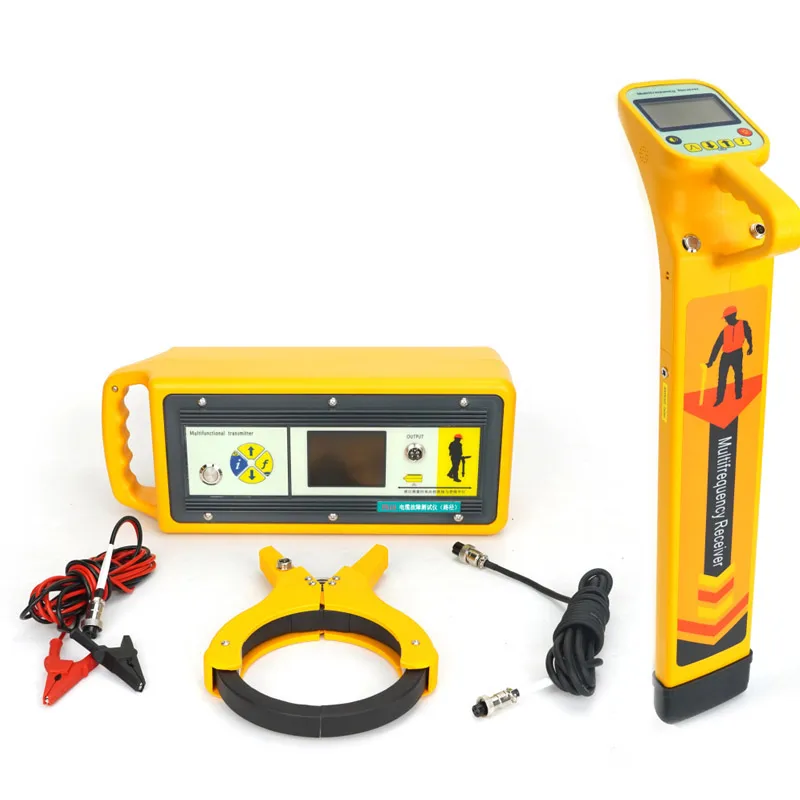
The FB18 Cable Fault Tester integrates a complete TDR-based fault location system designed for field use. Its distance measurement unit offers several practical advantages:
- High-speed sampling: Multiple selectable sampling rates (100 MHz, 50 MHz, 25 MHz, 12.5 MHz) to match different cable lengths and structures
- Intelligent analysis: Automatic fault distance calibration, waveform comparison, and overlay display
- Safe and reliable operation: Built-in high-voltage surge protection for stable performance in harsh field environments
- Portable design: Internal battery supports more than 3 hours of continuous operation, making it suitable for remote or non-powered locations
These features allow the FB18 to deliver accurate TDR cable fault location results while remaining easy to deploy in real maintenance scenarios.
Core Application Scenarios of TDR Technology
Power Cable Fault Location and Distance Measurement
In transmission and distribution networks, cable faults may result from insulation aging, external damage, joint failures, or moisture ingress. TDR is often the first-choice method for preliminary fault location. It quickly narrows the fault position to within meters—or even sub-meter accuracy—over distances of tens of kilometers, providing clear guidance for subsequent pinpointing and excavation.
Breakpoint Detection in Communication and Data Cables
For communication cables, coaxial lines, control cables, and metallic members of fiber optic cables, low-voltage TDR testing offers high precision without damaging sensitive equipment. It enables fast identification of breaks, shorts, and impedance abnormalities, making it a valuable tool for network maintenance and low-voltage system troubleshooting.
Underground Cable Route Tracing and Depth Measurement
Before excavation or maintenance work, knowing the exact cable route and burial depth is essential. Integrated TDR systems combined with route tracing functions allow technicians to track cable paths on the ground and measure depth accurately, helping prevent accidental damage during construction.
Cable Condition Assessment and Preventive Maintenance
Beyond fault location, TDR can also support predictive maintenance. Subtle impedance variations along the cable—often caused by moisture ingress, partial discharge, or insulation degradation—can be detected before they develop into full failures. By comparing historical waveforms, engineers can monitor cable health trends and shift maintenance strategies from reactive repair to proactive prevention.
Conclusion
With its clear physical principles, fast testing process, and reliable results, TDR Time Domain Reflectometry has become an indispensable tool for cable fault location. As equipment continues to evolve, integrated testers such as the FB18 further enhance the practicality and efficiency of TDR technology in real-world applications.
For professionals working in power, communications, railways, and industrial infrastructure, mastering TDR cable fault location means faster fault recovery, improved system reliability, and lower maintenance costs.
This article is based on the technical principles and application experience of the FB18 Cable Fault Tester and is intended as a reference for field engineers, technical support personnel, and industry training.