





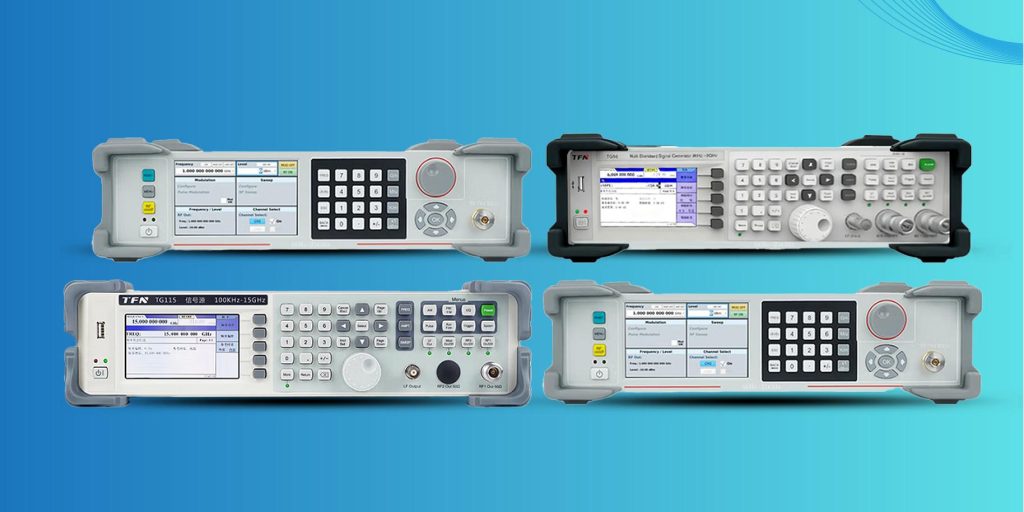
In electronic test and measurement, the term signal generators is used widely—but it actually covers several very different types of instruments. Under this umbrella are function generators, waveform generators, and RF signal generators, each designed for a specific level of signal complexity, frequency range, and test requirement.
This article clarifies how these instruments are related, how they differ, and when to choose each one. A high-performance example—TFN TG20A microwave signal generator—is also used to illustrate what sets professional RF-grade instruments apart.
1. Understanding the Hierarchy: One General Term, Multiple Categories
At the top level, a signal generator is any device that outputs electrical test signals. Depending on the waveform type, purity, and required frequency range, the category splits into several specialized instruments.
2. Function Generators: The Basics for Low-Frequency Testing
Function generators are the most fundamental members of the signal generator family. They are designed to generate a small set of standard periodic waveforms such as:
- Sine wave
- Square wave
- Triangle wave
- Sawtooth wave
Key characteristics:
- Low frequency range: typically from a few hertz to several MHz or a few hundred MHz.
- Fixed functionality: focuses on producing clean, ideal mathematical waveforms.
- Typical applications: basic electronics labs, audio testing, digital logic circuit development, and educational environments.
They serve testing scenarios where engineers only need a simple, predictable waveform rather than complex or high-frequency signals.
3. Waveform Generators (Arbitrary Waveform Generators): Flexibility for Simulation and Complex Testing
Stepping up in capability, waveform generators—especially arbitrary waveform generators (AWGs)—offer far more flexibility than function generators.
Instead of a few built-in waveforms, they allow engineers to create or import custom waveforms, including non-periodic or highly complex signal patterns.
How they work:
A digitally defined waveform is stored in memory and output through a high-speed DAC, enabling precise reproduction of virtually any signal.
Core advantages:
- Ability to simulate real-world signals: ECG traces, sensor outputs, bus protocols, fault transients, modulation formats
- High sampling rate and bandwidth
- Large memory depth for longer or complex sequences
- High vertical resolution for finer detail
Waveform generators are ideal whenever the test requires signal authenticity, complexity, or exact replication.
4. RF Signal Generators / Microwave Signal Generators: Precision and Purity
When tests reach RF or microwave frequencies, accuracy and purity become drastically more important. This is where RF signal generators and microwave signal generators come in.
These instruments are engineered to deliver a high-quality sine wave with exceptional stability and spectral purity.
Distinct characteristics:
- Extremely wide frequency range: from hundreds of kHz up to tens of GHz
- Exceptional phase noise performance for clean spectral output
- Very low spurious and harmonic content
- High-precision power level control
- Built-in analog and vector modulation capabilities
RF signal generators are essential for:
- Filter and amplifier testing
- Mixer characterization
- Receiver sensitivity measurements
- Radar system development
- Wireless communication R&D
- Satellite and navigation systems
Here, the priority is not waveform flexibility but the purity and stability of the output signal.
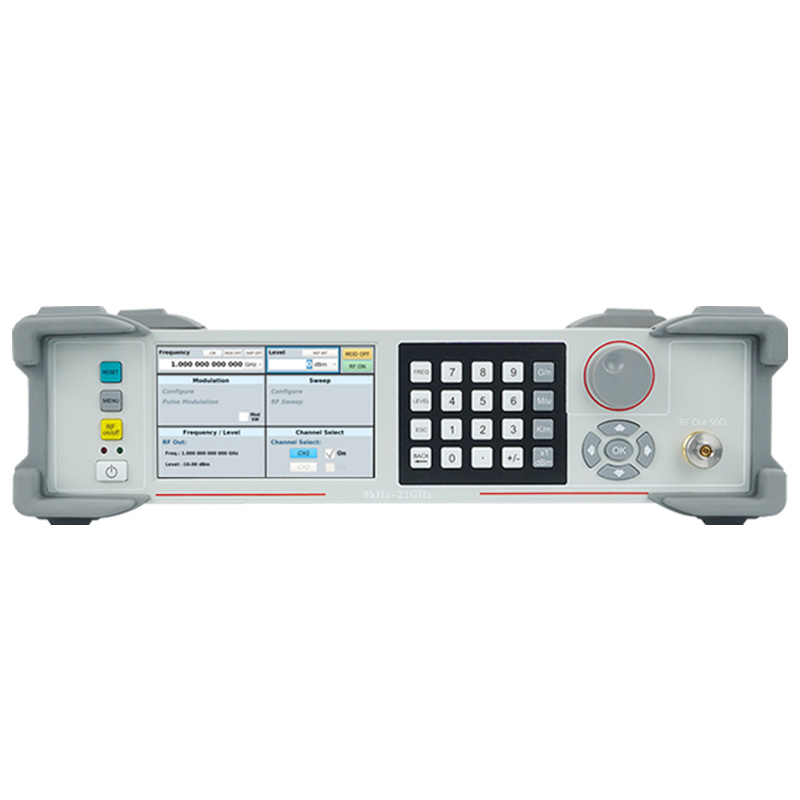
5. TFN TG20A — A Professional Microwave Signal Generator
The TFN TG20A demonstrates what sets high-end microwave signal generators apart from general-purpose function or waveform generators.
Key RF Capabilities
- Frequency coverage: 9 kHz to 21 GHz — firmly in professional microwave territory
- Exceptional phase noise: −112 dBc/Hz @ 10 kHz offset (10 GHz)
- Strong spurious suppression: up to −80 dBc at 10 GHz
-
High-resolution control:
- Frequency resolution: 0.001 Hz
- Power step resolution: 0.1 dB
- Output power range: −120 dBm to +17 dBm
- Excellent stability: internal reference with ±0.3 ppm aging per year
Who needs this level of performance?
Industries such as:
- Radar and ESA
- Aerospace and satellite
- Quantum research
- Advanced communication system design
For these users, the TG20A provides a clean, precise, controllable RF source, not a waveform playback tool. Its core value lies in high-purity sine wave generation across a wide frequency band, which is critical for RF performance validation.
6. Key Differences at a Glance
| Feature | Function Generators | Waveform Generators | RF Signal Generators |
|---|---|---|---|
| Main purpose | Basic periodic signals | Custom & complex signals | High-purity sine waves |
| Typical frequency | Hz to MHz | Hz to hundreds of MHz | kHz to tens of GHz |
| Waveform flexibility | Low | Very high | Low (focus on purity) |
| Priority | Cost & basics | Flexibility & simulation | Purity, accuracy, stability |
| Typical use cases | Education, low-frequency circuits | Sensor simulation, protocols, biomedical | Radar, microwave, RF modules |
7. How to Choose the Right Signal Generator
Use this simple mapping based on your application:
Choose a function generator if you need:
- Basic laboratory signals
- Education or introductory electronics
- Simple periodic waveforms
Choose a waveform generator if you need:
- Custom sequences
- Real-world signal reproduction
- Complex modulation or protocol simulation
- Power supply or sensor simulation
Choose an RF signal generator if you need:
- High-frequency, low-noise sine waves
- Precision power level control
- RF component testing (filters, LNA, mixers)
- Receiver sensitivity or radar/communication system tests
In high-frequency test environments, an RF signal source—like the TFN TG20A—becomes a non-negotiable tool for accurate and trustworthy results.
Conclusion
Although signal generators, function generators, and waveform generators are closely related, their design priorities differ significantly.
The right choice depends on whether your application needs:
- A simple standard waveform
- A highly customized signal
- Or a pure, stable, high-frequency RF output
By understanding these distinctions, engineers can select the instrument that aligns precisely with their testing goals—and avoid both over-specifying and under-specifying equipment.