





In modern telecommunications, validating network performance is critical for ensuring reliable service delivery. To standardize this process, the industry has developed several test methodologies, among which RFC2544 and Y.1564 are the most widely adopted. These standards help operators, enterprises, and service providers assess network efficiency, troubleshoot issues, and guarantee service-level agreements (SLAs).
What Is RFC2544? The Classic Benchmark for Network Device Performance
RFC2544, officially titled “Benchmarking Methodology for Network Interconnect Devices – Test Traffic”, is an IETF standard designed to benchmark the performance of switches, routers, and other network equipment.
It remains one of the most recognized methodologies for testing network quality at the device level.
Key Functions of RFC2544
1. Network Device Performance Benchmarking
RFC2544 defines multiple test procedures—including throughput, latency, frame loss, and back-to-back tests—to determine how well a network device performs under various traffic loads.
This helps organizations select equipment that meets their operational requirements.
2. Troubleshooting and Fault Diagnosis
Because RFC2544 simulates real traffic conditions, engineers can use it to identify bottlenecks and performance issues when diagnosing network faults.
3. Standardized and Repeatable Testing
Its unified methodology ensures fair performance comparison across devices from different vendors. This makes it a cornerstone standard for lab testing and network validation.
What Is Y.1564? The Carrier-Grade Ethernet Service Activation Test
Y.1564, the “Ethernet Service Activation Test Specification” defined by ITU-T, focuses on validating end-to-end service quality rather than individual device capabilities.
Compared to RFC2544, Y.1564 is more aligned with modern carrier requirements, especially for multi-service networks that must meet strict SLA requirements.
Key Functions of Y.1564
1. Ensuring End-to-End Service Quality (QoS)
Y.1564 measures essential KPIs—including frame loss, latency, jitter, and information rate accuracy—to ensure each service stream meets its defined performance levels.
2. SLA Verification
Operators rely on Y.1564 to confirm that Ethernet services comply with customer SLAs before activating them.
This helps reduce service disputes and enhances customer satisfaction.
3. Faster, More Efficient Testing
Unlike RFC2544, which tests one metric at a time, Y.1564 supports multi-stream, parallel testing—significantly reducing activation time for enterprise services.
4. Designed for Multi-Service Networks
Y.1564 evaluates multiple traffic streams simultaneously, analyzing performance under realistic conditions where services may interact or compete for bandwidth.
This makes it ideal for carrier networks offering voice, video, and data services concurrently.
RFC2544 vs Y.1564: What’s the Difference?
| Category | RFC2544 | Y.1564 |
|---|---|---|
| Focus | Device benchmarking | End-to-end service activation |
| Use Case | Lab testing, equipment evaluation | Service turn-up, SLA verification |
| Metrics | Throughput, latency, frame loss, back-to-back | Latency, jitter, frame loss, CIR/EIR compliance |
| Multi-Service Testing | Not supported | Fully supported |
| Testing Speed | Longer | Faster and more efficient |
In summary:
- RFC2544 is ideal for performance testing of individual network devices.
- Y.1564 is ideal for verifying whether the network can deliver SLA-compliant services.
Both standards complement each other and are used widely across carrier-grade networks.
TFN T3000A 10G Ethernet Tester: Comprehensive Support for RFC2544 & Y.1564
The T3000A 10 Gigabit Ethernet Tester is a powerful tool designed for network deployment, activation, and performance validation.
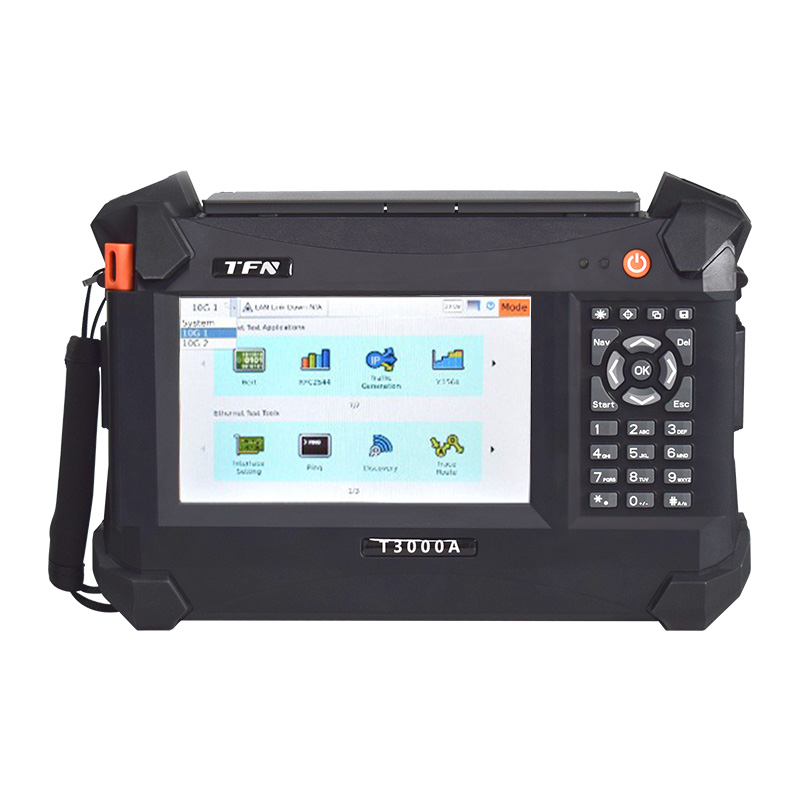
Why T3000A Stands Out
-
Supports both RFC2544 and Y.1564 test standards
→ Ideal for both device benchmarking and service activation -
Accurate performance measurements
→ Throughput, latency, jitter, frame loss, service availability - Ensures SLA compliance before service activation
- Suitable for operators, enterprises, and data centers
- Streamlines troubleshooting and network optimization
With dual support for the industry’s key testing standards, the T3000A helps operators rapidly evaluate network performance, optimize network configuration, and ensure high-quality service delivery.
Conclusion
RFC2544 and Y.1564 remain essential standards for evaluating network performance in carrier-grade environments.
While RFC2544 focuses on device-level benchmarking, Y.1564 ensures the reliability of end-to-end Ethernet services and SLA compliance.
By integrating both standards, tools like the TFN T3000A 10G Ethernet Tester enable service providers to deploy faster, diagnose issues more efficiently, and maintain high network quality in competitive markets.