





Ethernet is the most common computer networking technology and the most widely deployed local area network (LAN) protocol. It includes Standard Ethernet (10 Mbit/s), Fast Ethernet (100 Mbit/s), and up to 10G Ethernet (10 Gbit/s). The Ethernet ports on computers, Wi-Fi access points, switches, routers, as well as network cables, are all part of the Ethernet ecosystem. Today, Ethernet is increasingly used across LANs, WANs, and even the broader Internet due to its simplicity, stability and scalability.
An Ethernet tester, sometimes referred to as a network analyzer, is essential in daily network maintenance. It helps technicians quickly locate issues such as network outages, slow speeds, packet loss, IP conflicts, and other performance faults. With the ability to measure bandwidth, packet loss, latency, and jitter, an Ethernet tester provides accurate insight into overall network health.
TFN’s handheld Ethernet testers are designed for network deployment, troubleshooting, and maintenance across metropolitan networks, core networks, data centers, and commercial applications. So, what exactly can the TFN Ethernet testers measure?
1. Connectivity Testing
Supports PING, Trace Route, and IP scanning to verify device reachability and confirm that cables, ports, and connections are functioning correctly.
2. Virtual Cable Test (VCT)
Analyzes cable integrity by detecting short circuits, open circuits, crosstalk, and wiring faults. It can also measure cable length and pinpoint fault locations.
3. Traffic Generation and Analysis
Creates and analyzes network traffic (up to 16 streams). Supports traffic filtering and statistics on the receiving port. This helps evaluate network bandwidth, throughput, and performance under heavy load.
4. Latency and Jitter Measurement
Measures network delay and delay variation (jitter). These are essential metrics for evaluating real-time services such as VoIP, video conferencing, and industrial communication.
5. Data Error Detection
Supports Layer 1–4 BERT (Bit Error Rate Testing) to identify corrupted frames or packets, helping engineers diagnose performance degradation or hardware failures.
6. Protocol and Service Activation Testing
Conducts in-depth protocol analysis and verifies service performance using industry standards such as RFC 2544 and ITU-T Y.1564.
- RFC 2544: Includes throughput, latency, frame loss, and back-to-back testing, with clear results displayed on the UI.
- Y.1564: Validates service configuration, CIR/EIR performance, and supports multiple packet sizes and multi-stage rate tests (25%, 50%, 75%, 100%, 100%+EIR).
7. Pass-Through Monitoring Mode
Supports 10M–10G pass-through probing, enabling online traffic monitoring, passive analysis, real-time troubleshooting, and even fault injection while the network remains active.
8. Intelligent Diagnostics and Loopback
Provides port identification, packet capture, and loopback testing. Multiple loopback modes (L1/L2/L3/L4) ensure end-to-end traffic continuity and help isolate network segment faults.
9. Device Configuration Verification
Validates whether network devices are configured correctly, including IP settings, VLAN, VLAN QinQ, MPLS and other advanced network features.
Through these test functions, a handheld Ethernet tester ensures high-performance and stable network operation, helping engineers quickly detect and resolve issues before they affect business services.
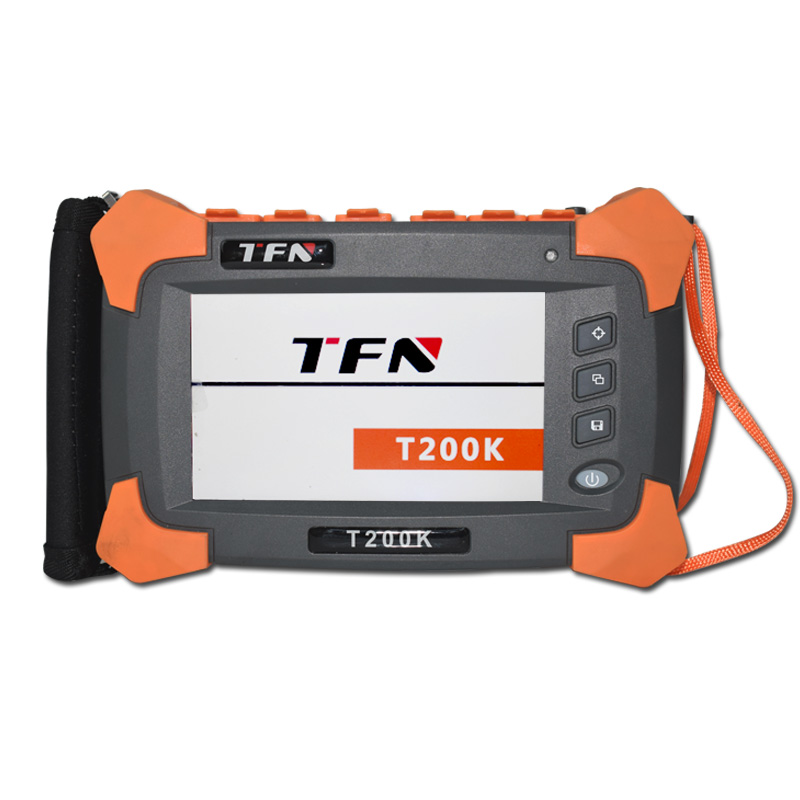
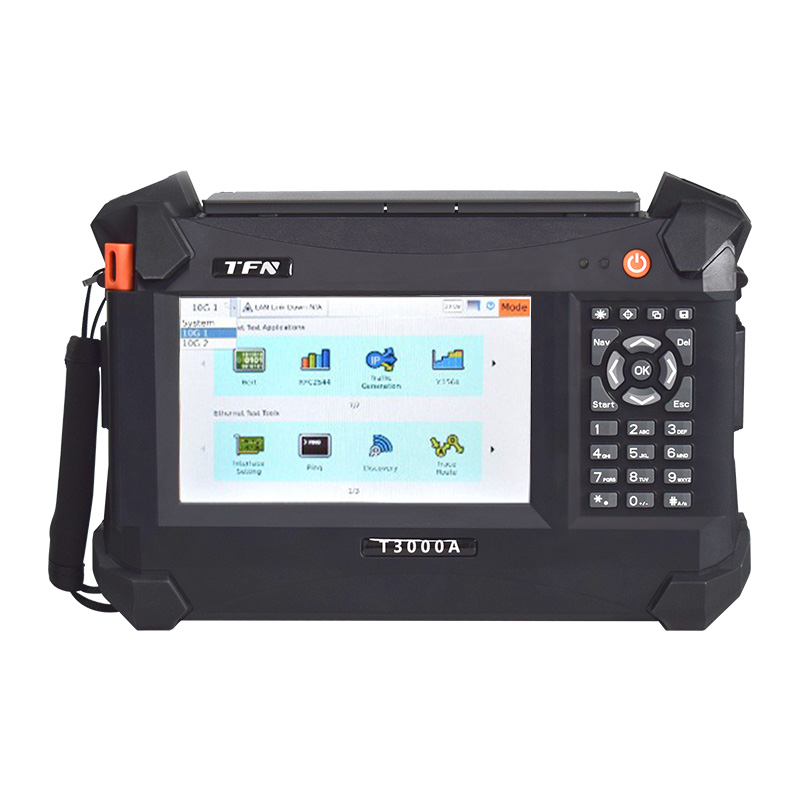
TFN offers several Ethernet testing solutions, including the T200K 1000M Ethernet Tester and the T3000A 10G Ethernet Tester. TFN also provides an advanced multi-service tester that integrates 1000M/10G Ethernet testing with E1, PRI, V.35/V.24, and OTDR/OPM/VFL optical testing capabilities—providing users with a powerful all-in-one solution for comprehensive network diagnostics.